
Case Study How a Publisher Reduced Production Time by 60%

Educational publishers face constant pressure to deliver high-quality content within increasingly demanding timelines. As curriculum updates accelerate and digital learning formats expand, many organizations struggle with production bottlenecks that delay publication schedules and increase operational costs.

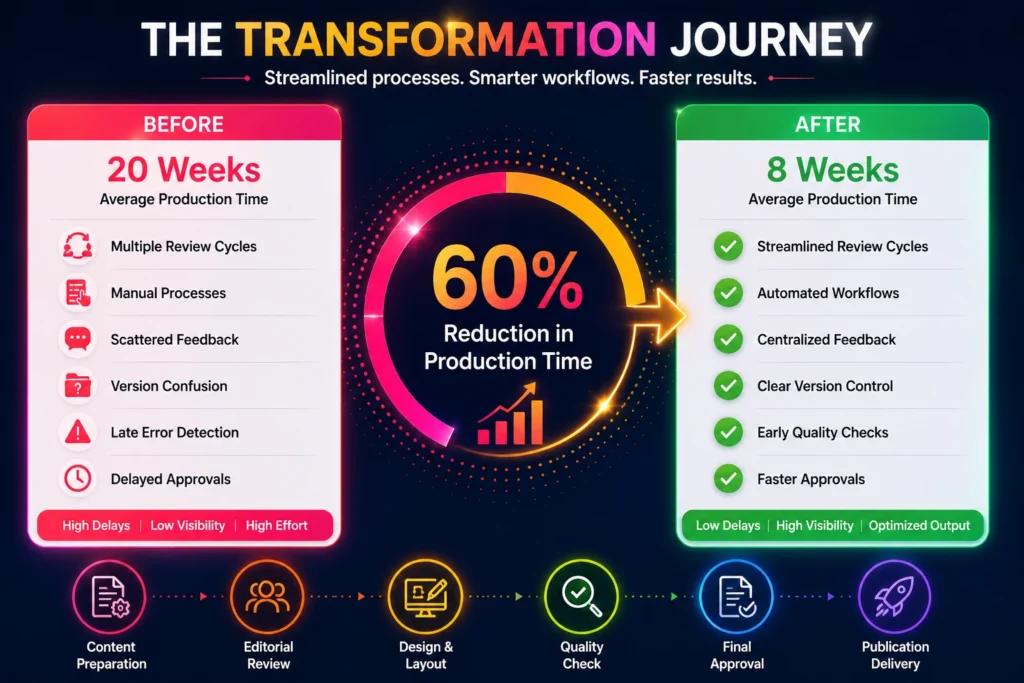
This case study examines how a mid-sized educational publisher streamlined its content production workflow and achieved a 60% reduction in production time by addressing workflow inefficiencies, improving content management practices, and standardizing production processes.

The Initial Challenge

The publisher managed a portfolio of K–12 educational materials, teacher resources, and assessment content. Although content development teams consistently met authoring deadlines, production schedules continued to slip.

Several issues contributed to the problem:

  • Multiple manual review cycles
  • Inconsistent file management practices
  • Repeated formatting corrections
  • Version-control confusion
  • Delayed stakeholder approvals
  • Limited visibility into project status

A typical project required approximately 20 weeks to move from finalized manuscript to publication-ready content.

Identifying The Production Bottlenecks

The organization conducted a workflow assessment to understand where delays were occurring.

Key Findings

Production Area

Primary Issue

Content Handover

Incomplete source files

Editorial Review

Duplicate feedback cycles

Layout Production

Repetitive formatting tasks

Quality Assurance

Late-stage error detection

Approvals

Multiple revision rounds

Project Tracking

Limited visibility

The analysis revealed that only a small percentage of total project time was spent on actual production activities. Most delays occurred during transitions between teams.

The Improvement Strategy

Rather than increasing staffing levels, the publisher focused on improving process efficiency.

Three operational goals were established:

  1. Reduce manual production effort
  2. Improve workflow visibility
  3. Standardize production processes

The objective was to eliminate unnecessary delays without compromising content quality

Phase One: Standardizing Content Preparation

Production teams frequently received content in different formats and structures, creating unnecessary rework.

To address this issue, the publisher introduced:

  • Standard manuscript templates
  • Content submission guidelines
  • Structured asset management procedures
  • Consistent file-naming conventions

As a result, production teams spent less time correcting source materials and more time advancing projects through the workflow.

Phase Two: Streamlining Review Cycles

Review stages represented one of the largest sources of delay.

The publisher implemented:

  • Clearly defined reviewer responsibilities
  • Consolidated feedback collection
  • Fixed review windows
  • Formal approval checkpoints
Before And After Review Process

Previous Process

Improved Process

Multiple reviewer submissions

Centralized feedback

Overlapping comments

Structured reviews

Open-ended deadlines

Scheduled review periods

Frequent revisions

Controlled revision cycles

The changes significantly reduced review-related delays.

Phase Three: Strengthening Production Governance

Project managers lacked real-time visibility into workflow status.

To improve oversight, the publisher established:

  • Production dashboards
  • Milestone tracking
  • Status reporting procedures
  • Escalation pathways for delays

Teams could now identify issues earlier and address bottlenecks before they affected delivery schedules.

.

The Results

After six months of implementation, the publisher measured several improvements.

Operational Outcomes

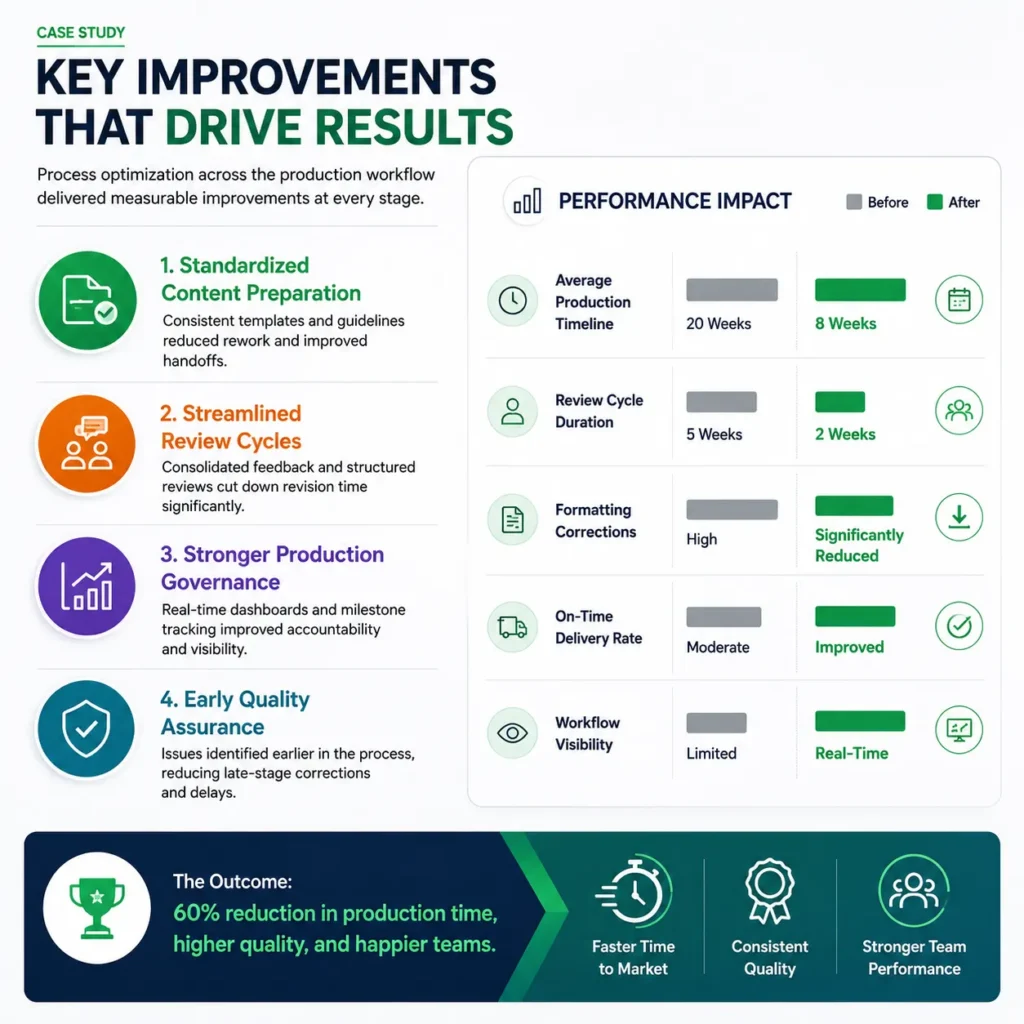
Performance Metric

Before

After

Average Production Timeline

20 Weeks

8 Weeks

Review Cycle Duration

5 Weeks

2 Weeks

Formatting Corrections

High

Significantly Reduced

Workflow Visibility

Limited

Real-Time

On-Time Delivery Rate

Moderate

Improved

Overall production time decreased by approximately 60%, allowing the organization to release content faster while maintaining quality standards.

Lessons Learned

The publisher identified several factors that contributed most to the project’s success.

Key Takeaways
  • Standardization often delivers greater benefits than additional staffing.
  • Workflow transparency improves decision-making.
  • Early quality checks reduce downstream corrections.
  • Structured reviews shorten approval cycles.
  • Consistent processes improve scalability.

Perhaps the most important lesson was that production efficiency depends on the coordination between teams rather than the speed of individual contributors

Applicability For Other Educational Publishers

Organizations facing similar challenges may benefit from evaluating:

  • Review workflows
  • Content preparation standards
  • Production handoff procedures
  • Quality assurance timing
  • Project tracking methods

Even modest process improvements can generate measurable reductions in production timelines.

Turning Operational Improvements Into Publishing Agility

Reducing production time is rarely the result of a single technology investment or staffing change. In this case, the publisher achieved substantial gains by improving workflow coordination, strengthening governance, and standardizing production practices. As educational publishing continues to evolve, organizations that focus on operational efficiency will be better positioned to deliver high-quality content faster, more consistently, and with greater confidence.

FAQ

Workflow standardization and streamlined review cycles delivered the greatest impact.

No. The improvements were achieved primarily through process optimization and better workflow management

Quality assurance remained essential, but checks were moved earlier in the workflow to reduce late-stage corrections

Yes. Many workflow improvements can be implemented regardless of organizational size

Review and approval cycles created the most significant delays due to fragmented feedback and inconsistent processes
