Common Challenges in Multilingual Engineering Typesetting and How to Overcome Them

Engineering Documents Demand Precision Across Every Language

Engineering documentation is built on accuracy. Product manuals, technical specifications, installation guides, maintenance instructions, safety documentation, and engineering reports contain detailed layouts that combine technical text, diagrams, tables, symbols, and measurements. During multilingual publishing, maintaining this level of precision becomes increasingly challenging. Even small formatting inconsistencies can affect readability, usability, and document quality.

Professional multilingual engineering typesetting helps organizations preserve technical accuracy while ensuring every localized publication maintains a consistent and professional appearance.

Multilingual Engineering typesetting

Why Engineering Typesetting Is More Complex

Unlike general publishing projects, engineering documents contain interconnected technical elements that must remain correctly aligned throughout the publication.

These often include:

  • Engineering diagrams
  • Technical tables
  • Measurement units
  • Mathematical equations
  • Warning and safety notices
  • Cross-references
  • Numbered procedures
  • Component callouts

Every element must work together without affecting the overall document structure.

Challenge 1: Layout Changes After Translation

Translated content often differs in length from the source text. Longer or shorter paragraphs can affect page layouts, tables, captions, and surrounding graphics.

How to Overcome It

  • Use flexible page layouts.
  • Build documents with consistent styles.
  • Leave sufficient white space.
  • Review page flow before final publication.
  • Apply standardized templates across projects.

Planning for layout adjustments reduces manual corrections during production.

Multilingual Engineering typesetting

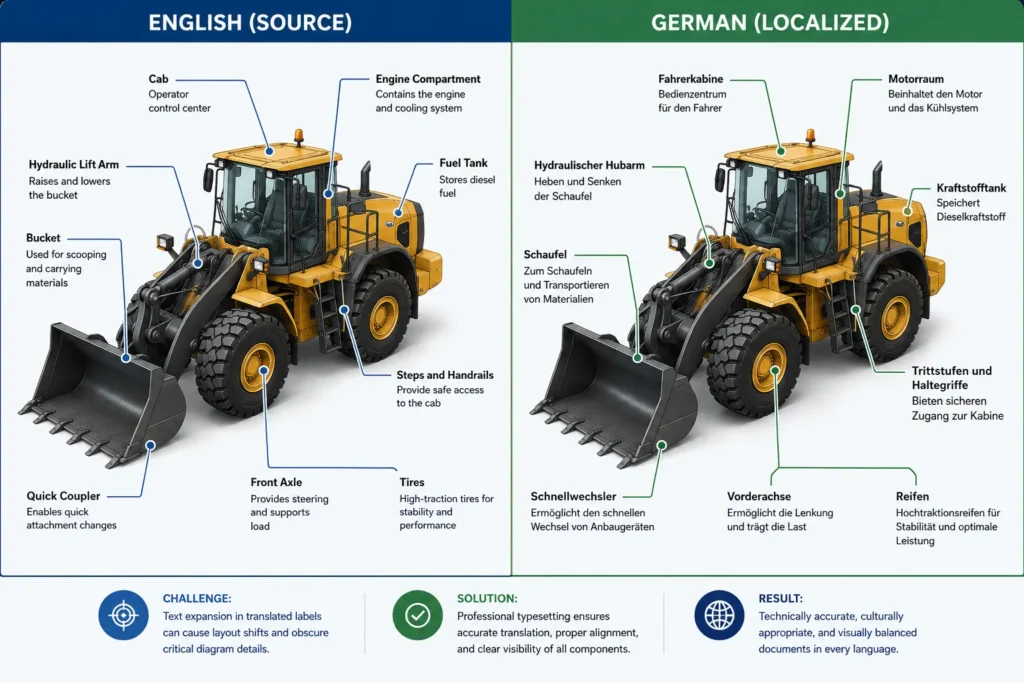
Challenge 2: Maintaining Technical Diagrams and Callouts

Engineering illustrations frequently contain numbered labels, annotations, and descriptive callouts. During localization, these elements must remain accurately positioned and easy to follow.

How to Overcome It

  • Use editable source graphics.
  • Verify callout positions after formatting.
  • Maintain consistent numbering.
  • Review diagrams during quality assurance.
  • Check illustration alignment before publication.

Well-managed graphics improve both technical accuracy and reader comprehension.

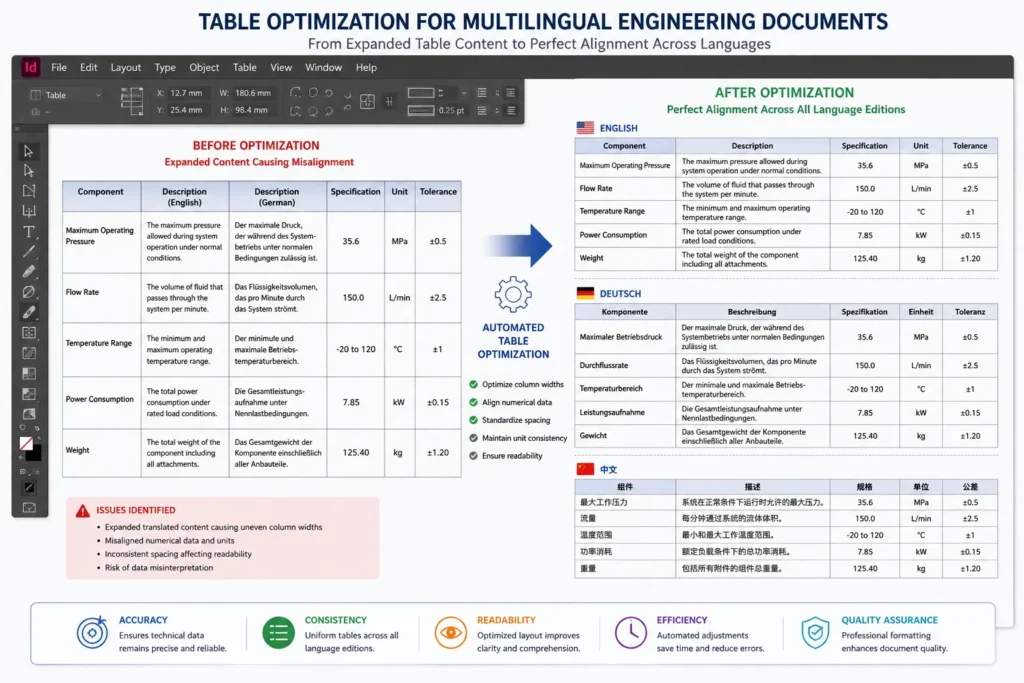
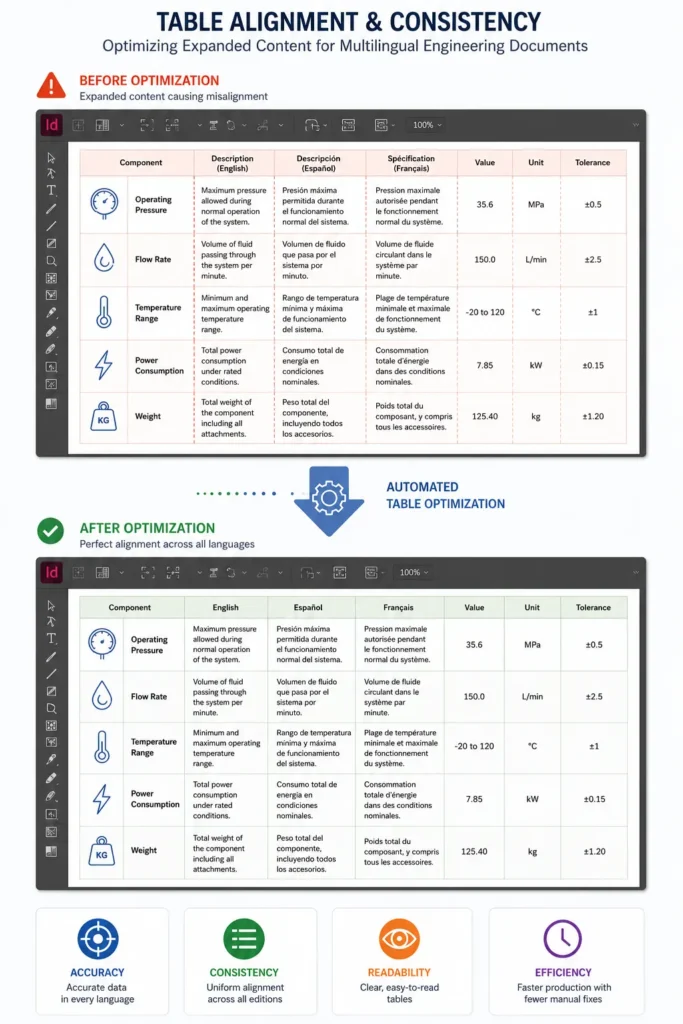
Challenge 3: Managing Tables and Structured Data

Engineering publications often include specification tables, performance charts, and comparison matrices. Translation can affect spacing, alignment, and overall readability.


Common Issue

Recommended Solution

Expanded table content

Optimize column widths and spacing

Misaligned values

Apply standardized table styles

Broken table formatting

Review tables after localization

Inconsistent units

Verify technical measurements

Uneven row spacing

Maintain consistent formatting rules

Structured table management helps preserve technical clarity.

Challenge 4: Preserving Mathematical and Technical Content

Many engineering documents include equations, formulas, symbols, and scientific notation. These elements require precise formatting throughout the production process.

How to Overcome It

  • Use professional equation editing tools.
  • Maintain consistent mathematical fonts.
  • Verify superscripts and subscripts.
  • Apply standardized numbering.
  • Include technical proofreading before publication.

Accurate formatting protects the integrity of engineering information.

Challenge 5: Maintaining Document Consistency

Large engineering projects often involve hundreds of pages produced by multiple contributors. Without standardized formatting practices, inconsistencies quickly appear throughout the publication.

How to Overcome It

Organizations should establish:

  • Standard paragraph styles
  • Consistent typography
  • Master page templates
  • Organized file structures
  • Document quality checklists
  • Version control procedures

These practices simplify updates and improve long-term document management.

Improving Collaboration Across Production Teams

Engineering publishing typically involves technical writers, designers, reviewers, engineers, translators, and production specialists. A structured typesetting workflow enables each team to focus on technical accuracy instead of correcting formatting issues.

Benefits include:

  • Improved collaboration
  • Faster review cycles
  • Reduced production rework
  • Better document consistency
  • Simplified revision management

A coordinated workflow supports efficient multilingual engineering publishing from initial layout through final delivery.

A Practical Engineering Publishing Scenario

A heavy equipment manufacturer is preparing maintenance manuals, installation guides, spare parts catalogs, and safety documentation for distribution across multiple international markets. After translation, each publication requires updates to engineering diagrams, specification tables, warning panels, and mathematical formulas while preserving the original design standards.

Using a structured multilingual typesetting workflow, the production team applies standardized templates, refines page layouts, verifies diagrams and equations, and performs detailed quality checks before publication. The resulting documentation remains technically accurate, visually consistent, and easier for engineers, technicians, and end users to navigate.

Multilingual Engineering typesetting

A Practical Engineering Publishing Scenario

A heavy equipment manufacturer is preparing maintenance manuals, installation guides, spare parts catalogs, and safety documentation for distribution across multiple international markets. After translation, each publication requires updates to engineering diagrams, specification tables, warning panels, and mathematical formulas while preserving the original design standards.

Using a structured multilingual typesetting workflow, the production team applies standardized templates, refines page layouts, verifies diagrams and equations, and performs detailed quality checks before publication. The resulting documentation remains technically accurate, visually consistent, and easier for engineers, technicians, and end users to navigate.

Building Reliable Engineering Publications for Global Audiences

Engineering documentation must communicate complex technical information with clarity and consistency, regardless of where it is published. By addressing common multilingual typesetting challenges through structured workflows, standardized formatting, and comprehensive quality assurance, organizations can improve production efficiency while maintaining the precision expected in professional engineering publications. This approach supports reliable documentation that engineers, technicians, and customers can trust.

FAQs

Multilingual engineering typesetting is the process of formatting translated engineering documents while preserving technical layouts, diagrams, tables, equations, and overall document consistency.

Engineering publications contain complex technical elements that require precise positioning and formatting to maintain accuracy and readability.

Installation manuals, maintenance guides, product specifications, technical reports, engineering catalogs, operating instructions, safety manuals, and equipment documentation all benefit from professional typesetting.

It helps preserve technical accuracy, maintains formatting consistency, reduces production errors, and supports efficient document reviews.

Using standardized templates, consistent styles, editable graphics, structured quality reviews, and professional typesetting practices significantly reduces formatting challenges while improving document quality.
