
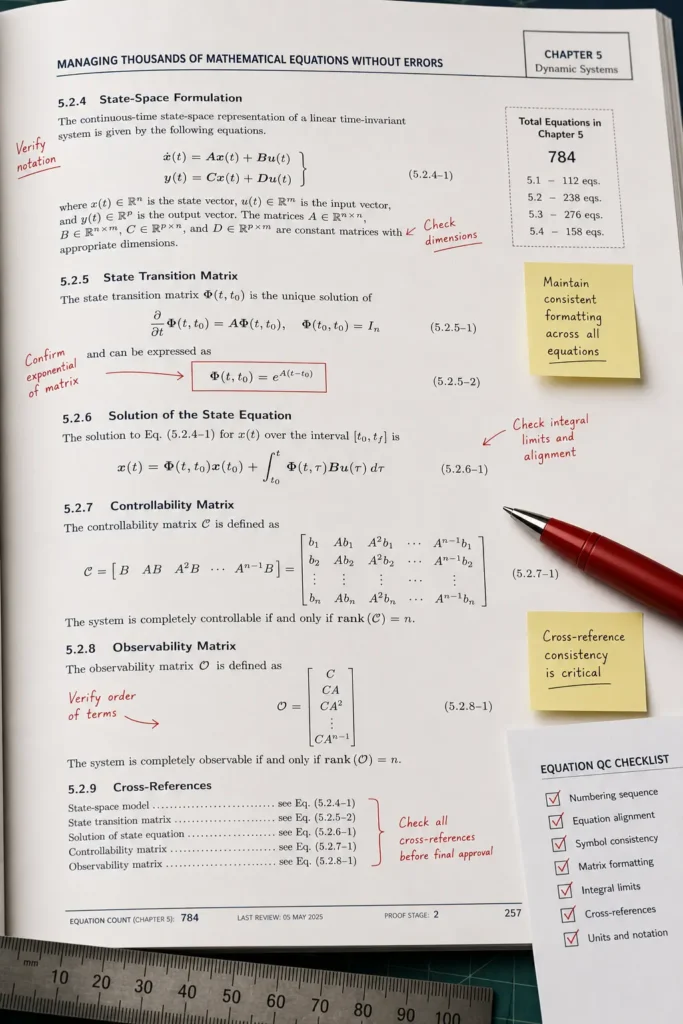

Managing Thousands of Mathematical Equations Without Errors

When One Equation Error Affects an Entire Publication

A university mathematics textbook, engineering manual, or scientific journal may contain thousands of equations distributed across hundreds of pages. During revisions, equations are updated, figures are moved, chapters are reorganized, and references change. In such environments, even a small formatting mistake can create confusion for readers, trigger lengthy review cycles, and delay publication schedules.

For publishers producing STEM content, managing large volumes of mathematical equations is one of the most demanding aspects of content production. Accuracy, consistency, and scalability must be maintained throughout the publishing workflow to ensure every equation appears exactly as intended.

Mathematical equation management
Why Mathematical Content Requires Specialized Management

Unlike standard text, mathematical content contains complex structures that must remain visually and technically accurate.

Common elements include:

  • Fractions and radicals
  • Integrals and derivatives
  • Matrices and vectors
  • Greek symbols
  • Subscripts and superscripts
  • Multi-line equations
  • Equation numbering systems
  • Cross-references

A single textbook may contain thousands of these elements, making manual management increasingly difficult as projects grow.

The Risk of Small Errors

Mathematical content is highly sensitive to formatting issues.

Common problems include:

  • Missing symbols
  • Incorrect equation numbering
  • Misaligned matrices
  • Inconsistent spacing
  • Broken cross-references
  • Superscript and subscript errors

Even when the mathematical logic is correct, poor presentation can reduce readability and increase the likelihood of review corrections.

Mathematical equation management
The Challenges of High-Volume Equation Production

Large STEM publishing projects often involve multiple contributors, editors, reviewers, and production specialists.

As content moves through revisions, several challenges emerge.

Frequent Content Updates

Authors regularly revise:

  • Formulas
  • Variables
  • Constants
  • Examples
  • Chapter references

A change to one equation may require updates to references throughout the publication.

Multiple Output Requirements

The same equation may need to appear in:

  • Print textbooks
  • eBooks
  • Digital learning platforms
  • Assessment systems
  • Online educational resources

Maintaining consistency across every format requires structured production workflows

Structured Workflows Reduce Equation Errors

Organizations managing high-volume mathematical content typically rely on structured production environments rather than manual formatting approaches.

These workflows help standardize:

  • Equation styles
  • Numbering systems
  • Symbol libraries
  • Reference management
  • Layout consistency

By establishing production standards early, publishers reduce the likelihood of formatting variations appearing throughout the project.

Traditional Approach vs Structured Equation Management

Traditional Approach

Structured Workflow

Manual equation updates

Centralized equation management

Higher formatting variation

Consistent styling standards

Manual cross-reference checks

Automated reference tracking

Increased review effort

Streamlined quality control

Greater error risk

Improved accuracy

Maintaining Consistent Equation Numbering

Equation numbering becomes increasingly complex as publications expand.

For example:

  • Eq. 3.1-1
  • Eq. 3.1-2
  • Eq. 3.2-1
  • Eq. 4.1-1

When content is inserted, deleted, or reorganized, numbering sequences can easily become inconsistent.

A structured numbering system helps publishers maintain accurate references between:

  • Equations
  • Figures
  • Tables
  • Chapters
  • Appendices

This consistency improves both usability and editorial efficiency.

Mathematical equation management
Why Layout Precision Matters

Mathematical publishing is not only about correctness. It is also about presentation.

Readers must be able to quickly understand relationships between variables, operators, and expressions.

Important considerations include:

  • Alignment of multi-line equations
  • Matrix formatting
  • Operator spacing
  • Symbol consistency
  • Equation placement within columns
  • Page-break control

Poorly formatted equations can make complex concepts appear more difficult than they actually are.

For educational publishers, readability directly influences learning outcomes.

Supporting Large STEM Publishing Programs

Publishers producing engineering, mathematics, physics, and scientific materials often manage entire content portfolios rather than individual books.

These programs may include:

  • Textbooks
  • Workbooks
  • Instructor guides
  • Assessment materials
  • Digital learning content

A standardized equation-management process allows teams to maintain consistency across all products while supporting future revisions and new editions.

This becomes especially important when multiple production teams are involved in the same publishing program.

A Practical Publishing Scenario

Consider a publisher developing a series of engineering textbooks for higher education.

The project contains:

  • 2,500 equations
  • 400 technical diagrams
  • 250 tables
  • Multiple print and digital outputs

During peer review, several chapters require significant updates. Without a structured workflow, production teams must manually locate and verify hundreds of equation references.

Using standardized equation management processes allows revisions to be implemented more efficiently while preserving consistency across every output format.

The result is improved accuracy, reduced production effort, and faster publication timelines.

Strengthening Accuracy at Scale

Managing thousands of mathematical equations is not simply a formatting task. It is a critical quality-control function within STEM publishing. As educational content becomes more complex and multi-format distribution becomes standard practice, publishers need workflows that support precision, consistency, and scalability.

Organizations that invest in structured equation-management processes can reduce errors, simplify revisions, improve readability, and deliver high-quality mathematical content that remains reliable across every stage of the publishing lifecycle.

FAQ

Large publications often contain thousands of equations, references, and revisions, making consistency and accuracy challenging without structured workflows

Formatting errors can reduce readability, create confusion, and increase editorial review requirements

Accurate numbering ensures that equations, references, and supporting explanations remain connected throughout the publication.

They improve consistency, reduce formatting errors, simplify revisions, and support multi-format publishing

Publishers use standardized production processes, rigorous quality-control reviews, controlled equation styles, and systematic reference validation to maintain accuracy at scale.