
How InDesign Improves Consistency in Large-Scale Educational Publishing Projects

When Educational Content Grows Faster Than Production Capacity

Educational publishers are under constant pressure to produce more content in less time. New curriculum requirements, frequent updates, digital learning initiatives, and expanding content portfolios have increased the volume of material that publishing teams must manage.

In many organizations, the challenge is no longer creating content. The challenge is moving approved content through production efficiently without sacrificing quality or consistency.

This is where XML-based workflows and InDesign automation have become valuable tools for modern learning content production.

The Problem With Manual Production Processes

Imagine a publisher developing a series of higher education textbooks across multiple subjects.

Each title may contain:

  • Chapter introductions
  • Learning objectives
  • Tables and charts
  • Assessment questions
  • Instructor notes
  • References and citations
  • Images and diagrams

When production teams manually format every page, repetitive tasks can consume a significant portion of the project schedule.

Even simple updates may require teams to make changes repeatedly across multiple chapters or publications, increasing the risk of errors and inconsistencies.

Why Structured Content Matters

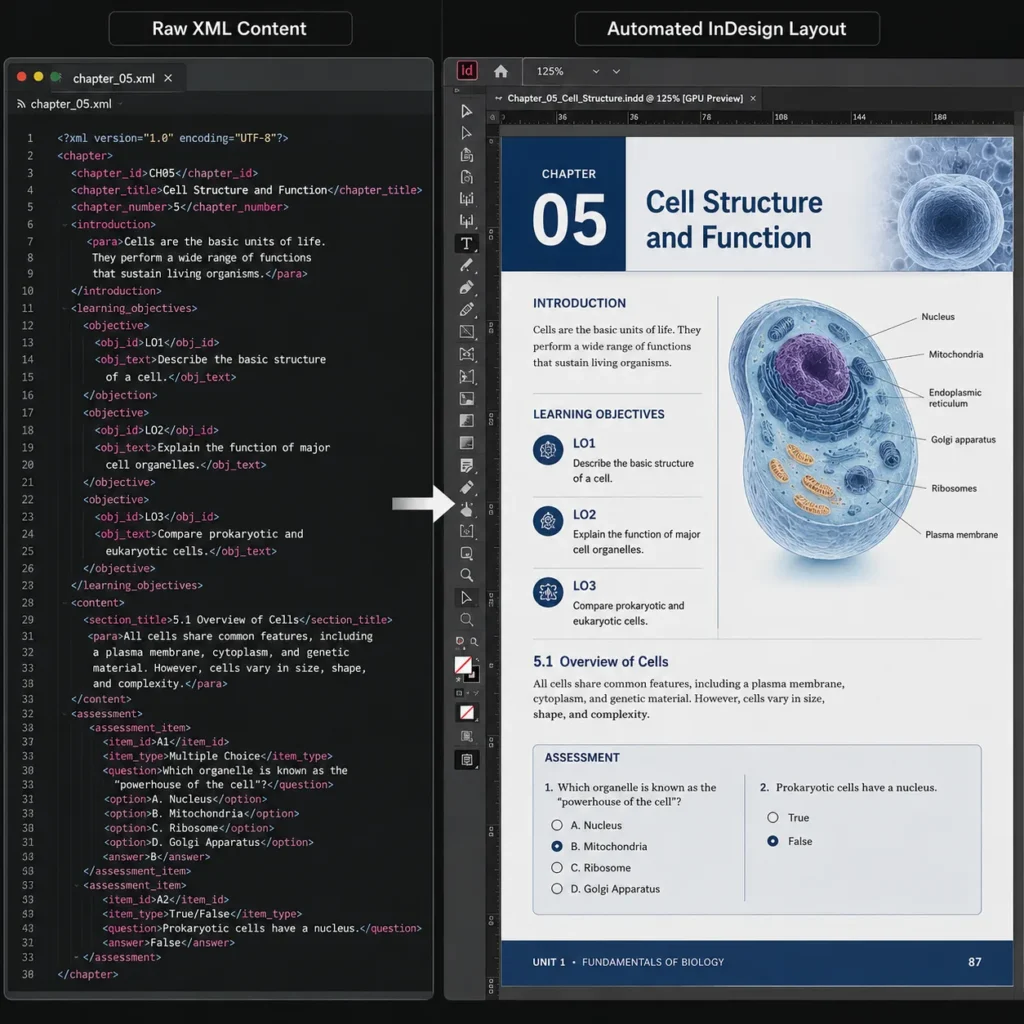
Traditional publishing workflows often focus on page layouts. XML-based workflows take a different approach by organizing content according to structure rather than appearance.

For example, content elements can be identified as:

  • Chapter titles
  • Headings
  • Learning objectives
  • Activities
  • Assessments
  • References
  • Figure captions

Because content is organized consistently, production systems can process and format information more efficiently.

This structured approach creates a foundation for automation.

How XML Supports Faster Content Production

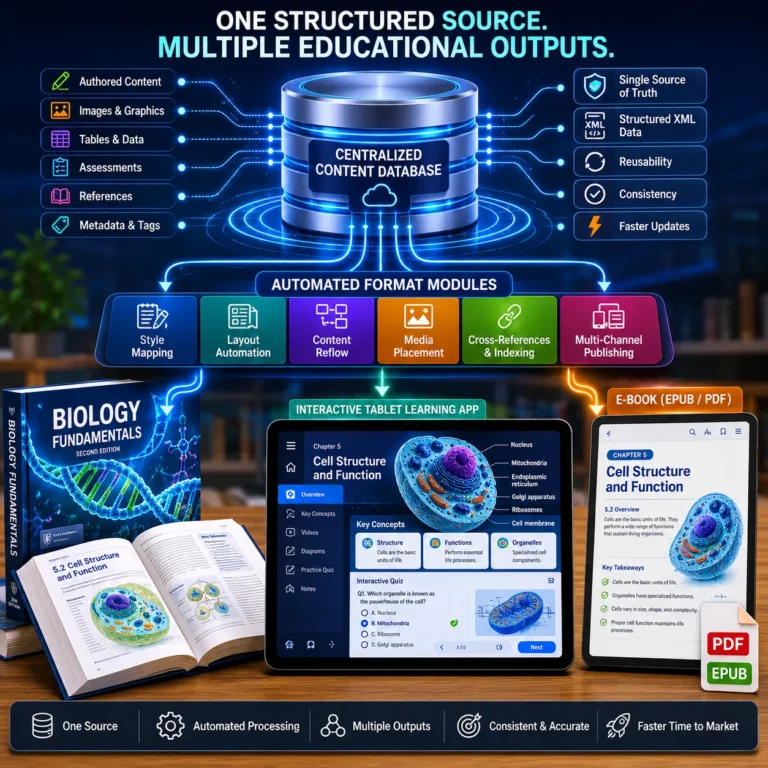
XML allows educational content to be stored in a structured format that can be reused across different publications and outputs.

Instead of manually rebuilding content for each project, publishers can work from a centralized content source.

This approach helps teams:

  • Reduce repetitive formatting tasks
  • Maintain consistency across publications
  • Simplify content updates
  • Support multiple output formats
  • Improve production scalability

As content libraries expand, these efficiencies become increasingly important.

The Role of InDesign Automation

Automation helps production teams apply predefined publishing rules without requiring manual intervention for every task.

For example, automated workflows can assist with:

  • Page composition
  • Style application
  • Table formatting
  • Image placement
  • Chapter generation
  • Cross-reference updates
  • Content synchronization

Rather than spending hours on repetitive production activities, teams can focus on quality review and content improvement.

A Real-World Publishing Scenario

Consider a publisher managing a collection of university-level science textbooks.

The organization receives updated content from authors and academic reviewers throughout the year. Without automation, every update would require manual formatting and layout adjustments.

By combining structured XML content with automated publishing workflows, updated material can be integrated more efficiently into existing publications. Standard layouts, formatting rules, and content structures can be applied automatically, reducing production effort while maintaining consistency.

Supporting Multi-Format Publishing

Modern educational content is often distributed through multiple channels.

A single content source may need to support:

  • Printed textbooks
  • Digital learning materials
  • Interactive PDFs
  • Instructor resources
  • Online learning platforms

XML-based workflows make it easier to reuse content across these formats without recreating material from scratch.

This helps publishers respond more quickly to changing delivery requirements

Benefits for Educational Publishers

Organizations that adopt XML and automation strategies often aim to achieve:

  • Faster production cycles
  • Reduced manual effort
  • Greater content consistency
  • Improved scalability
  • Easier content maintenance
  • Better version control
  • More efficient revision management

These benefits become especially valuable for publishers handling large educational content portfolios.

Preparing Educational Publishing for Scale

Educational publishers are managing more content, more formats, and more frequent updates than ever before. Relying entirely on manual production processes can limit growth and slow publication schedules. By combining XML-based content management with automated publishing workflows, organizations can streamline production, improve consistency, and accelerate the delivery of high-quality learning materials. As educational publishing continues to evolve, structured content and automation are becoming key components of scalable content production strategies

FAQ

XML is a structured content format that organizes information according to defined content elements, making it easier to manage, reuse, and automate.

XML helps publishers manage large volumes of content more efficiently while supporting consistency and multi-format publishing.

Automation reduces repetitive production tasks such as formatting, page composition, style application, and content updates.

Yes. XML allows content to be reused across multiple delivery formats, including print and digital learning resources.

As educational content volumes increase, automation helps publishers improve efficiency, reduce production bottlenecks, and scale operations more effectively.
