How Trados and MemoQ-Compatible Files Simplify Translation Projects

In a globalized marketplace, expanding your reach means speaking your customers’ language. But if you have ever managed a large-scale localization project, you know it is rarely as simple as translating words on a page. Dealing with complex file formats, mismatched formatting, and fragmented communication between internal teams and external linguists can quickly turn a routine translation into an operational bottleneck.

To streamline this process, modern language professionals rely on specialized software known as Computer-Assisted Translation (CAT) tools. Among the global industry standards, Trados and memoQ lead the pack.

By ensuring your project files are fully optimized and compatible with these two powerful platforms, you can eliminate structural errors, drastically cut localization costs, and accelerate your time-to-market. Here is how leveraging Trados and memoQ-compatible ecosystems transforms the way businesses handle international content.
How Trados and MemoQ-Compatible Files Simplify Translation Projects

The Technology Explained: What Makes a File CAT-Tool Ready?

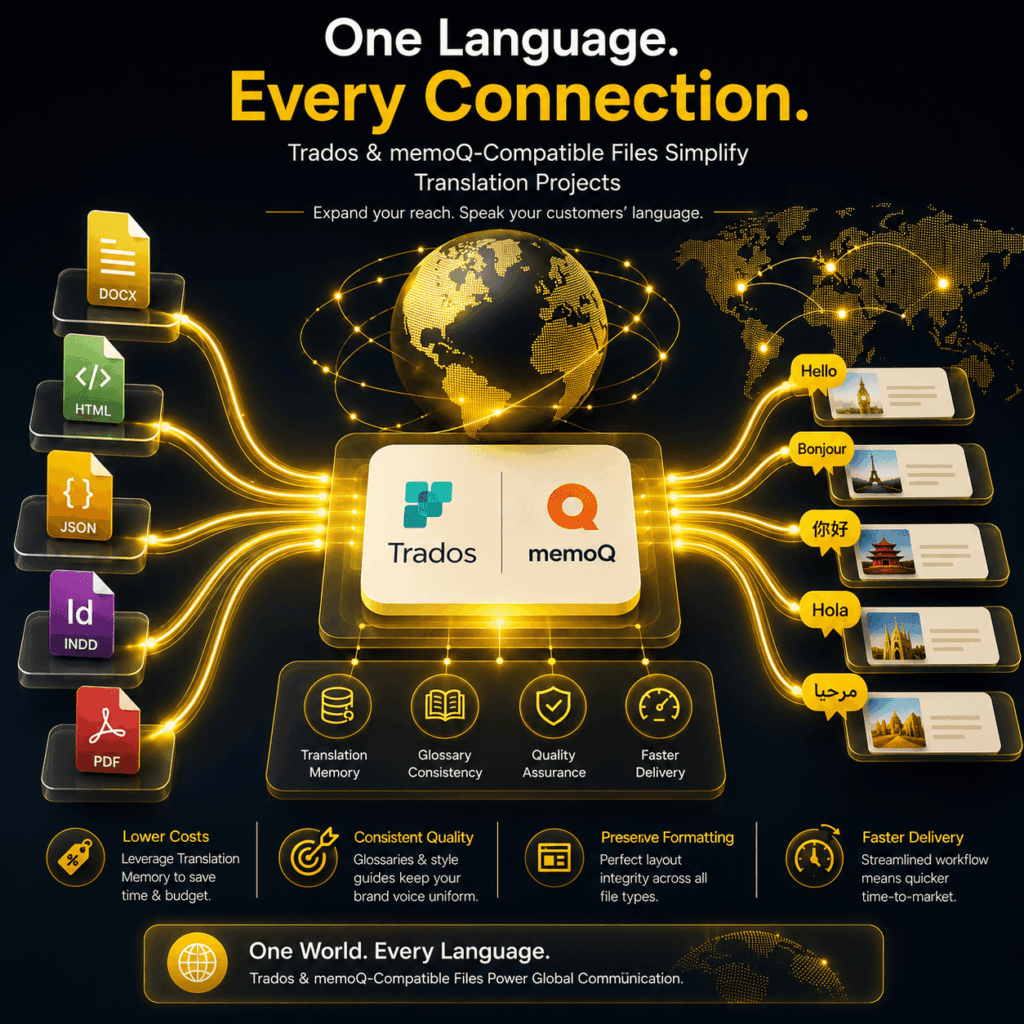
When we talk about Trados and memoQ-compatible files, we aren’t referring to plain text files. We are talking about smart, standardized localization formats—such as .XLIFF (XML Localization Interchange File Format), specialized .SDLXLIFF files, or carefully structured bilingual tables.

Unlike a standard Word document or a raw PDF, a compatible file separates your actual textual content from its underlying code, styling, and design layout. When an expert linguist imports a compatible file into Trados or memoQ, the software splits the document into distinct, manageable segments (sentences or phrases). This allows the translator to focus entirely on the nuances of language without worrying about accidentally breaking HTML tags, corrupting software strings, or messing up desktop publishing (DTP) layouts.

Operational Advantages: What Your Business Secures

Choosing a workflow built around industry-standard tool compatibility provides immediate, measurable advantages for your localization timeline:

Operational Impact

Business Value for You

Maximized Cost Efficiency

Leverage Translation Memories (TM) to avoid paying full price for sentences translated in previous projects.

Absolute Brand Continuity

Force real-time integration with approved glossaries, ensuring product terminology remains uniform across 40+ languages.

Zero Layout Distortion

Protect your underlying design; once translated, the text imports seamlessly back into its native layout (like InDesign or HTML).

Accelerated Delivery Timelines

Automated segment propagation and intuitive user interfaces allow translators to work up to 40% faster.

How Trados and MemoQ-Compatible Files Simplify Translation Projects

Who reaps the greatest advantages from this workflow?

If your company handles diverse digital assets or continuous content updates, ignoring CAT-tool compatibility can result in massive overhead. This system is essential for:

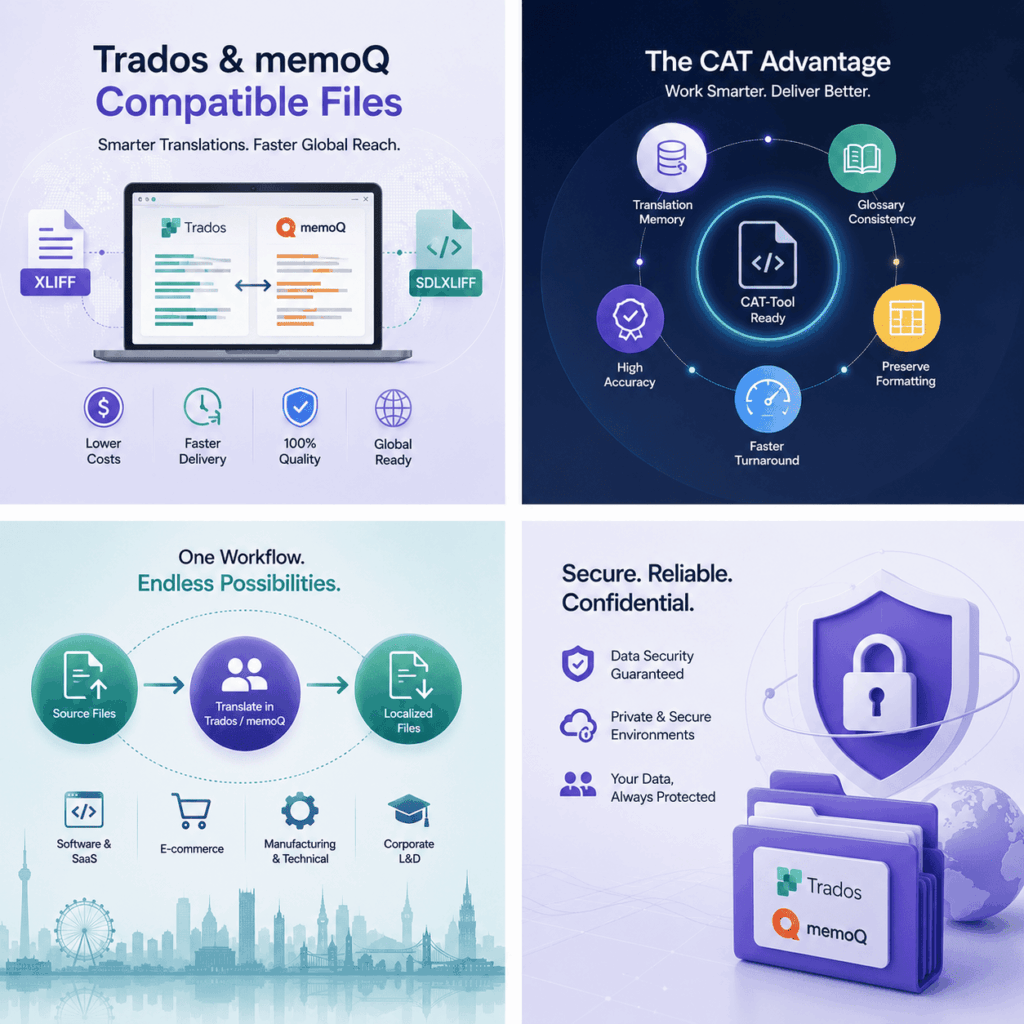
  • Software Developers & SaaS Platforms: To cleanly translate complex.json,.xml, or.yaml translation strings without generating broken code or software bugs.
  • E-Commerce Brands: For managing massive product catalogs with repetitive descriptions, where Translation Memory matching can slash budgets significantly.
  • Technical Manufacturers: For updating dense user manuals, engineering guides, and safety sheets that require absolute terminological precision.
  • Corporate L&D Teams: To localize comprehensive multimedia training modules, compliance courses, and HR documents for operations around the world.

FAQ

Most frequent questions and answers

No, your business does not need to purchase expensive software licenses. By working with a professional translation partner who utilizes these tools, you simply provide your source files, and they will manage the entire technical extraction, translation, and rebuild process for you.

A Translation Memory is a dynamic database that saves your translated sentences in bilingual pairs. When your files are compatible with Trados or memoQ, the system automatically cross-references new text against this database. If a sentence matches a previously translated phrase, it is flagged, allowing the linguist to reuse it instantly, saving you time and money.

Not at all. Trados and memoQ are not automated machine translation engines like Google Translate; they are environment platforms for human professionals. They provide human linguists with the contextual databases, glossaries, and quality assurance checks needed to produce highly accurate, natural, and culturally nuanced translations.

Yes. One of the greatest benefits of a compatible workflow is its ability to process complex design files (like .idml for InDesign). The system extracts the text for translation while locking the structural design elements in place, meaning your final localized brochure or blueprint looks exactly like the original.

Trados and memoQ environments allow translators to work within highly secure, often offline or private cloud setups. Because the text is processed through structured file formats rather than being pasted into public, unsecured online tools, your proprietary business data and intellectual property remain fully protected.
