
How Large Educational Publishers Handle High-Volume Typesetting Projects

Managing Thousands Of Pages Without Compromising Quality

Large educational publishers rarely work on a single textbook at a time. Many organizations manage hundreds of titles simultaneously, covering multiple subjects, grade levels, curriculum versions, languages, and delivery formats.

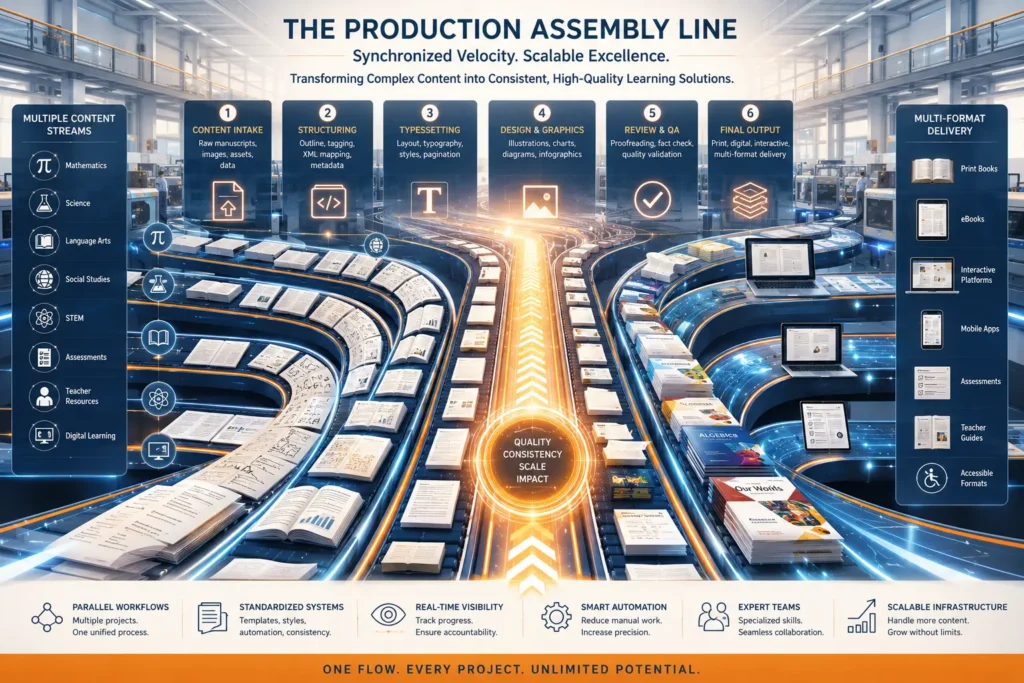
A typical publishing cycle may involve textbooks, workbooks, teacher guides, assessment materials, eBooks, and digital learning resources being produced concurrently. Handling such volumes efficiently requires structured workflows, standardized processes, and scalable production models.

Creating extra pages is not the only challenge. The real challenge is maintaining consistency, accuracy, and delivery schedules across thousands of pages and multiple projects.

Building Standardized Production Frameworks

High-volume educational publishing depends on standardization.

Rather than designing every publication from scratch, publishers establish production frameworks that define:

  • Typography standards
  • Layout structures
  • Chapter templates
  • Assessment formats
  • Table styles
  • Figure treatments
  • Pagination rules

These guidelines greatly minimise production effort while establishing uniformity across big content collections.

Why Standardization Matters

Without Standards

With Standards

Repeated design decisions

Faster production cycles

Inconsistent layouts

Consistent learner experience

Higher review effort

Simplified quality control

Increased revisions

Greater efficiency

Difficult scalability

Easier project expansion

For publishers managing multiple titles, standardized production systems become essential.

Dividing Projects Into Structured Workflows

Large publishing projects are rarely managed as a single production task.

Instead, content is divided into manageable production stages.

Typical workflow segments include:

  • Manuscript preparation
  • Editorial review
  • Layout production
  • Illustration integration
  • Typesetting
  • Proofreading
  • Quality assurance
  • Final file preparation

This structured approach allows multiple teams to work simultaneously without creating production bottlenecks.

Using Template-Driven Typesetting

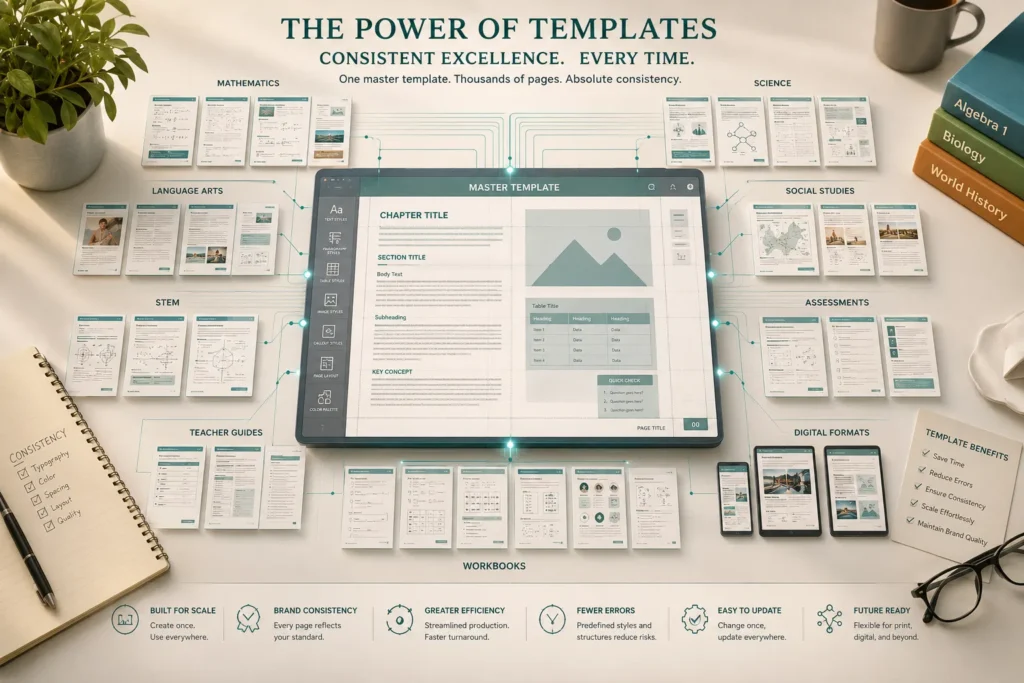
One of the best methods for managing extensive educational publishing operations is template-driven production.

Templates help automate recurring page structures such as:

  • Chapter openers
  • Learning objectives
  • Practice exercises
  • Summary sections
  • Assessment pages
  • Reference materials

Benefits include:

  • Faster page composition
  • Reduced formatting errors
  • Consistent presentation
  • Easier future updates

For large publishers, templates can save substantial production time across hundreds of titles.

Managing Multiple Titles Simultaneously

Educational publishers often produce content for:

  • Mathematics
  • Science
  • Social studies
  • Language arts
  • Professional education
  • Higher education programs

Each project may have different schedules, review cycles, and production requirements.

To manage this complexity, publishers frequently use centralized production planning systems that track:

  • Project status
  • Resource allocation
  • Production milestones
  • Review schedules
  • Delivery deadlines

This visibility helps teams prioritize work and maintain publishing schedules.

Scaling Through Specialized Production Teams

High-volume publishing requires access to specialized expertise.

Production teams may include:

  • Educational typesetters
  • Layout specialists
  • STEM formatting experts
  • Illustration coordinators
  • Quality-control reviewers
  • Digital publishing specialists

Rather than relying on generalist production resources, large publishers often assign specialists to specific workflow stages.

This approach improves efficiency and reduces production errors.

Handling STEM And Technical Content At Scale

Science, technology, engineering, and mathematics publications present additional challenges.

These materials often contain:

  • Mathematical equations
  • Scientific symbols
  • Technical tables
  • Engineering diagrams
  • Complex illustrations

Because technical content requires greater precision, publishers frequently implement dedicated review processes for STEM publications.

Specialized workflows help maintain accuracy while supporting large-scale production volumes.

Leveraging Technology For Production Efficiency

Technology-driven workflows are becoming more and more important in modern educational publishing.

Common capabilities include:

  • XML-first publishing systems
  • Automated content validation
  • Template-based production
  • Content management platforms
  • Digital asset management
  • Workflow automation

These technologies help publishers improve consistency while reducing manual production effort.

As content volumes grow, workflow automation becomes increasingly important for maintaining efficiency.

Strengthening Quality Assurance At Every Stage

Quality control cannot be treated as a final production step in high-volume publishing environments.

Instead, leading publishers embed quality reviews throughout the workflow.

Review checkpoints often verify:

  • Formatting consistency
  • Figure placement
  • Typography standards
  • Cross-references
  • Pagination
  • Assessment accuracy
  • Technical content integrity

Continuous quality assurance reduces downstream corrections and supports on-time delivery.

Supporting Multi-Format Educational Publishing

Contemporary educational materials may need to be delivered simultaneously in a variety of formats.

Publishers may need to produce:

  • Printed textbooks
  • eBooks
  • Digital learning modules
  • Assessment platforms
  • Mobile learning content

Managing separate workflows for each format can increase production complexity.

Large publishers increasingly rely on structured content workflows that support multiple outputs from a common content foundation.

This method preserves platform consistency while increasing scalability.

Scaling Educational Publishing Without Sacrificing Quality

High-volume educational publishing is built on efficient workflows, strong production standards, specialized expertise, and continuous quality control. By combining structured processes with scalable production models, large educational publishers can manage extensive content portfolios while maintaining the consistency, accuracy, and reliability that educators and learners expect.

FAQ

Templates improve consistency, reduce production time, and simplify large-scale content management

They typically use structured production workflows, centralized project management systems, and specialized production teams.

Publishers must maintain quality, consistency, and accuracy across thousands of pages while meeting strict deadlines

STEM publications often contain equations, technical diagrams, scientific notation, and specialized formatting requirements.

Technology enables template-driven production, automation, content management, workflow monitoring, and multi-format publication.
