

Best Practices For Formatting Standardized Test Materials

Standardized test materials must do more than present questions and answer options. They need to ensure consistency, readability, fairness, and accuracy across thousands or even millions of test takers. A single formatting issue, such as misaligned answer choices, inconsistent numbering, or poorly displayed mathematical equations, can create confusion and increase the risk of scoring errors.

For assessment providers, educational publishers, and exam boards, formatting is a crucial quality-control process that directly impacts the testing experience. Following proven formatting practices helps improve usability, supports accessibility requirements, and ensures content remains consistent across print and digital delivery channels.

Why Formatting Matters In Standardized Assessments

Standardized examinations rely on uniform presentation. Every candidate should encounter the same content structure, visual hierarchy, and navigation experience.

Poor formatting can lead to:

  • Misinterpretation of questions
  • Difficulty reading diagrams and charts
  • Inconsistent answer selection experiences
  • Printing and rendering issues
  • Increased review and correction cycles

Assessments with proper formatting increase candidate confidence while preserving exam integrity.

Establish Consistent Layout Standards

A standardized layout creates familiarity and reduces cognitive load for test takers.

Key elements to standardize include:

  • Page margins
  • Header and footer placement
  • Question numbering formats
  • Answer option styling
  • Font usage
  • Section dividers
  • Instruction placement

When every assessment follows the same structure, learners spend less time navigating the document and more time focusing on the content.

Example Layout Standards

Element

Recommended Practice

Fonts

Use consistent font families throughout

Headings

Maintain uniform sizes and styles

Numbering

Apply a single numbering convention

Spacing

Use consistent paragraph spacing

Instructions

Position in predictable locations

Prioritize Readability And Accessibility

Assessment materials should be easy to read across different devices and printed formats.

Important considerations include:

  • Clear font selection
  • Adequate line spacing
  • High contrast between text and background
  • Consistent alignment
  • Sufficient white space

Accessibility reviews should also verify that:

  • Tables are clearly structured
  • Images include appropriate descriptions where required
  • Visual elements do not convey meaning through color alone
  • Content remains usable when enlarged or displayed on different screens

These practices help create a more inclusive testing experience.

Ensure Mathematical And Scientific Content Displays Correctly

Mathematics and science assessments often contain complex formatting requirements.

Special attention should be given to:

  • Equations
  • Chemical formulas
  • Scientific notation
  • Graphs
  • Tables
  • Geometric diagrams

Every equation should align properly and maintain consistency throughout the assessment.

Common Formatting Risks

Formatting Issue

Potential Impact

Misaligned equations

Candidate confusion

Distorted diagrams

Incorrect interpretation

Broken tables

Loss of information

Inconsistent symbols

Scoring disputes

Poor image resolution

Reduced readability

Rigorous quality checks help prevent these issues before publication.

Maintain Consistency Across Print And Digital Versions

These days, a lot of organisations provide exams in both digital and physical formats.

Formatting should remain consistent regardless of delivery method.

Key validation areas include:

  • Page breaks
  • Interactive elements
  • Diagram rendering
  • Font compatibility
  • Screen responsiveness
  • Print output quality

Traditional Vs Modern Assessment Production

Traditional Approach

Modern Approach

Separate print and digital layouts

Unified content workflows

Manual corrections

Automated validation checks

Multiple formatting versions

Centralized content management

Repeated reviews

Structured quality processes

Maintaining a single source of truth helps reduce inconsistencies between formats.

Implement Multi-Level Quality Assurance Reviews

Formatting reviews should not occur only at the final production stage.

Successful assessment teams typically perform:

Content Review

Verifies accuracy of questions, instructions, and answer options.

Formatting Review

Checks layout consistency, spacing, numbering, and typography.

Technical Validation

Verifies that equations, tables, charts, and pictures are displayed appropriately.

Final Production Review

Ensures readiness for printing or digital deployment.

This layered approach helps identify issues earlier in the workflow and reduces costly revisions later.

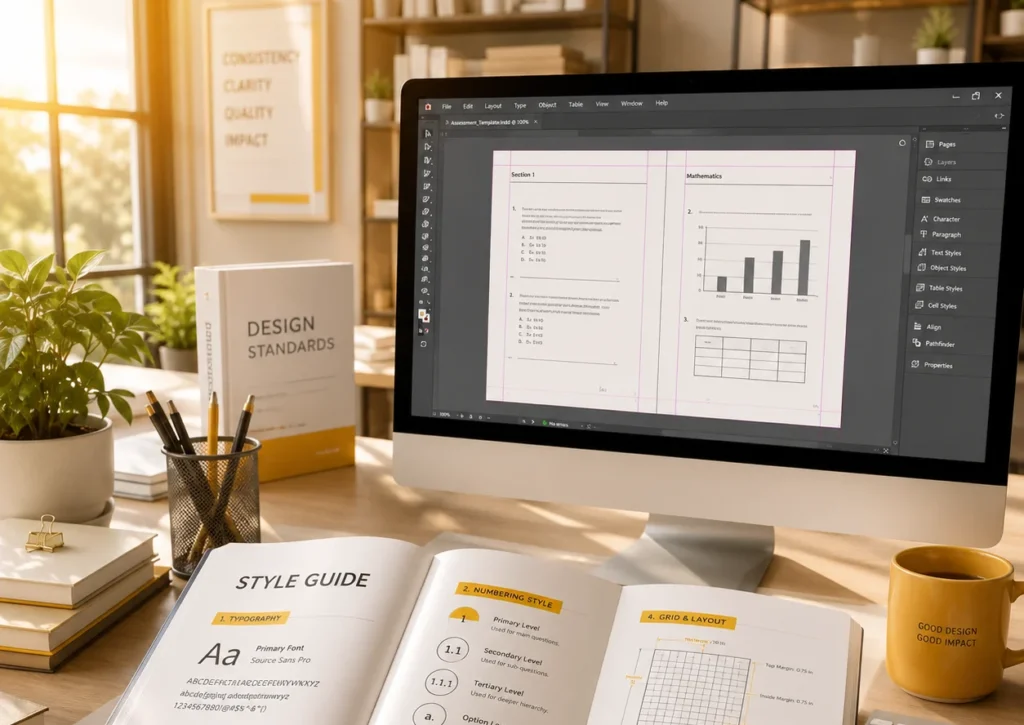
Use Structured Templates And Style Guides

Templates improve efficiency and consistency across assessment programs.

A well-designed style guide should define:

  • Typography standards
  • Numbering rules
  • Diagram specifications
  • Table formats
  • Accessibility requirements
  • Branding guidelines
  • Review procedures

Templates help teams maintain quality across massive amounts of information while reducing the amount of manual formatting work.

Practical Assessment Production Scenario

Consider a national testing organization preparing thousands of examination items across mathematics, science, and language subjects.

Reviewers may come across irregular layouts, uneven spacing, and different equation styles in the absence of uniform formatting guidelines. These problems lengthen the review process and increase the risk of manufacturing errors.

The company may increase uniformity, speed up approvals, and provide trustworthy assessment materials in print and digital settings by putting in place organised templates, centralised style guides, and several quality-review phases.

Strengthening Assessment Quality Through Better Formatting

Formatting is not simply a design task—it is a critical component of assessment quality. Consistent layouts, accessible presentation, accurate equation rendering, and structured review processes help examination providers deliver reliable and professional testing experiences. By establishing clear formatting standards and maintaining rigorous quality controls, organizations can improve efficiency while supporting fair and accurate assessment delivery.

Frequently Asked Questions

It is the process of organizing assessment content using consistent layouts, typography, numbering, spacing, and visual presentation standards.

All test takers will have a consistent experience thanks to proper formatting, which also increases readability and decreases confusion.

Accessibility helps ensure assessment materials can be used effectively by a wider range of learners and supports compliance requirements.

Templates speed up production, decrease manual labour, increase uniformity, and streamline quality-control procedures.

Organizations can reduce errors by using structured templates, maintaining style guides, performing multi-stage reviews, and validating content before final publication.
