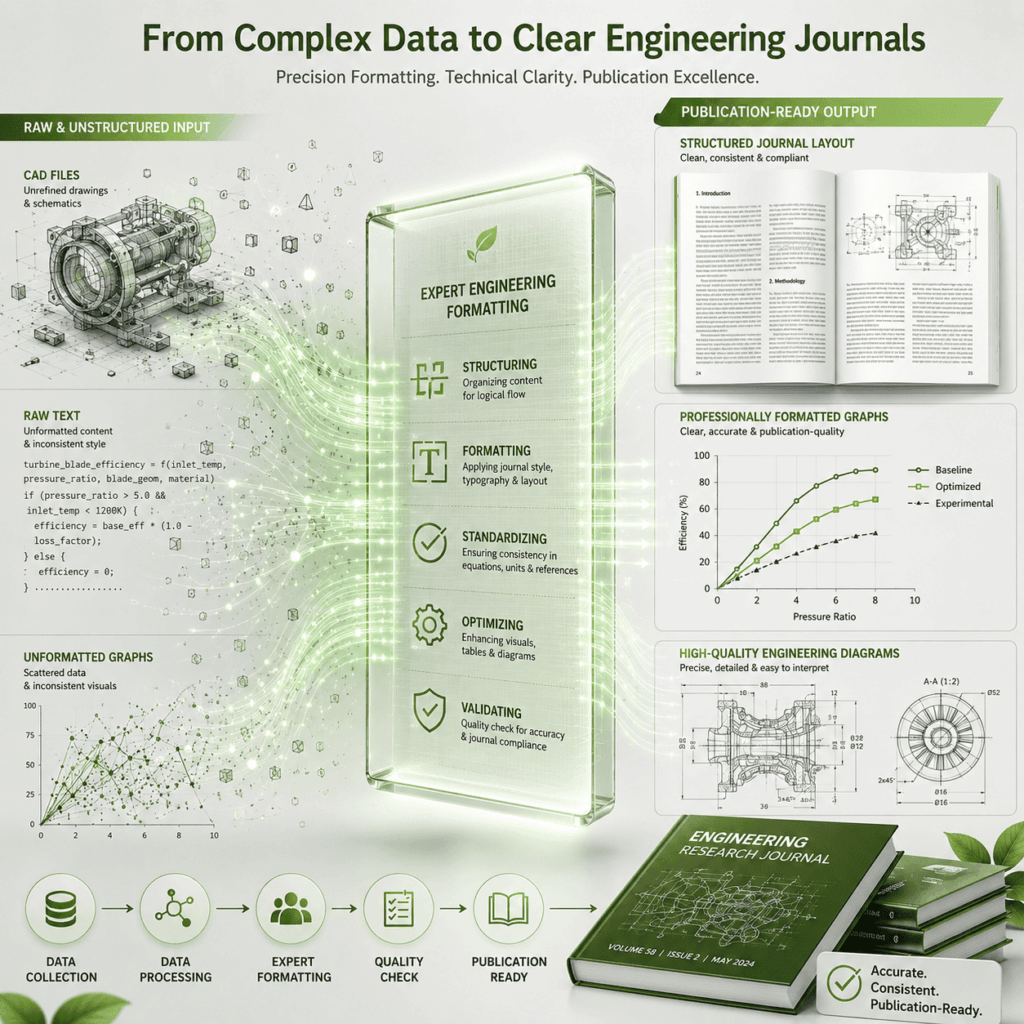
Expert Formatting for Engineering Journals: Managing Equations, CAD Data, and Graphs

Engineering journals demand more than accurate research content. They require flawless formatting, structured layouts, and precise presentation of highly technical elements such as mathematical equations, CAD drawings, tables, graphs, and scientific illustrations. Even minor formatting inconsistencies can affect readability, peer review outcomes, and publication quality.

As engineering research becomes increasingly data-driven and globally distributed, publishers and academic institutions are turning to expert formatting services to ensure every journal meets professional publishing standards. Specialized engineering journal formatting support helps streamline complex publishing workflows while improving clarity, consistency, and visual accuracy.

Precision Matters in Engineering Publishing

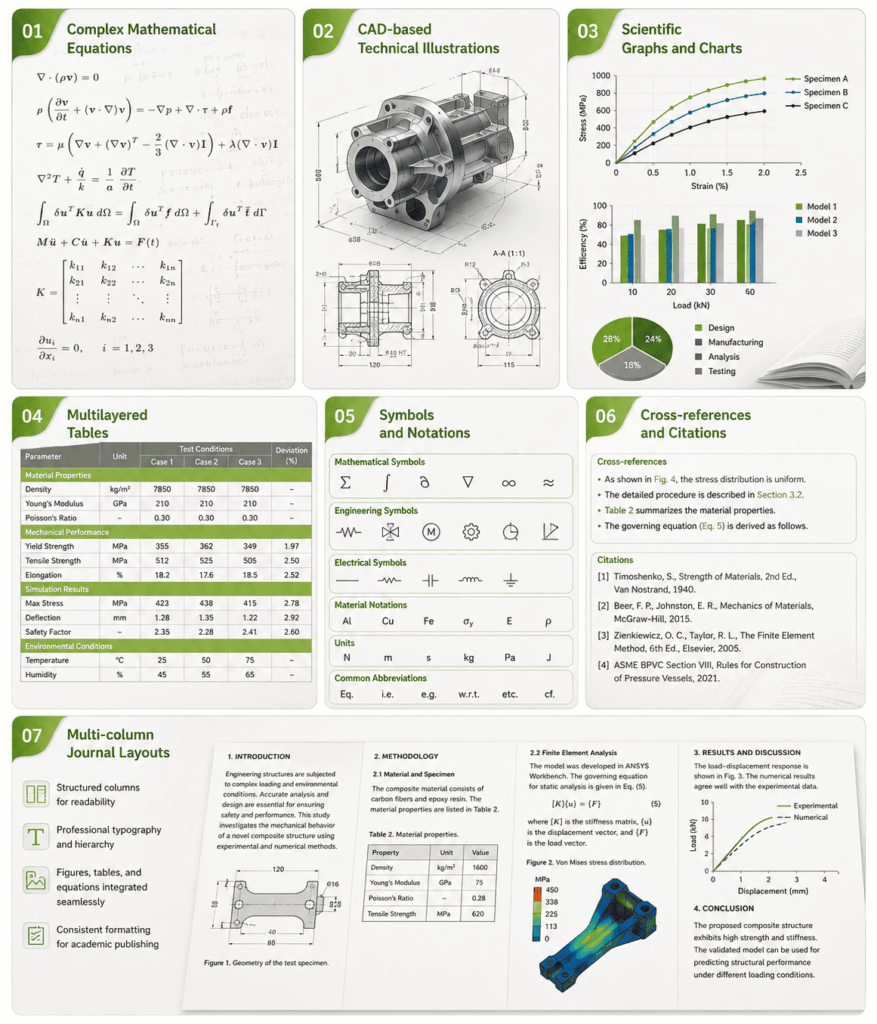
Engineering journals are filled with technical content that must be displayed with absolute accuracy. Unlike standard document formatting, engineering publishing requires careful handling of:

  • Complex mathematical equations
  • CAD-based technical illustrations
  • Scientific graphs and charts
  • Multilayered tables
  • Symbols and notations
  • Cross-references and citations
  • Multi-column journal layouts

Professional formatting ensures that every element is aligned, readable, and publication-ready across both digital and print platforms

Engineering Journal Formatting

Why Engineering Journals Require Specialized Formatting Expertise

Handling Advanced Equations Without Errors

Engineering research often includes extensive formulas, matrices, integrals, and scientific notations. Improper spacing, alignment, or symbol formatting can change the meaning of technical content.

Specialized formatting teams use tools such as LaTeX and MathType to maintain equation accuracy and consistency throughout the publication.

Integrating CAD Drawings into Publication Layouts

CAD files and engineering schematics require careful optimization before publication. High-resolution diagrams must remain sharp, scalable, and compatible with journal formatting standards.

Professional formatting experts ensure CAD visuals are properly labeled, aligned, and integrated without losing technical detail.

Presenting Graphs and Data Clearly

Engineering journals rely heavily on graphs, statistical visuals, and performance charts. Formatting specialists enhance readability by maintaining proper scaling, typography, axis labeling, and visual consistency across all graphical elements.

This improves reader comprehension and overall journal presentation.

Beyond Basic Typesetting: What Expert Formatting Includes

Professional engineering journal formatting services typically cover:

  • Equation formatting and validation
  • CAD image optimization
  • Scientific graph enhancement
  • Multi-column page layouts
  • Reference and citation styling
  • XML and digital publishing preparation
  • Table formatting and alignment
  • Figure placement and caption management
  • Journal template compliance
  • Proofreading and pre-publication checks

These services help journals maintain a polished and professional appearance while meeting publisher guidelines.

 

Engineering Journal Formatting

Technologies Powering Modern Engineering Journal Formatting

Advanced publishing technology plays a major role in maintaining formatting accuracy for technical publications.

Commonly used tools include:

  • LaTeX
  • Adobe InDesign
  • MathType
  • AutoCAD-compatible workflows
  • XML publishing systems
  • MATLAB graph integration
  • FrameMaker
  • OCR correction software

These technologies support efficient management of high-volume engineering content.

The Publishing Challenges Engineering Teams Face

Managing engineering journal formatting internally can become difficult due to growing publication demands and technical complexity.

Common challenges include:

Inconsistent Formatting Standards

Multiple contributors and varying submission formats often create inconsistencies in layouts, citations, and graphical presentation.

Time-Consuming Corrections

Engineering journals require extensive manual adjustments for equations, graphs, and technical figures, increasing production timelines.

Digital Compatibility Issues

Journals must be optimized for online publishing, mobile viewing, XML conversion, and digital repositories.

Large Volumes of Technical Content

Research institutions and publishers often handle hundreds of technical manuscripts simultaneously, making scalability a major concern.

Engineering Journal Formatting

Why Publishers Prefer Professional Engineering Formatting Services

Outsourcing expert formatting services helps engineering publishers improve efficiency while maintaining publication quality.

Faster Publication Timelines

Dedicated formatting teams streamline workflows and reduce delays caused by repeated corrections and layout issues.

Improved Technical Accuracy

Experienced professionals ensure technical elements are formatted according to engineering publishing standards.

Consistent Journal Presentation

Professional formatting creates a uniform visual identity across every issue and publication.

Scalable Publishing Support

Formatting providers can manage large manuscript volumes efficiently during peak publishing cycles.

Better Reader Experience

Clean layouts, readable equations, and properly structured visuals improve engagement and content accessibility.

It is a long established fact that a reader will be distracted by the readable content of a page when looking at its layout. 

Supporting the Future of Engineering Research Publishing

As engineering research becomes more advanced and globally collaborative, journal publishers need formatting solutions that combine technical precision with publishing efficiency. Expert formatting services help transform complex engineering manuscripts into high-quality, publication-ready journals that meet modern academic and industry standards.

From mathematical equations and CAD drawings to scientific graphs and digital publishing workflows, professional formatting support ensures engineering content is delivered with clarity, consistency, and technical excellence.

FAQ

Most frequent questions and answers

Engineering journals contain complex equations, technical diagrams, and scientific data that require precise formatting for readability and publishing accuracy.

Popular tools include LaTeX, Adobe InDesign, MathType, AutoCAD-compatible systems, XML publishing tools, and FrameMaker.

Yes. Professional formatting providers optimize CAD files and engineering schematics for both print and digital publishing.

Formatting specialists use advanced equation tools such as LaTeX and MathType to ensure accuracy, alignment, and consistency. 

Yes. Modern formatting services support XML workflows, eBooks, online journals, and mobile-compatible publishing formats.
