From Manuscript to Print-Ready Educational Textbook: A Complete Workflow

Every Successful Textbook Begins Long Before Printing

When educators, students, or institutions receive a finished textbook, they typically see only the final product. What remains invisible is the extensive publishing workflow required to transform a manuscript into a professionally formatted educational resource.

Educational textbooks often contain chapter structures, learning objectives, illustrations, assessments, references, tables, and subject-specific content that must work together seamlessly. A well-managed production workflow ensures that these elements are organized, accurate, and ready for classroom use.

Understanding this process helps publishers improve efficiency, reduce errors, and deliver higher-quality educational materials.

Stage 1: Manuscript Development And Content Preparation

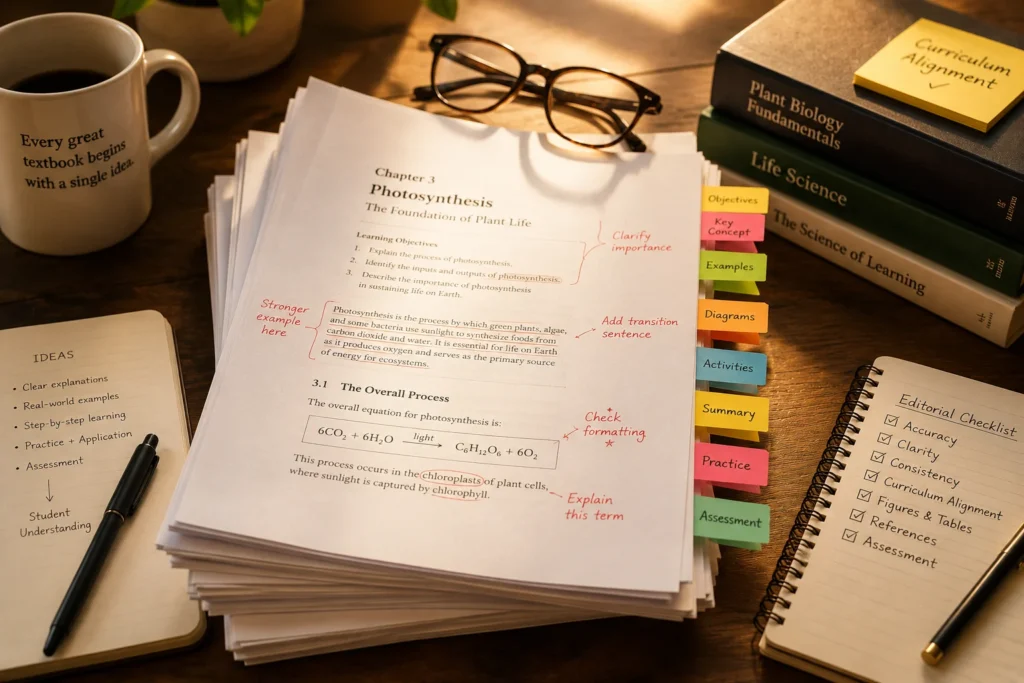
The workflow begins with the creation and collection of source content.

This stage typically includes:

  • Author manuscripts
  • Subject matter expert reviews
  • Curriculum alignment
  • Editorial revisions
  • Content approval

At this point, the focus remains on educational accuracy rather than visual presentation.

Before production begins, publishers often verify:

  • Chapter completeness
  • Learning objectives
  • Assessment content
  • Figure requirements
  • Reference materials

A well-organized manuscript significantly reduces production challenges later in the workflow.

Stage 2: Editorial Review And Content Structuring

Once the manuscript is approved, editorial teams prepare the content for design and production.

Key activities include:

  • Content standardization
  • Heading hierarchy creation
  • Style guide application
  • Reference verification
  • Content sequencing

Editorial preparation establishes the foundation for a consistent learner experience throughout the publication.

This stage also identifies elements such as:

  • Tables
  • Diagrams
  • Callout boxes
  • Exercises
  • Chapter summaries

that require special formatting attention during production.

Stage 3: Textbook Design And Layout Planning

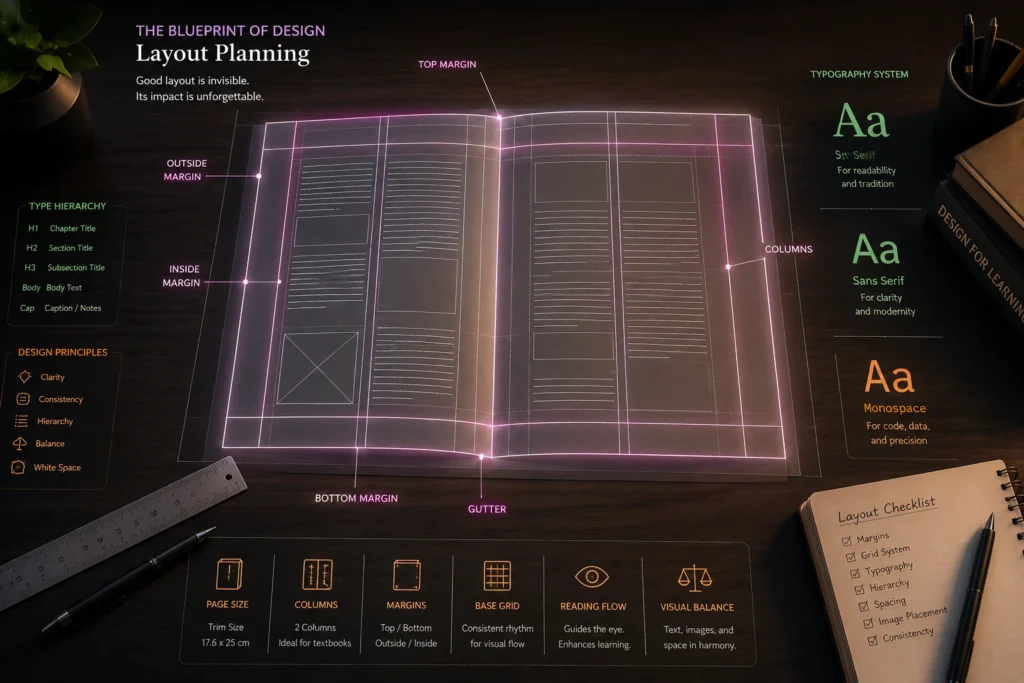
Before pages are typeset, publishers establish the visual framework of the book.

Layout planning defines:

  • Page dimensions
  • Typography standards
  • Margin structures
  • Chapter opening pages
  • Assessment layouts
  • Figure placement rules

The goal is to create a design system that supports readability and educational effectiveness.

For K-12 publications, layouts may prioritize visual engagement, while higher education materials often emphasize information density and technical clarity.

Stage 4: Professional Typesetting And Page Composition

This is the stage where the manuscript begins to resemble a textbook.

Typesetting involves organizing:

  • Text content
  • Headings
  • Tables
  • Equations
  • Images
  • Diagrams
  • References
  • Learning activities

The production team ensures that every page follows established design standards.


Key Typesetting Objectives

Objective

Purpose

Consistent typography

Improves readability

Structured hierarchy

Supports navigation

Accurate equation placement

Maintains technical accuracy

Logical figure positioning

Enhances comprehension

Balanced white space

Reduces cognitive load

Standardized layouts

Creates consistency

This stage often represents the most visible transformation in the publishing workflow.

Stage 5: Illustration, Figure, And Diagram Integration

Educational textbooks frequently rely on visual learning elements.

These may include:

  • Scientific illustrations
  • Maps
  • Infographics
  • Technical diagrams
  • Engineering drawings
  • Data visualizations

Visual elements are carefully integrated into the page structure to support the surrounding content.

Proper placement is essential because students learn more effectively when visuals appear close to the related explanations.

Stage 6: Proofreading And Quality Assurance

Even well-designed textbooks require extensive review before publication.

Quality-control teams evaluate:

  • Formatting consistency
  • Heading accuracy
  • Figure alignment
  • Pagination
  • Table presentation
  • Reference integrity
  • Typographical errors

For STEM publications, additional reviews often verify:

  • Mathematical notation
  • Equation formatting
  • Scientific symbols
  • Unit consistency

This stage helps prevent costly corrections after printing.

Stage 7: Prepress Preparation And Print Validation

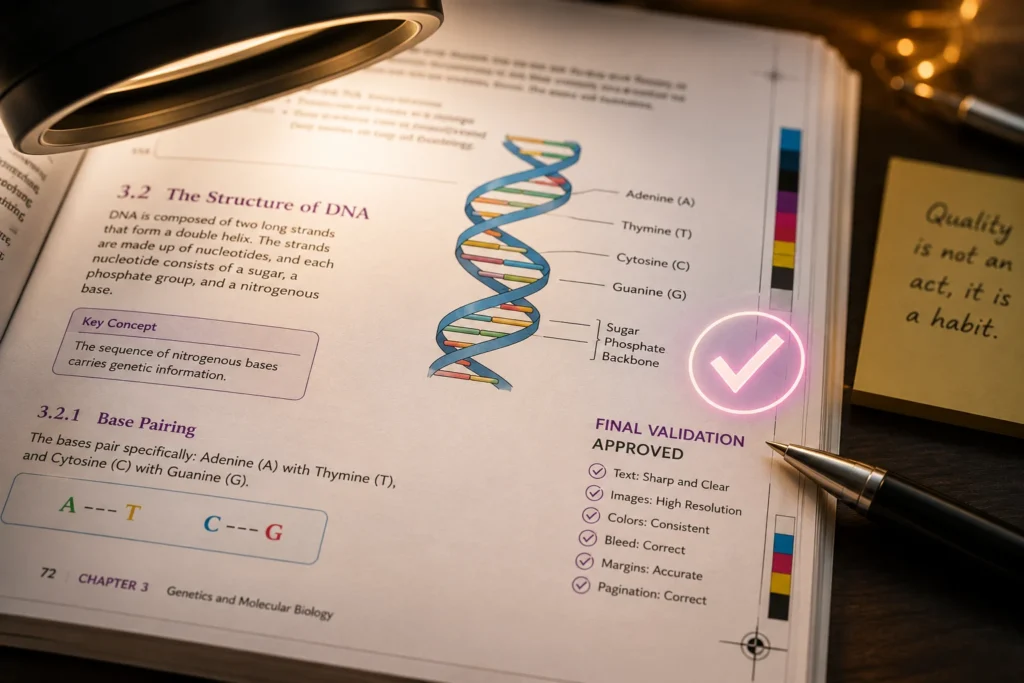
Before files are sent to production, publishers perform final technical checks.

Typical validations include:

  • Print-ready PDF generation
  • Image resolution verification
  • Font embedding
  • Color consistency checks
  • Bleed and margin validation
  • File packaging

These steps ensure that the textbook will reproduce accurately during printing.

Any mistake made at this point could have an impact on the finished printed product.

Stage 8: Printing And Distribution

Once approved, the textbook moves into production.

Publishers may produce:

  • Student editions
  • Teacher editions
  • Workbooks
  • Assessment materials
  • Digital companion resources

Depending on the publishing strategy, materials may be distributed through:

  • Educational institutions
  • Retail channels
  • Digital platforms
  • Learning management systems

The effectiveness of every previous stage directly influences the quality of the final product.

Turning Educational Content Into Classroom-Ready Resources

Producing a textbook involves far more than arranging words on a page. From manuscript preparation and editorial review to typesetting, quality assurance, and print production, each stage contributes to the effectiveness of the final learning resource. A structured publishing workflow helps educational publishers deliver textbooks that are accurate, consistent, readable, and ready to support students across a wide range of learning environments.

Frequently Asked Questions

The process begins with manuscript development, content review, and curriculum alignment.

Editorial preparation standardizes content and establishes the structure needed for efficient page composition.

Typesetting transforms manuscripts into organized textbook pages by formatting text, visuals, tables, equations, and educational elements.

Quality assurance helps identify formatting, content, and technical issues before publication, reducing production errors.

STEM publications often contain equations, technical diagrams, scientific symbols, and specialized formatting requirements that require additional review and validation.
