
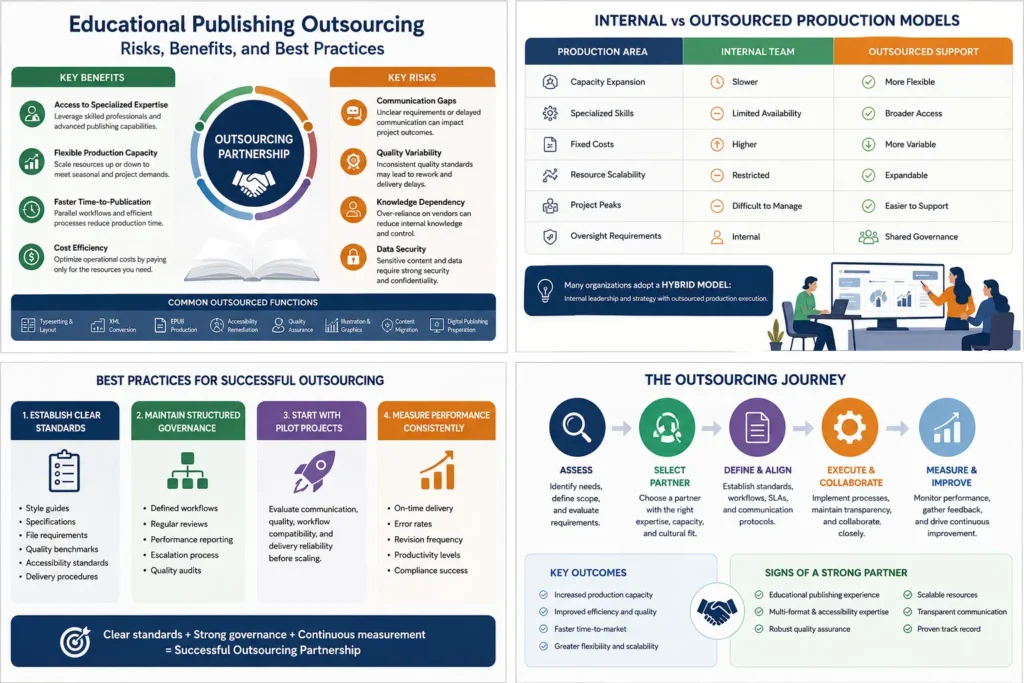

Educational Publishing Outsourcing Risks, Benefits, and Best Practices

Educational publishers are under increasing pressure to produce more content, support multiple delivery formats, meet accessibility requirements, and maintain aggressive publication schedules. As content volumes grow, many organizations evaluate outsourcing as a strategy to expand production capacity without significantly increasing internal infrastructure.

While outsourcing can provide substantial operational advantages, it also introduces risks that must be carefully managed. Successful publishers typically approach outsourcing as a structured operational strategy rather than a simple cost-reduction initiative.

Why Educational Publishers Consider Outsourcing

Educational content production involves numerous specialized activities that require expertise, technology, and scalable resources.

Common outsourced functions include:

  • Typesetting and page layout
  • XML conversion
  • EPUB production
  • Accessibility remediation
  • Quality assurance
  • Illustration and graphics support
  • Content migration projects
  • Digital publishing preparation

Outsourcing allows publishers to access specialized skills while maintaining focus on core editorial and curriculum responsibilities.

The Benefits Of Educational Publishing Outsourcing
Access To Specialized Expertise

Many production partners employ professionals with extensive experience in educational publishing workflows.

Specialized capabilities often include:

  • Adobe InDesign production
  • XML-first publishing
  • Multi-format publishing
  • Accessibility compliance
  • Assessment content production

This expertise can accelerate project delivery and improve consistency.

Flexible Production Capacity

Publishing workloads are rarely consistent throughout the year.

Outsourcing provides the ability to:

  • Handle seasonal peaks
  • Support large curriculum projects
  • Manage multiple titles simultaneously
  • Increase throughput without hiring

This flexibility helps organizations respond to changing production demands.

Faster Time-To-Publication

External production teams can often support parallel workflows that reduce bottlenecks.

Examples include:

  • Simultaneous layout and quality review
  • Concurrent format conversion
  • Dedicated correction cycles
  • Accelerated production schedules

These approaches can shorten overall project timelines.

Understanding The Risks

Outsourcing can provide value, but organizations must also address potential challenges.

Communication Gaps

Misunderstandings can occur when project requirements are not clearly documented.

Potential issues include:

  • Ambiguous specifications
  • Inconsistent feedback
  • Delayed approvals
  • Version-control confusion

Strong communication processes are essential for minimizing risk.

Quality Variability

Not all production providers follow the same standards.

Organizations should evaluate:

  • Quality-control procedures
  • Review processes
  • Staff expertise
  • Publishing experience
  • Performance metrics

Quality expectations should be clearly defined before project initiation.

Knowledge Dependency

Excessive reliance on external providers can create operational challenges.

Risks may include:

  • Reduced internal knowledge retention
  • Limited process visibility
  • Vendor dependency
  • Transition difficulties

Publishers should maintain internal oversight and governance structures.

Comparing Internal And Outsourced Production Models

Production Area

Internal Team

Outsourced Support

Capacity Expansion

Slower

More Flexible

Specialized Skills

Limited Availability

Broader Access

Fixed Costs

Higher

More Variable

Resource Scalability

Restricted

Expandable

Project Peaks

Difficult To Manage

Easier To Support

Oversight Requirements

Internal

Shared Governance

Many organizations adopt hybrid models that combine internal leadership with outsourced production execution

Best Practices For Successful Outsourcing
Establish Clear Production Standards

Successful projects begin with documented expectations.

Include:

  • Style guides
  • Production specifications
  • File requirements
  • Quality benchmarks
  • Accessibility standards
  • Delivery procedures

Clear standards reduce rework and improve consistency.

Maintain Structured Governance

Outsourcing should be managed through formal processes.

Recommended controls include:

  • Defined approval workflows
  • Scheduled project reviews
  • Performance reporting
  • Escalation procedures
  • Quality audits

Governance ensures accountability throughout the project lifecycle.

Start With Pilot Projects

Rather than outsourcing large programs immediately, many publishers begin with smaller initiatives.

Pilot projects help evaluate:

  • Communication effectiveness
  • Quality performance
  • Workflow compatibility
  • Delivery reliability

The results provide valuable information before expanding the partnership

Measure Performance Consistently

Performance metrics help maintain long-term quality.

Common measures include:

Metric

Purpose

On-Time Delivery

Schedule performance

Error Rates

Quality monitoring

Revision Frequency

Process effectiveness

Productivity Levels

Capacity measurement

Compliance Success

Standards adherence

Regular measurement supports continuous improvement.

Signs Of A Strong Publishing Production Partner

Educational publishers often look for providers that demonstrate:

✔ Educational publishing experience

✔ Multi-format production capabilities

✔ Accessibility expertise

✔ Structured quality assurance

✔ Scalable resource capacity

✔ Transparent communication processes

✔ Proven workflow management

These characteristics often contribute to more predictable project outcomes.

FAQ

Typesetting, XML conversion, EPUB production, accessibility support, quality assurance, and content conversion are among the most commonly outsourced services.

No. Small and mid-sized publishers can also benefit from specialized expertise and flexible production capacity.

Poor communication and unclear project requirements are among the most common causes of outsourcing challenges

By establishing production standards, conducting regular reviews, and implementing structured governance processes.

Many organizations achieve better results with a hybrid approach that combines internal oversight with external production support
