

How Publishers Handle Seasonal Peaks in Educational Content Production

Educational publishing is rarely a steady, predictable operation. Curriculum revisions, academic calendars, assessment cycles, government education initiatives, and the introduction of new products all cause major production surges for the majority of publishers. Content volumes might rise sharply during these busy times, putting strain on the editorial, design, production, and quality assurance teams.

Organizations that fail to prepare for these fluctuations often encounter delayed releases, resource bottlenecks, rising costs, and quality issues. However, successful publishers manage seasonal demand without interfering with delivery schedules by using scalable production techniques and organised planning.

Why Seasonal Production Peaks Occur

Educational publishing follows demand patterns that differ from many other industries.

Common triggers include:

  • Back-to-school publishing cycles
  • Curriculum revisions
  • Examination content development
  • Government education programs
  • New textbook adoptions
  • Digital learning platform updates

These events can create short periods where production requirements are several times higher than normal operating volumes.

Typical Peak-Season Challenges

Challenge

Operational Impact

Increased manuscript volume

Resource overload

Compressed deadlines

Schedule pressure

Multiple simultaneous projects

Coordination difficulties

Higher review workloads

Approval bottlenecks

Multi-format publishing demands

Production complexity

These difficulties can have an impact on content quality and delivery speed if they are not planned for.

Building Flexible Production Capacity

Many publishers avoid maintaining large permanent teams solely for peak workloads.

Instead, they create flexible production models that can expand when demand increases.

Common approaches include:

  • Dedicated production partners
  • Specialized freelance resources
  • Scalable design teams
  • External quality assurance support
  • Multi-format publishing specialists

This flexibility allows organizations to increase output without significantly increasing fixed operating costs.

Standardization Reduces Peak-Season Pressure

One of the most effective methods for handling production surges is reducing unnecessary work.

Publishers often develop:

  • Master templates
  • Style guides
  • Content component libraries
  • Illustration standards
  • Workflow checklists

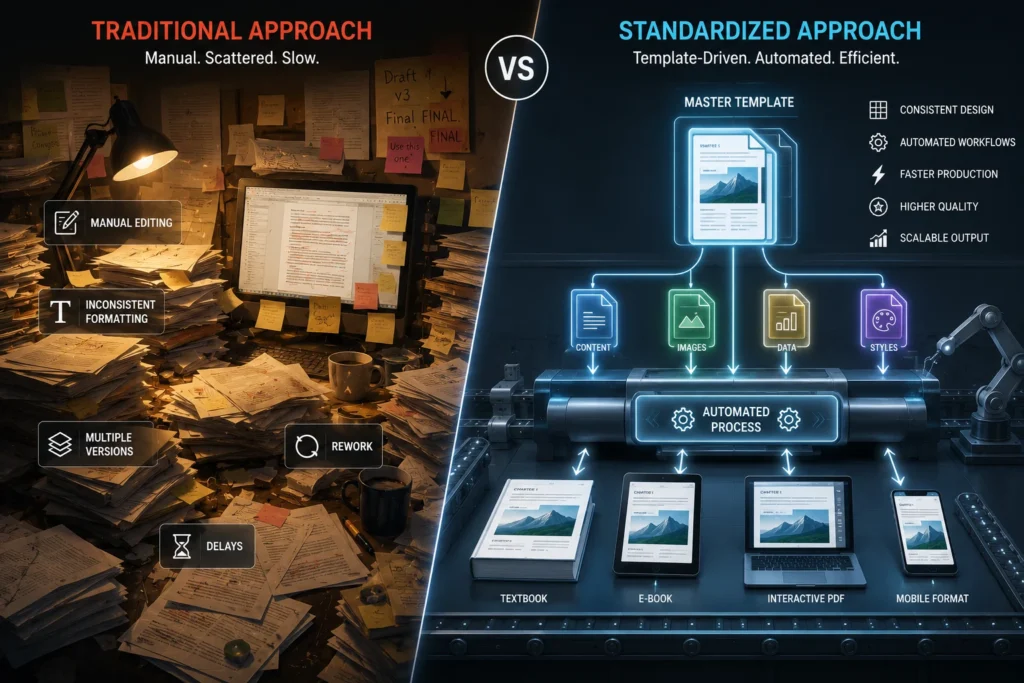
Benefits Of Standardization

Traditional Approach

Standardized Approach

Repeated formatting decisions

Predefined standards

Manual page setup

Template-driven production

Inconsistent outputs

Uniform content structure

Longer review cycles

Faster validation

Standardization helps teams process larger content volumes more efficiently.

Forecasting Demand Before It Arrives

Effective publishers begin preparing months before peak production periods.

Production forecasting often includes:

  • Historical workload analysis
  • Publication schedule reviews
  • Curriculum adoption timelines
  • Resource capacity assessments
  • Project pipeline evaluations

Forecasting helps organizations identify upcoming capacity gaps before they become operational problems.

Key Planning Questions

  • How many titles are expected?
  • Which projects have fixed deadlines?
  • What specialized skills will be required?
  • Which production stages may become bottlenecks?

The earlier these questions are addressed, the easier it becomes to manage peak demand.

Managing Multiple Projects Simultaneously

During peak periods, publishers rarely work on a single project at a time.

Successful organizations often implement:

  • Centralized project dashboards
  • Production scheduling systems
  • Resource allocation planning
  • Milestone tracking processes

Managers may prioritise tasks and avoid project disputes with increased visibility.

Using Parallel Production Workflows

Sequential production processes can create major bottlenecks during high-volume periods.

Many publishers now use parallel workflows where activities occur simultaneously.

Examples include:

  • Editorial review alongside design preparation
  • Accessibility validation during production
  • Concurrent quality assurance reviews
  • Multi-format conversion during layout development

This approach helps reduce overall production timelines.

Workflow Comparison

Sequential Workflow

Parallel Workflow

One task at a time

Multiple tasks coordinated

Longer schedules

Faster completion

More idle time

Better utilization

Increased bottlenecks

Improved throughput

During seasonal peaks, parallel execution becomes especially beneficial.

Technology Supports Capacity Expansion

Technology helps publishers manage higher workloads without proportionally increasing staffing.

Common tools support:

  • Workflow automation
  • File management
  • Production tracking
  • Quality validation
  • Version control
  • Reporting and analytics

These systems improve visibility and reduce manual administrative effort.

Creating A Sustainable Peak-Season Strategy

Publishers that successfully handle seasonal spikes usually employ a number of strategies:

  • Early forecasting
  • Flexible resource models
  • Standardized workflows
  • Parallel production processes
  • Strong project visibility
  • Consistent quality controls

Together, these practices create a production environment that can absorb demand fluctuations while maintaining delivery commitments.

Protecting Quality During High-Volume Production

One of the biggest risks during peak periods is declining quality.

To maintain standards, publishers often implement:

✔ Structured review processes

✔ Quality checkpoints

✔ Automated validation tools

✔ Standardized production procedures

✔ Dedicated quality assurance teams

Maintaining quality controls throughout the workflow prevents costly corrections later.

Building Resilience For Future Publishing Cycles

Seasonal demand fluctuations are a normal part of educational publishing. Rather than reacting to production surges as they occur, successful publishers develop scalable systems that can adapt to changing workloads. Through forecasting, workflow optimization, flexible capacity planning, and strong quality controls, organizations can navigate peak production periods more efficiently while continuing to deliver high-quality educational content on schedule.

Frequently Asked Questions

Curriculum updates, academic calendars, examination cycles, and textbook adoption schedules often create concentrated periods of high production demand.

They typically use forecasting, capacity planning, resource allocation strategies, and workflow standardization.

Production efficiency is increased and rework is decreased with the use of templates, style guides, and organised workflows.

They provide scalable capacity and specialized expertise that help publishers handle increased workloads without expanding permanent teams.
