Creating a Scalable Content Factory for Educational Publishers

Educational publishers today face a difficult balancing act. Content demand is growing across print, digital learning platforms, assessments, mobile applications, and institutional learning environments. At the same time, publishers must maintain quality, support accessibility requirements, manage curriculum updates, and meet increasingly aggressive production schedules.

Many organizations discover that traditional production models struggle to keep pace with these demands. As content portfolios expand, workflows become more complex, production bottlenecks increase, and operational costs rise.

A scalable content factory provides a framework for managing growing content volumes efficiently while maintaining consistency, quality, and flexibility across publishing operations.

Why Traditional Production Models Struggle To Scale

Many publishing workflows were originally designed around individual projects rather than continuous content production.

Common challenges include:

  • Manual handoffs between teams
  • Repetitive formatting activities
  • Duplicate content creation
  • Limited content reuse
  • Separate workflows for each output format
  • Capacity constraints during peak periods

As product portfolios grow, these issues can slow production and increase operational complexity.

Scalable publishing requires a shift from project-based production to process-driven content operations.

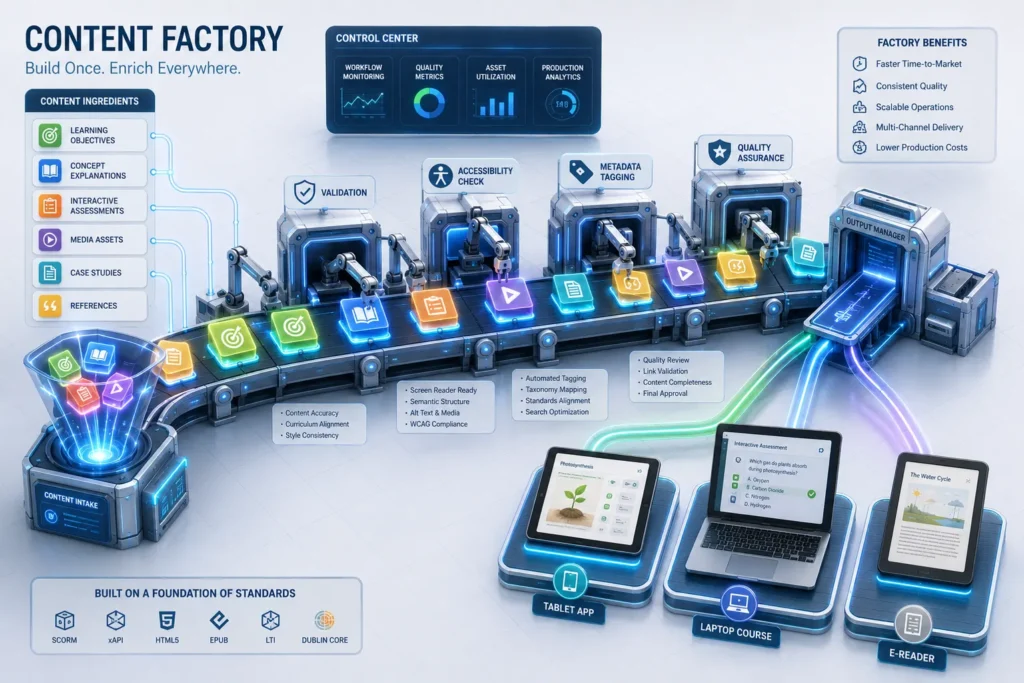
What Is A Content Factory Model?

A content factory is not about producing content faster at the expense of quality.

Instead, it focuses on building repeatable systems that support:

  • Consistent workflows
  • Reusable content assets
  • Standardized quality controls
  • Multi-format publishing
  • Efficient resource utilization

The goal is to create an operational environment where content can move smoothly from development through delivery regardless of production volume.

Build Around Structured Content

Structured content forms the foundation of a scalable publishing operation.

Rather than treating content as static pages, publishers organize information into reusable components such as:

  • Learning objectives
  • Assessments
  • Figures
  • Tables
  • Activities
  • Glossaries
  • Reference materials

This approach allows content to be updated, reused, and distributed more efficiently.

Benefits Of Structured Content

  • Faster revisions
  • Improved consistency
  • Easier content reuse
  • Better version control
  • Simplified multi-channel publishing

Structured workflows help publishers scale without multiplying production effort.

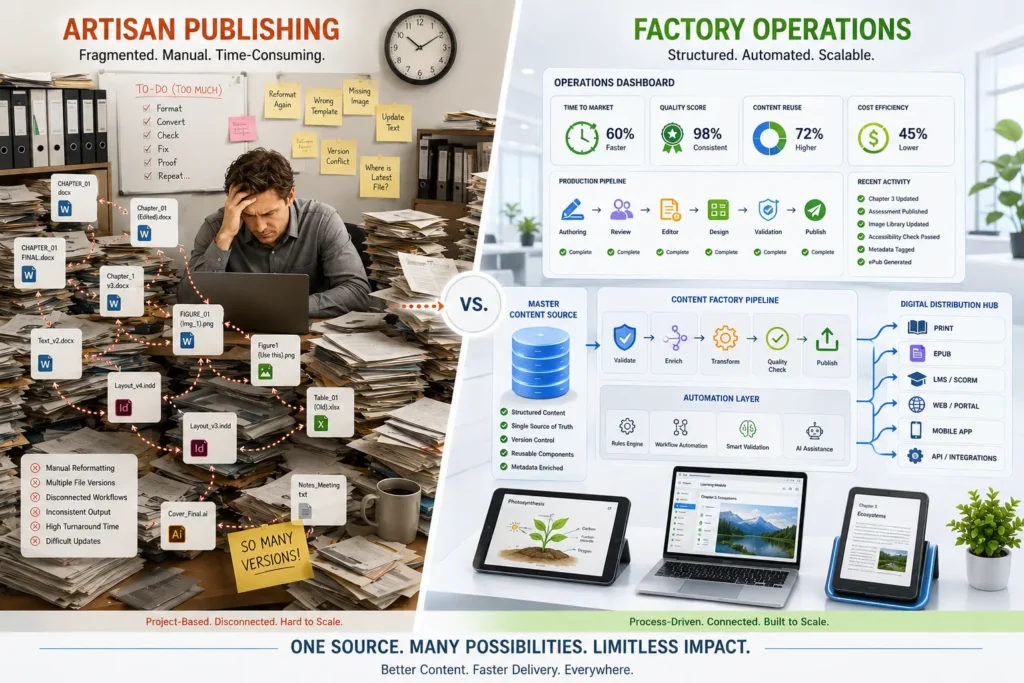
Compare Traditional Production And Content Factory Operations

Traditional Production

Scalable Content Factory

Project-based workflows

Process-driven workflows

Multiple content versions

Single-source content management

Manual production tasks

Automated workflow support

Limited reuse

Modular content architecture

Fixed production capacity

Flexible scalability

The difference lies in building systems that support growth rather than relying solely on additional resources.

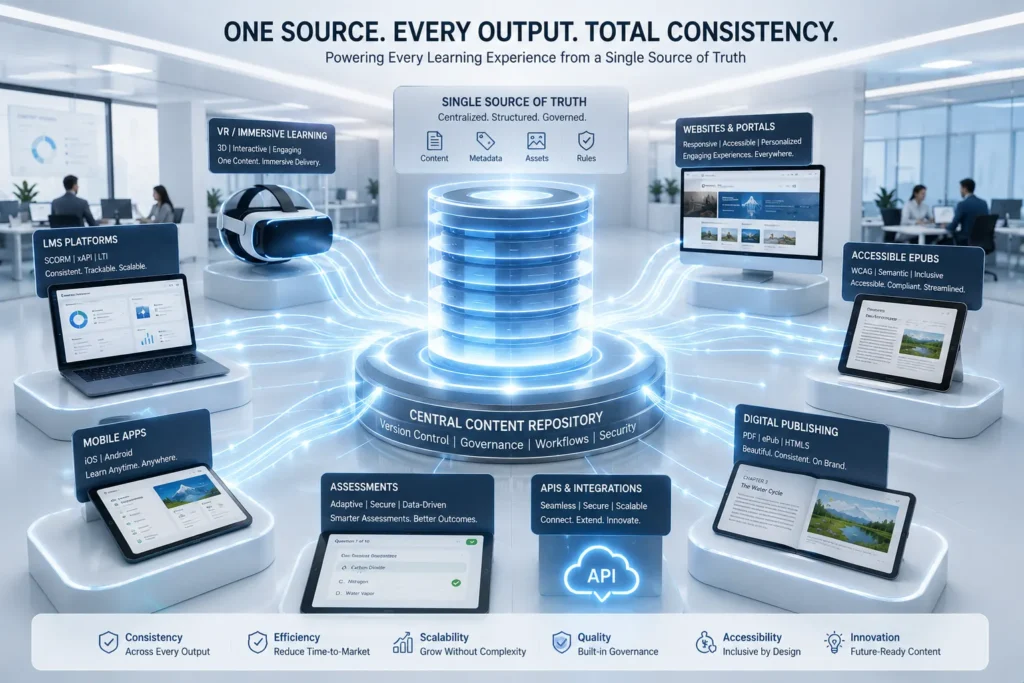
Create A Single Source Of Truth

One of the biggest obstacles to scalability is managing multiple versions of the same content.

Publishers often maintain separate files for:

  • Print editions
  • Digital products
  • Learning platforms
  • Mobile applications
  • Assessment systems

This creates duplication and increases maintenance effort.

A centralized content repository allows publishers to manage content from a single source while generating multiple outputs as needed.

This improves both efficiency and consistency.

Standardize Production Processes

Scalable operations require predictable workflows.

Publishers should establish clear standards for:

  • Content development
  • Editorial review
  • Design processes
  • Accessibility validation
  • Quality assurance
  • Final delivery

Standardization reduces uncertainty and helps teams work more efficiently.

It also simplifies onboarding and knowledge transfer as organizations grow.

Integrate Accessibility Into The Workflow

Accessibility is increasingly becoming a core publishing requirement.

Treating accessibility as a separate activity can create production delays and additional costs.

Instead, scalable content factories incorporate accessibility from the beginning through:

  • Structured content models
  • Semantic markup
  • Alternative text workflows
  • Accessibility review checkpoints
  • Consistent compliance standards

This reduces remediation effort while improving content quality.

Support Workflow Automation Where Appropriate

Automation can help reduce repetitive manual activities.

Examples include:

  • Metadata generation
  • Content validation
  • Workflow routing
  • Version tracking
  • Quality-control checks
  • Production reporting

Automation is most effective when applied to routine operational processes rather than editorial decision-making.

Human expertise remains essential for educational quality and instructional effectiveness.

Build Flexible Capacity

Educational publishing demand often fluctuates throughout the year.

Curriculum updates, new product launches, and institutional adoption cycles can create sudden production surges.

A scalable content factory should support:

  • Resource flexibility
  • Specialized expertise access
  • Capacity expansion when needed
  • Efficient workload distribution

Flexibility helps publishers maintain delivery schedules without creating long-term operational inefficiencies.

Practical Publishing Scenario

A publisher manages textbooks, digital learning products, assessments, and teacher resources across multiple educational markets. As content demand grows, production teams experience recurring bottlenecks, duplicate effort, and delayed updates.

The organization transitions to a structured content model supported by a centralized repository, standardized workflows, accessibility integration, and automated validation processes. Content components become reusable across multiple products, allowing teams to manage larger content volumes with greater efficiency.

The result is a more scalable publishing operation capable of supporting future growth without sacrificing quality.

FAQs

I am item content. Click edit button to change this text. Lorem ipsum dolor sit amet, consectetur adipiscing elit. Ut elit tellus, luctus nec ullamcorper mattis, pulvinar leo.

I am item content. Click edit button to change this text. Lorem ipsum dolor sit amet, adipiscing elit. Ut elit tellus, luctus nec mattis, pulvinar dapibus leo.

I am item content. Click edit button to change this text. Lorem ipsum dolor sit amet, consectetur adipiscing elit. Ut elit tellus, luctus ullamcorper mattis, pulvinar dapibus leo.

I am item content. Click edit button to change this text. Lorem ipsum dolor sit amet, consectetur adipiscing elit. Ut luctus nec ullamcorper mattis, pulvinar dapibus leo.

I am item content. Click edit button to change this text. Lorem ipsum dolor sit amet, adipiscing elit. Ut elit tellus, luctus nec ullamcorper mattis, pulvinar dapibus leo.