

How Assessment Providers Manage Large-Scale Examination Content Production

Coordinating Accuracy, Consistency, and Scalability Across Thousands of Assessment Materials

Assessment providers often manage examination programs that serve thousands—or even millions—of learners across multiple regions, grade levels, and subject areas. Producing a single examination paper requires extensive planning, review, formatting, quality assurance, and distribution processes. Content creation becomes a very structured process when hundreds of assessments need to be created at once.

Writing questions is only one aspect of producing exam content on a large scale. Assessment providers must coordinate subject matter experts, editors, instructional specialists, production teams, quality reviewers, and technology platforms to ensure that every assessment meets academic, regulatory, and operational requirements.

Why Large-Scale Assessment Production Is Challenging

Examination content must be accurate, secure, consistent, and aligned with curriculum standards.

Large assessment programs often involve:

  • Multiple subjects
  • Various grade levels
  • Different examination versions
  • Print and digital delivery formats
  • Accessibility requirements
  • Regional curriculum variations

Managing these variables requires structured workflows and rigorous production controls.

Without standardized processes, maintaining consistency across large assessment portfolios becomes difficult.

The Examination Content Production Lifecycle

Large-scale assessment development typically follows a multi-stage production process.

Content Authoring

The process begins with subject matter experts creating assessment items aligned with learning objectives and curriculum standards.

Assessment content may include:

  • Multiple-choice questions
  • Short-answer questions
  • Essay prompts
  • Scenario-based assessments
  • STEM problem-solving exercises

Question development follows predefined assessment frameworks.

Editorial Review

Editorial teams review assessment content for:

  • Language clarity
  • Instruction consistency
  • Question quality
  • Formatting standards
  • Assessment fairness

This stage helps eliminate ambiguities before production begins.

Technical Production

Once content is approved, production teams prepare materials for publication.

This often includes:

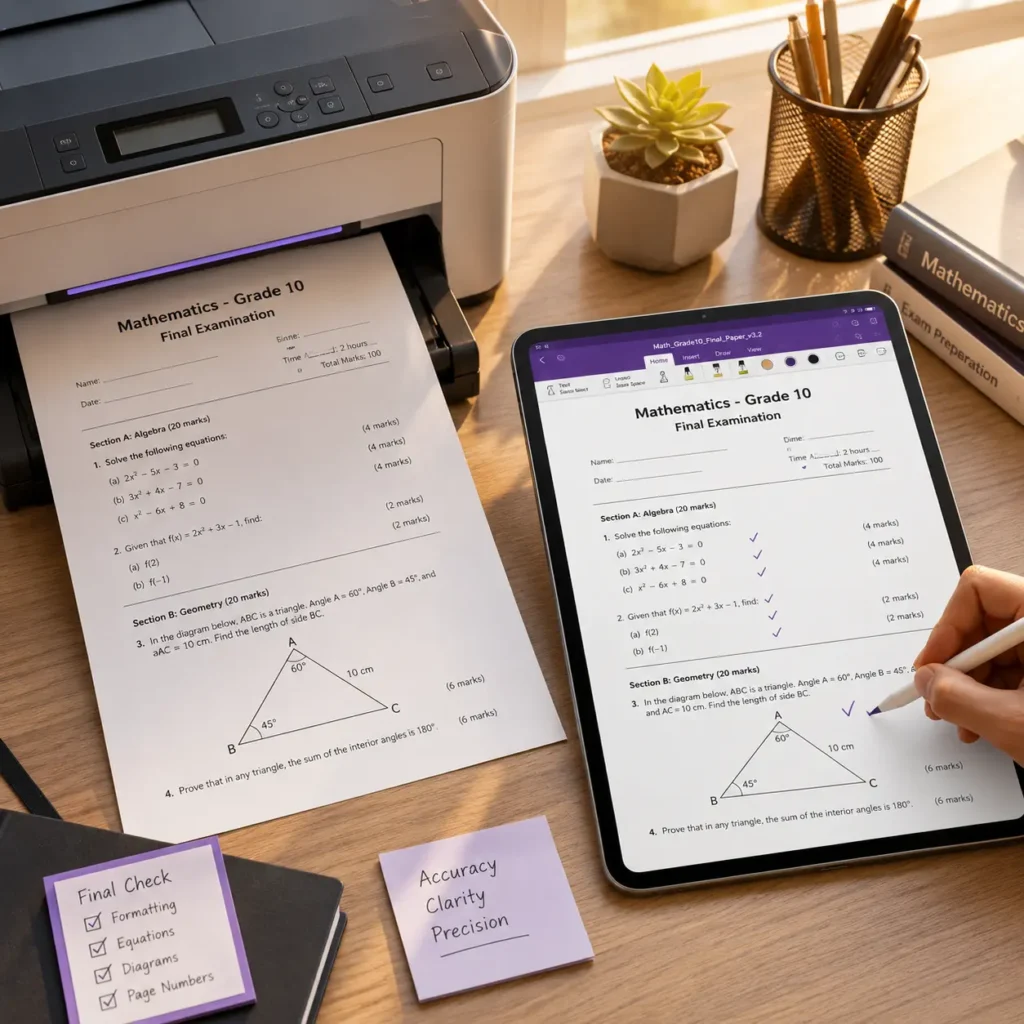
  • Typesetting examination papers
  • Formatting mathematical equations
  • Creating tables and diagrams
  • Applying style standards
  • Preparing print and digital outputs

Technical production ensures visual consistency across all examination materials.

Managing Large Assessment Item Banks

Modern assessment providers maintain extensive question repositories.

These item banks may contain:

  • Thousands of approved questions
  • Difficulty-level classifications
  • Subject-based categorization
  • Learning objective mappings
  • Historical usage records

Structured item banks help assessment teams efficiently build new examination papers while maintaining content balance.

Benefits Of Centralized Question Banks

A centralized repository helps organizations:

  • Reuse approved content
  • Improve version control
  • Reduce duplication
  • Maintain assessment consistency
  • Accelerate exam development cycles

Content management becomes significantly easier when assessment resources are organized systematically.

Comparing Traditional And Modern Examination Production

Traditional Process

Modern Production Workflow

Manual content tracking

Centralized content management

Paper-based reviews

Digital review workflows

Independent production files

Structured content repositories

Limited content reuse

Managed assessment item banks

Manual version control

Automated tracking systems

Modern workflows improve visibility and scalability while supporting quality assurance requirements

Supporting Print And Digital Examination Delivery

Assessment providers increasingly support multiple delivery formats.

These may include:

  • Printed examination papers
  • PDF assessments
  • Computer-based testing
  • LMS-integrated assessments
  • Accessible examination formats

A single examination often needs to maintain consistency across several delivery channels.

This requirement has increased demand for structured content production workflows.

Best Practices For Large-Scale Assessment Production

Successful assessment organizations typically implement several operational practices.

Establish Standardized Templates

Templates improve consistency across examination series.

Maintain Structured Content Repositories

Centralized repositories support efficient content management and version control.

Implement Multi-Stage Review Processes

Independent reviews improve quality and reduce production risks.

Use Production Workflows That Support Scalability

Structured workflows allow organizations to manage growing assessment volumes without compromising quality.

A Practical Examination Production Scenario

An assessment provider is preparing end-of-year examinations for multiple grade levels across mathematics, science, and language arts.

The project includes hundreds of examination papers, thousands of assessment items, and both print and digital delivery requirements.

Subject matter experts develop questions, editors review content quality, production teams prepare formatted examination papers, and quality assurance specialists conduct final validation checks.

Through centralized content management and structured workflows, the organization maintains consistency while delivering large volumes of assessment materials on schedule.

Building Reliable Examination Programs At Scale

A balance between academic knowledge, editorial supervision, technical production, and operational discipline is necessary for large-scale examination production. Assessment providers may effectively produce high-quality test materials while preserving consistency, accuracy, and learner confidence across all assessment programs by investing in structured content management, standardised workflows, and thorough quality assurance procedures

FAQ

It is the process of developing, reviewing, formatting, managing, and distributing large volumes of assessment materials across multiple subjects and learner groups.

Question banks help organize approved assessment content, improve reuse, and support efficient examination development.

Quality assurance helps ensure content accuracy, consistency, formatting quality, and curriculum alignment before publication

They use structured content workflows that support print, PDF, digital testing, LMS delivery, and accessible outputs from a controlled content source.

Large assessment programs often involve thousands of questions and multiple examination versions, making scalable workflows essential for maintaining quality and meeting deadlines.
