
AI Vs Manual Typesetting: What Educational Publishers Should Know

Educational publishers are under constant pressure to produce high-quality learning materials while managing tight schedules, multiple formats, and increasing content volumes. From textbooks and assessment papers to digital learning resources and instructor guides, typesetting remains one of the most important stages in the publishing process.

As artificial intelligence becomes more integrated into publishing workflows, many organizations are evaluating whether AI-driven typesetting can replace or complement traditional manual typesetting. Even if AI greatly increases productivity, human knowledge is still essential for guaranteeing publishing quality.

Publishers can make well-informed production decisions by being aware of the advantages and disadvantages of both strategies.

Why Typesetting Still Matters In Educational Publishing

Typesetting is more than arranging text on a page. It ensures that educational content is presented clearly, consistently, and accurately.

Well-executed typesetting supports:

  • Better readability
  • Consistent learning experiences
  • Accurate assessment presentation
  • Professional publication quality
  • Improved accessibility
  • Multi-format publishing requirements

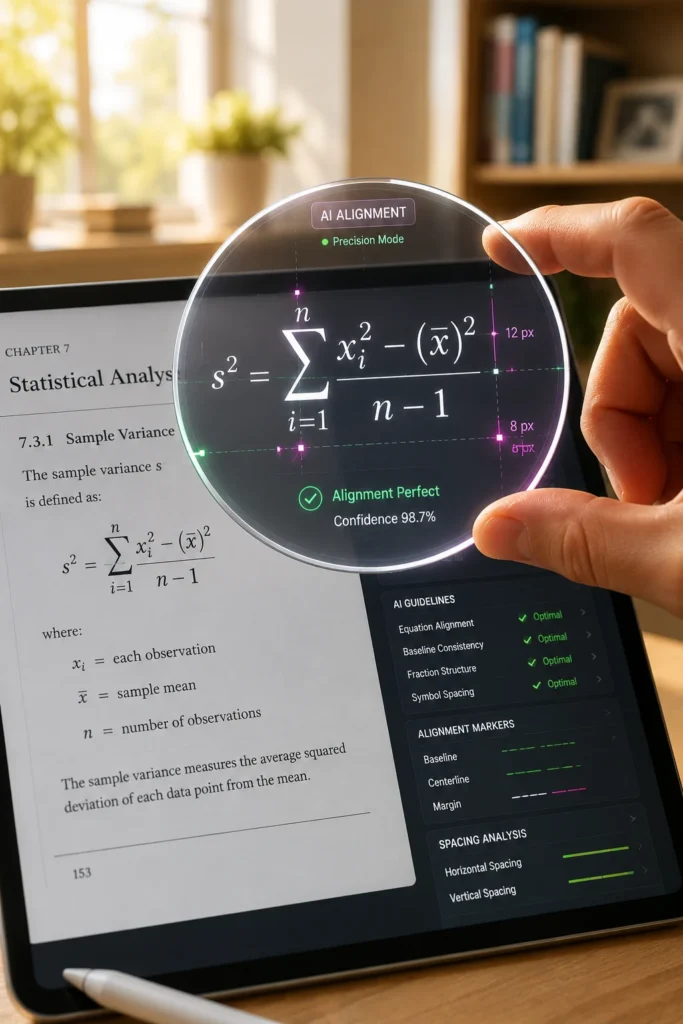
Educational materials often contain complex elements such as equations, tables, diagrams, references, and structured learning components that require careful formatting.

What AI-Powered Typesetting Can Do

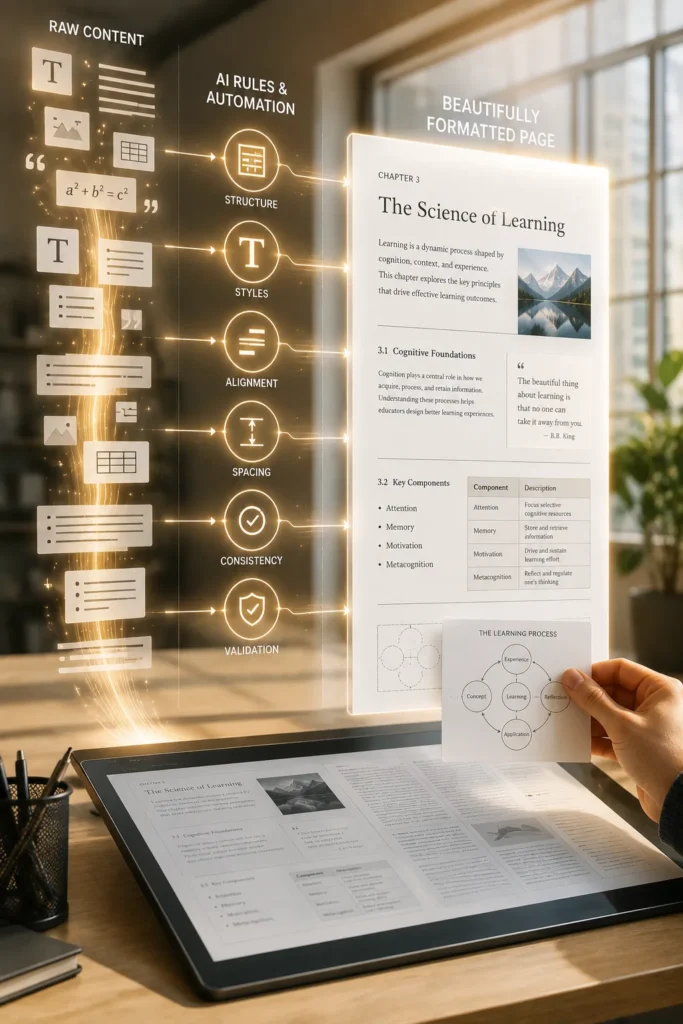
AI-assisted typesetting tools are designed to automate repetitive formatting tasks and improve production efficiency.

Common capabilities include:

  • Layout standardization
  • Style application
  • Metadata handling
  • Content categorization
  • Template compliance checks
  • Formatting validation

AI can quickly process large volumes of content while applying predefined publishing rules.

Benefits Of AI-Assisted Typesetting
  • Faster production cycles
  • Reduced manual formatting effort
  • Improved consistency
  • Better scalability
  • Automated quality checks
  • Streamlined workflow management

These advantages make AI particularly useful for large publishing programs with standardized layouts.

Where Manual Typesetting Remains Essential

Despite advances in automation, educational publishing often involves content that requires human judgment.

Manual typesetting is especially valuable when working with:

  • Complex mathematical equations
  • Scientific diagrams
  • Engineering content
  • Assessment materials
  • Custom page designs
  • Interactive learning resources

Human specialists can identify contextual issues that automated systems may overlook.

For example, a mathematical formula may be technically correct but visually unclear within a particular layout. Skilled typesetters can modify presentation to enhance student comprehension.

AI Vs Manual Typesetting Comparison

Area

AI-Assisted Typesetting

Manual Typesetting

Speed

Very fast

Slower

Scalability

High

Moderate

Consistency

Strong for standard layouts

Depends on process controls

Complex Content Handling

Limited in some cases

Strong

Creative Layout Decisions

Limited

Excellent

Human Judgment

Minimal

Extensive

Quality Oversight

Automated checks

Expert review

Rather than regarding them as conflicting alternatives, the most successful publication workflows frequently integrate both strategies.

Managing Mathematical And Technical Content

Educational publishers frequently produce materials containing:

  • Mathematical notation
  • Scientific formulas
  • Engineering diagrams
  • Data tables
  • Assessment items

These elements require precise formatting and validation.

Challenges For Automated Typesetting

AI systems may occasionally struggle with:

  • Multi-line equations
  • Specialized notation
  • Complex diagram placement
  • Context-sensitive formatting decisions
  • Unusual content structures

Human review remains essential to ensure accuracy and usability in these situations.

Quality Assurance Considerations

Publishing accuracy depends on more than layout automation.

Quality assurance should verify:

  • Formatting consistency
  • Equation rendering
  • Table alignment
  • Reference accuracy
  • Accessibility compliance
  • Template adherence
AI-Assisted QA Vs Traditional QA

Traditional Review

AI-Assisted Review

Manual inspections

Automated validation

Visual checking

Pattern detection

Time-intensive reviews

Faster issue identification

Reviewer-driven corrections

Automated alerts plus review

AI can help identify potential issues earlier, but final approval typically benefits from human oversight.

Finding The Right Balance

Rather than replacing manual typesetting entirely, many educational publishers are adopting hybrid workflows.

In a hybrid approach:

AI Handles
  • Template application
  • Style enforcement
  • Initial formatting
  • Metadata validation
  • Routine quality checks
Publishing Specialists Handle
  • Complex layouts
  • Technical content
  • Final reviews
  • Accessibility verification
  • Publication approval

This balance helps organizations improve efficiency while maintaining quality standards.

Practical Publishing Scenario

Consider an assessment publisher producing thousands of examination papers annually. AI-assisted typesetting can automatically apply formatting templates, organize question structures, and validate layout consistency.

To guarantee correctness and readability, however, professional publishing specialists are still needed for scientific illustrations, mathematical formulae, and final assessment checks.

By combining automation with expert oversight, the organization can accelerate production while maintaining the quality expected in high-stakes educational content.

Building Smarter Typesetting Workflows

The discussion is no longer about choosing AI or manual typesetting exclusively. Educational publishers increasingly benefit from combining automation with human expertise. AI can accelerate routine formatting and validation tasks, while skilled publishing professionals ensure complex content remains accurate, accessible, and effective for learners. Organizations that integrate both approaches thoughtfully can improve productivity while maintaining the high publishing standards that educational content demands.

FAQ

AI-assisted typesetting uses automated tools to apply formatting rules, manage layouts, and support publishing workflows.

Not in most educational publishing environments. Human expertise remains important for handling complex content and quality assurance.

The primary benefits include faster production, improved consistency, scalability, and reduced manual formatting effort

Manual typesetting provides human judgment, layout refinement, and specialized handling of technical and educational content.

For most organizations, a hybrid approach that combines AI automation with expert review delivers the best balance of efficiency and quality
