How AI and Automation Are Transforming Engineering DTP and Multilingual Publishing

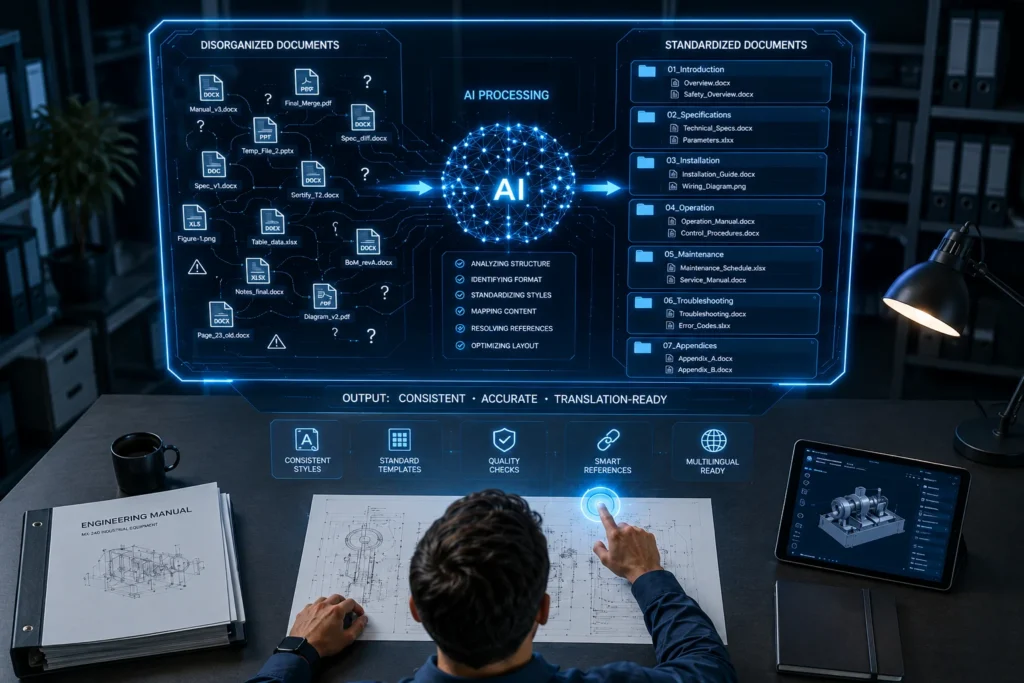
Engineering organizations manage thousands of technical documents throughout a product’s lifecycle, including user manuals, maintenance guides, installation instructions, service bulletins, and compliance documents. As products evolve and reach new global markets, updating these materials manually becomes increasingly time-consuming. AI and automation are helping engineering teams improve document production by reducing repetitive tasks, supporting consistency, and simplifying multilingual publishing for left-to-right (LTR) languages.

Why Traditional Engineering Publishing Workflows Face Challenges

Engineering documentation often undergoes multiple revisions before a product reaches customers. Every product update may require changes across several documents, diagrams, tables, and specifications.

When these updates are managed manually, organizations may experience:

  • Repetitive formatting work
  • Inconsistent layouts across documents
  • Delayed publishing cycles
  • Higher review effort
  • Increased risk of formatting errors
  • Difficulty maintaining multiple language editions

AI-assisted workflows help address these challenges by automating routine publishing activities while allowing technical experts to focus on content accuracy.

Where AI Adds Value in Engineering DTP

Artificial intelligence is not replacing technical writers or desktop publishing specialists. Instead, it supports repetitive production tasks that consume valuable time.

Intelligent Content Preparation

AI can identify formatting inconsistencies, detect missing elements, organize document structures, and prepare files for publishing workflows. This reduces manual corrections before localization begins.

Terminology Consistency

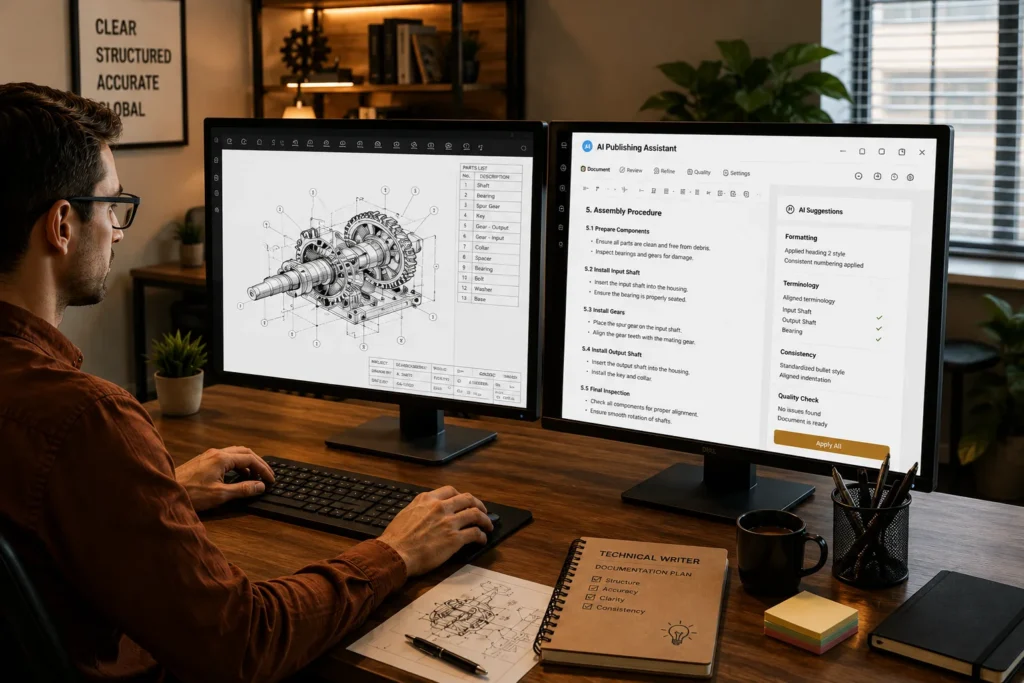
Engineering documentation depends on consistent terminology. AI-assisted terminology checks help identify variations in product names, component descriptions, warnings, and technical instructions, improving document quality across projects.

Automated Quality Checks

Modern publishing workflows can automatically review:

  • Missing headings
  • Incorrect numbering
  • Table inconsistencies
  • Broken references
  • Style violations
  • Incomplete figure captions

Early detection reduces editing effort during later production stages.

Automation in Engineering Desktop Publishing

Automation extends beyond document creation. It streamlines repetitive layout and production tasks that traditionally required significant manual effort.

Common automated publishing activities include:

  • Applying document templates
  • Updating paragraph and character styles
  • Generating tables of contents
  • Managing cross-references
  • Formatting large specification tables
  • Producing consistent PDF outputs
  • Preparing editable files for multilingual publishing

These capabilities help maintain consistent document quality while reducing production time.

AI-Supported Publishing vs Traditional Publishing

Traditional Workflow

AI-Assisted Workflow

Manual formatting

Automated style application

Repeated quality reviews

Intelligent validation checks

Inconsistent terminology

Standardized terminology verification

Lengthy document updates

Faster content revisions

Separate formatting for each edition

Reusable publishing templates

Higher production effort

Improved workflow efficiency

AI supports publishing teams by reducing repetitive activities rather than replacing technical expertise.

How AI Improves Multilingual Publishing

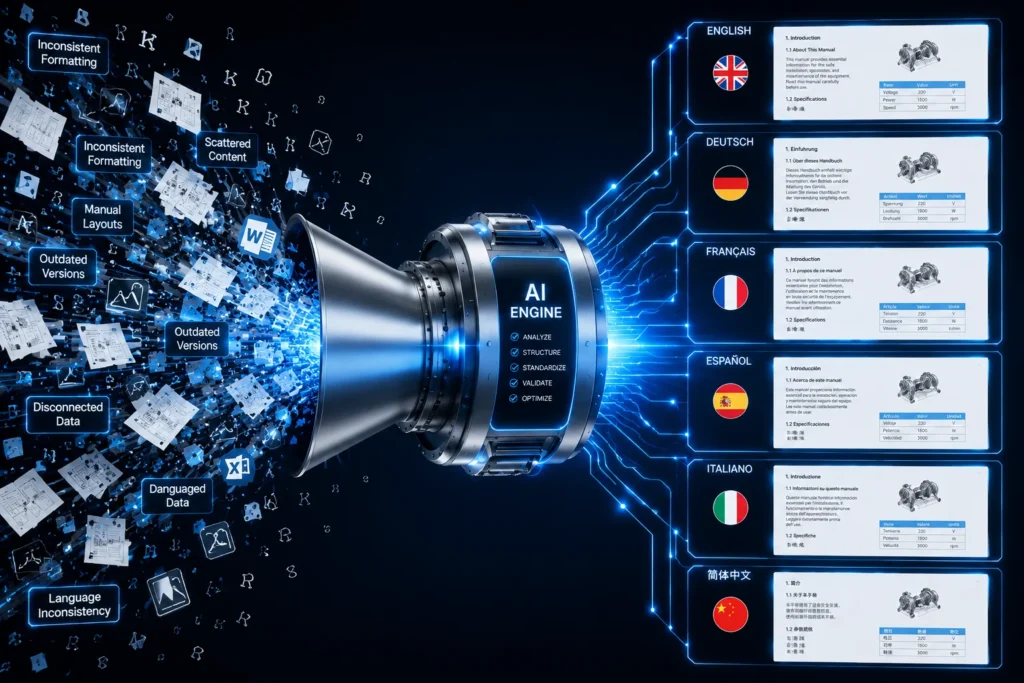
Engineering companies frequently publish documentation in several left-to-right languages. Every translated edition must preserve technical accuracy while maintaining consistent formatting.

AI supports multilingual publishing by helping teams:

Prepare Structured Source Files

Well-organized documents are easier to localize and maintain across multiple language editions.

Improve Translation Consistency

AI-assisted terminology validation helps ensure identical technical concepts are translated consistently throughout related documents.

Reduce Manual Desktop Publishing

Automation can apply predefined formatting rules across translated files, minimizing layout corrections and reducing production time.

Support Faster Document Updates

When source documentation changes, structured publishing workflows allow only revised sections to move through translation and publishing, improving efficiency for ongoing product updates.

Practical Engineering Publishing Scenario

An engineering manufacturer maintains installation manuals, maintenance procedures, safety documentation, and technical catalogs for multiple product lines. Product updates occur several times each year, requiring documentation revisions in several LTR languages.

By combining AI-assisted terminology management with automated desktop publishing workflows, the organization standardizes document templates, performs automated quality checks, and accelerates multilingual production. Publishing teams spend less time correcting layouts and more time validating technical accuracy, resulting in faster release cycles and improved document consistency.

Best Practices for Adopting AI in Engineering DTP

Organizations can maximize the benefits of AI and automation by following structured publishing practices.

  • Maintain editable source files.
  • Standardize document templates across departments.
  • Use consistent paragraph and character styles.
  • Separate text from graphical elements.
  • Establish approved technical terminology.
  • Include automated quality validation before publishing.
  • Review AI-assisted outputs with technical experts before release.

Combining automation with human review helps maintain both efficiency and technical reliability.

Building Smarter Engineering Publishing Workflows

AI and automation are reshaping engineering desktop publishing by simplifying repetitive production activities while supporting high-quality documentation. When combined with structured document design and expert review, these technologies improve efficiency, strengthen consistency, and make multilingual publishing more manageable. Engineering organizations that adopt AI-assisted publishing workflows are better positioned to maintain accurate technical documentation, respond to product changes more quickly, and support global communication with greater confidence.

Frequently Asked Questions

It is the use of artificial intelligence and automation to support document formatting, quality checks, terminology consistency, and multilingual publishing workflows.

Automation reduces repetitive formatting tasks, improves consistency, accelerates document updates, and supports standardized publishing processes.

AI helps prepare structured documents, improves terminology consistency, assists quality control, and reduces manual desktop publishing effort across multiple LTR language editions.

Organizations can improve productivity, reduce publishing costs, strengthen document consistency, accelerate release cycles, enhance governance, and support better decision-making.

User manuals, installation guides, maintenance manuals, technical specifications, service documentation, product catalogs, safety instructions, and compliance documents are well suited to AI-supported publishing workflows.
