InDesign Workflow Strategies for Higher Education Publishing Companies
Why Workflow Efficiency Matters in Higher Education Publishing
Higher education publishing operates in a uniquely demanding environment. Unlike many educational products that are revised periodically, university-level content often requires continuous updates driven by academic research, curriculum changes, accreditation requirements, and evolving industry standards.
A typical higher education publisher may be responsible for producing textbooks, instructor guides, laboratory manuals, research-based learning resources, assessment materials, and digital companion content across multiple disciplines. Managing these resources efficiently requires more than strong editorial practices—it requires a production workflow capable of handling complexity at scale.
As a result, many publishing organizations focus heavily on workflow design as a way to improve productivity, maintain quality, and accelerate time to market.

The Challenge of Managing Large Academic Publications
Higher education content is often more complex than general educational material.
A university textbook may contain:
- Technical diagrams
- Research references
- Citations and bibliographies
- Mathematical equations
- Data tables
- Academic illustrations
- Assessment sections
- Supplemental resources
When multiple contributors are involved, maintaining consistency across hundreds of pages can become a significant operational challenge.
Without a structured workflow, formatting issues, version-control problems, and production delays can quickly accumulate
Building a Template-Driven Production Process
Many successful higher education publishers begin by standardizing their publication structure before production starts.
Instead than creating each textbook on their own, teams frequently develop reusable frameworks for:
- Chapter openers
- Learning objectives
- Case studies
- Assessment sections
- Reference pages
- Figure and table placements
This approach reduces repetitive design work and creates a consistent experience across an entire publishing portfolio.
Separating Editorial and Production Responsibilities
One strategy frequently adopted by higher education publishers is the clear separation of editorial activities and production activities.
Editorial teams typically focus on:
- Content development
- Peer reviews
- Academic accuracy
- Author communication
- Curriculum alignment
Production teams concentrate on:
- Layout implementation
- Page composition
- Content formatting
- Graphic integration
- Publication preparation
By defining responsibilities clearly, organizations can reduce bottlenecks and improve overall workflow efficiency.
Managing Revisions More Effectively
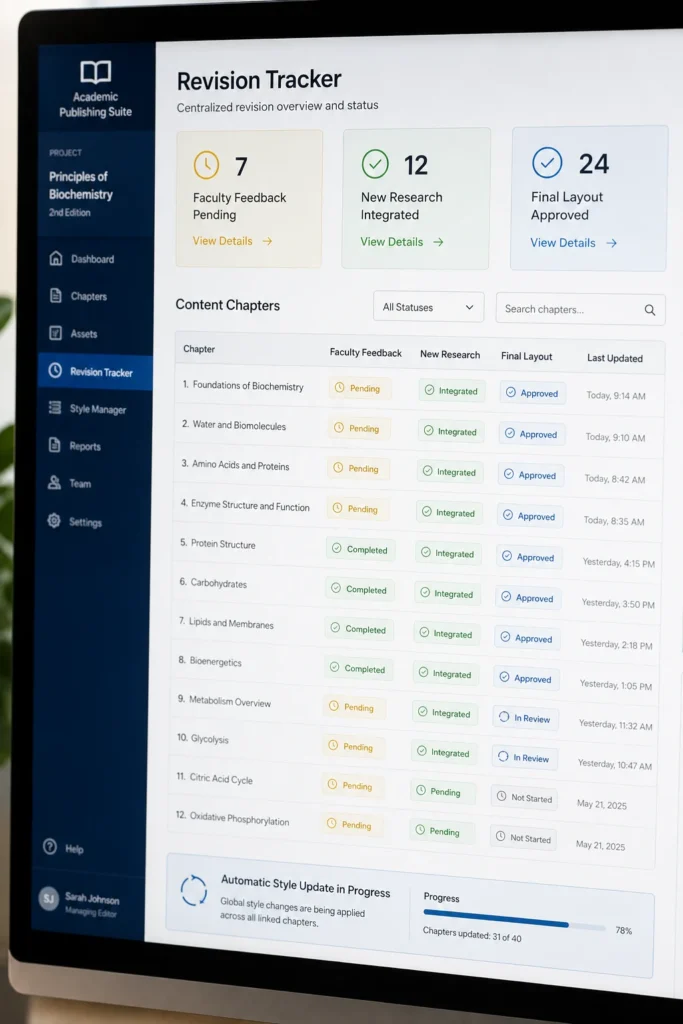
Academic content is rarely finalized after a single review cycle.
Publishers often encounter:
- Faculty feedback
- Author revisions
- Updated research findings
- New accreditation requirements
- Content corrections
A structured workflow helps teams manage revisions without disrupting the entire publication process. Instead of making manual changes across multiple documents, updates can be applied systematically through established production standards.
Supporting Multi-Format Publishing
University students increasingly consume content through multiple channels.
A single publication may need to be delivered as:
- Printed textbooks
- Digital course materials
- Interactive PDFs
- Online learning resources
- Faculty support materials
Publishing companies often develop workflows that allow content to move efficiently between these formats while maintaining consistency in structure and presentation
A Real-World Publishing Scenario
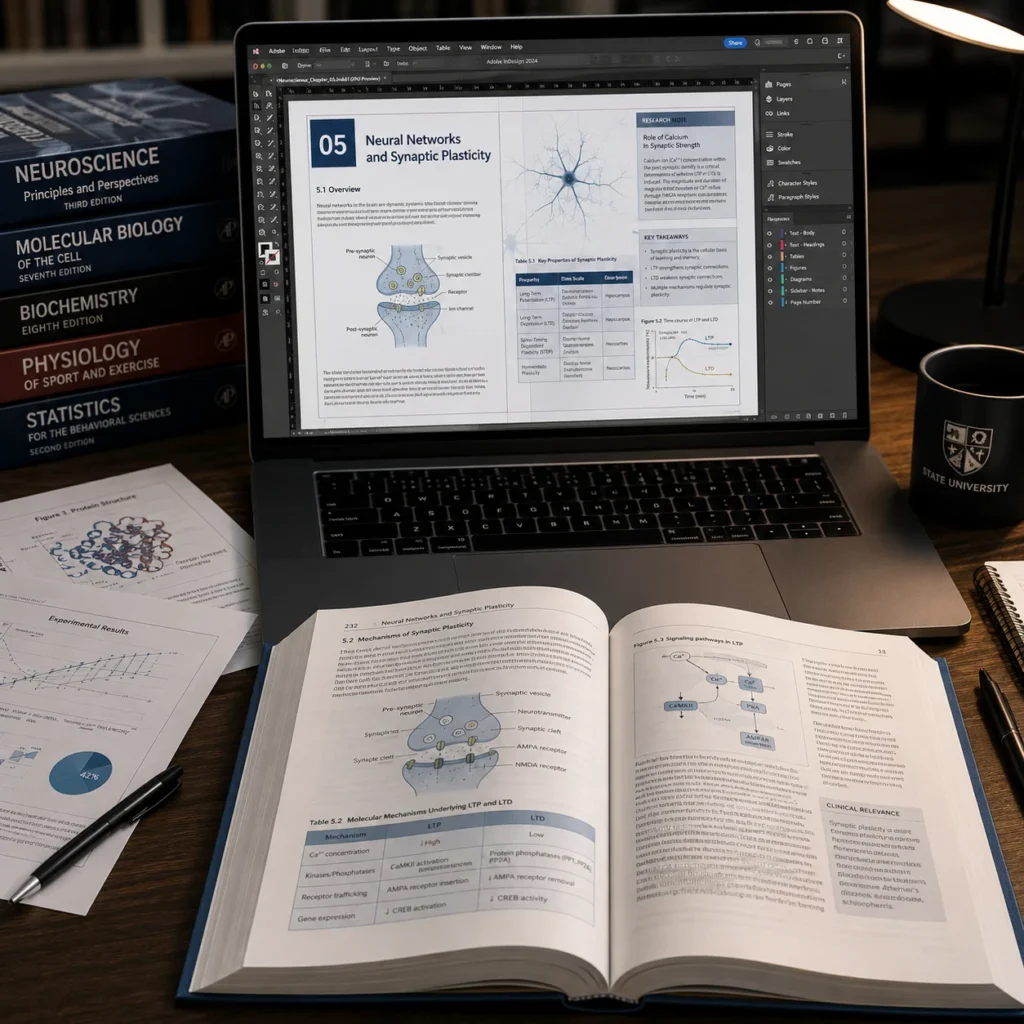
Imagine a higher education publisher preparing a new engineering textbook.
Numerous authors, technical reviewers, editors, and designers have contributed to the project. Additional changes are needed during production to include updated case studies and new industry requirements.
Rather than redesigning large sections of the publication, the team follows an established workflow that allows updates to be integrated systematically. Templates, standardized layouts, and production guidelines help maintain consistency while keeping the project on schedule.
Why Scalable Workflows Create Long-Term Value
As publishing portfolios expand, workflow efficiency becomes increasingly important.
Organizations that invest in structured production processes often gain advantages such as:
- Faster publication cycles
- Improved consistency
- Better version control
- Reduced production errors
- Easier collaboration
- More efficient resource allocation
These benefits become particularly valuable when managing multiple academic titles simultaneously.
The Future of Higher Education Publishing Workflows
The demands placed on higher education publishers continue to grow as institutions require more content, faster updates, and support for multiple learning formats. In this environment, workflow design becomes a strategic advantage rather than an operational detail. By implementing structured production processes, standardized templates, and scalable content management practices, publishing companies can improve efficiency while maintaining the academic quality that higher education audiences expect.
FAQ
Higher education content often includes complex layouts, academic references, technical content, and multiple review cycles that require structured production processes.
Managing revisions while maintaining consistency across large and complex publications is one of the most common challenges.
Templates help standardize content structure, reduce repetitive work, and improve consistency across multiple publications.
Many organizations use structured workflows that separate editorial review from production implementation, making updates easier to manage.
Yes. Many higher education publishers develop unified production workflows that support multiple delivery formats from a common content foundation.

ValueDocs India offer the most competent multilingual typesetting services that are best in the industry. Typesetting services includes all aspects of designing a book.