

How Educational Publishers Can Reduce Production Costs Without Sacrificing Quality

Educational publishers face a constant balancing act. Rising production costs, increasing content volumes, shorter publication schedules, and expanding digital delivery requirements all place pressure on publishing budgets. At the same time, educators, institutions, and learners continue to expect high-quality content, accurate formatting, accessibility compliance, and seamless digital experiences.

Reducing costs may seem like it requires compromising quality, but many publishers are discovering that smarter production strategies can improve efficiency while maintaining the standards their customers expect.

Understanding Where Production Costs Originate

Before reducing costs, publishers need to identify the areas that generate the highest production expenses.

Common cost drivers include:

  • Manual formatting and layout work
  • Multiple rounds of corrections
  • Content rework
  • Version management challenges
  • Accessibility remediation
  • Repetitive quality-control processes
  • Separate workflows for print and digital outputs

In many cases, inefficiencies within workflows create greater costs than the actual content production itself.

A detailed workflow review often reveals opportunities for meaningful savings.

Reduce Rework Through Better Upstream Processes

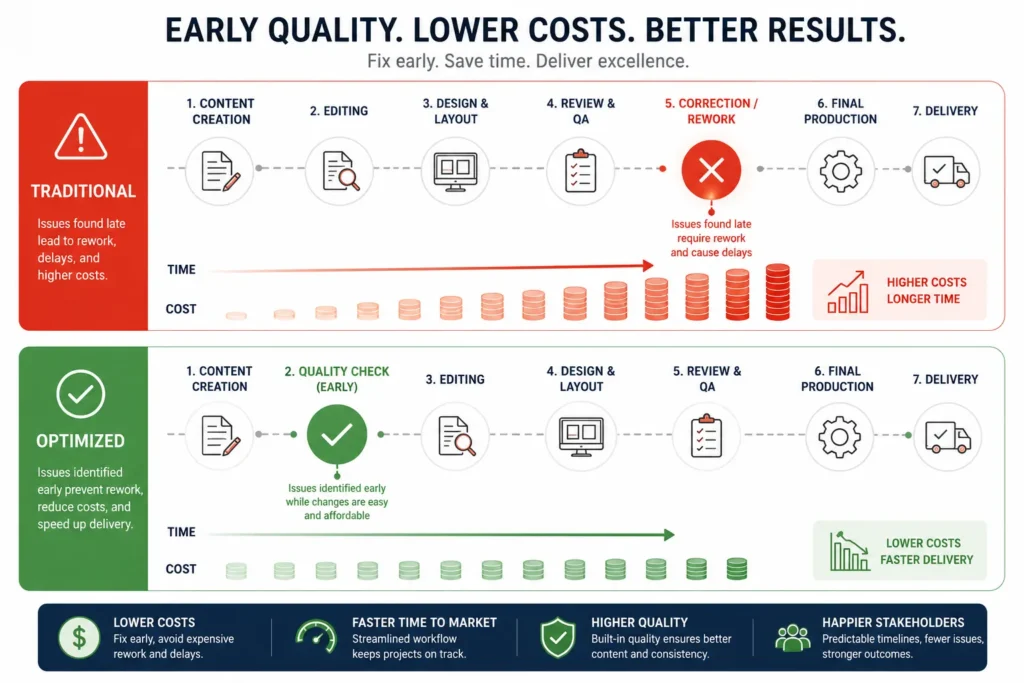
One of the most expensive aspects of publishing production is rework.

Errors introduced during manuscript preparation frequently create additional costs during design, typesetting, quality assurance, and final production stages.

Publishers can reduce rework by:

  • Establishing clear author guidelines
  • Standardizing editorial processes
  • Using structured content templates
  • Implementing early-stage quality reviews
  • Defining consistent production standards

Preventing issues early is often significantly less expensive than correcting them later

Compare Traditional And Streamlined Production Models

Many publishers still rely on fragmented workflows that require repeated manual intervention.

The difference between traditional and optimized production models can be substantial.

Traditional Production Model

Streamlined Production Model

Multiple manual handoffs

Standardized workflows

Repeated content corrections

Early quality validation

Separate print and digital processes

Unified content management

High dependency on manual tasks

Greater process automation

Frequent version-control issues

Centralized content oversight

Streamlined workflows help publishers improve consistency while lowering operational costs.

Adopt Single-Source Publishing Strategies

Maintaining separate content files for different formats often increases production effort.

A single-source publishing approach allows publishers to create content once and generate multiple outputs from the same source.

Benefits include:

  • Reduced duplication of work
  • Faster updates
  • Improved consistency
  • Better version control
  • Lower maintenance costs

This approach becomes especially valuable when producing content for print, EPUB, online learning platforms, and digital resource libraries.

Improve Efficiency Through Structured Content

Structured content workflows help publishers manage educational materials more efficiently.

Rather than focusing solely on page layouts, content is organized into reusable components such as:

  • Learning objectives
  • Assessment questions
  • Figures
  • Tables
  • References
  • Glossaries

Structured content supports:

  • Content reuse
  • Multi-channel publishing
  • Faster updates
  • Improved accessibility workflows
  • Simplified content management

As content volumes increase, these efficiencies can significantly reduce long-term production expenses.

Optimize Outsourcing For Specialized Production Tasks

Many publishers successfully reduce costs by outsourcing specialized production activities to experienced publishing partners.

Common outsourced services include:

  • Typesetting
  • EPUB production
  • XML conversion
  • Accessibility remediation
  • Artwork adaptation
  • Quality assurance support

The goal is not simply cost reduction but access to scalable production capacity and specialized expertise.

Publishers can often improve turnaround times while maintaining quality standards through carefully managed outsourcing partnerships.

Use Technology To Support Quality Control

Technology can help publishers improve quality while reducing manual review effort.

Examples include:

  • Automated preflight checks
  • Accessibility validation tools
  • Content consistency checks
  • Workflow tracking systems
  • Version-control management platforms

These tools help identify issues earlier, reducing the likelihood of expensive corrections later in the production cycle.

However, technology should complement human expertise rather than replace editorial and quality-review processes.

Practical Publishing Scenario

A publisher produces K–12 educational materials for both print and digital delivery. The production team manages separate workflows for textbooks, teacher resources, EPUB files, and online learning content.

After reviewing its operations, the publisher introduces structured content workflows, standardizes editorial templates, integrates accessibility checks earlier, and consolidates content management processes. Production teams spend less time correcting formatting issues, updates become easier to manage, and multiple outputs are generated more efficiently.

The publisher reduces operational costs while maintaining the quality expected by educators and institutions.

Creating More Efficient Publishing Operations

Reducing production costs does not require sacrificing editorial quality, design standards, or learner experience. By focusing on workflow optimization, structured content management, proactive accessibility practices, and efficient production processes, educational publishers can control costs while continuing to deliver reliable, high-quality content. The most successful organizations are often those that improve efficiency throughout the publishing lifecycle rather than attempting to cut quality-related activities.

FAQ

Common cost drivers include manual formatting, content rework, accessibility remediation, version management, and fragmented production workflows.

Single-source publishing minimizes duplicate work by allowing multiple output formats to be generated from one content source

Yes. Incorporating accessibility early in the workflow often reduces remediation costs and prevents delays later in production

Structured content improves content reuse, simplifies updates, and supports efficient multi-format publishing workflows

Publishers can improve workflow efficiency, reduce rework, standardize processes, use structured content strategies, and leverage specialized production expertise while maintaining rigorous quality standards