
Converting Legacy Educational Content into Modern Digital Formats

Many educational publishers possess valuable content libraries developed over decades. These archives often include textbooks, teacher guides, assessment materials, workbooks, and reference resources originally created for print production. While the content itself remains valuable, the formats in which it exists can create challenges for modern digital distribution.

Publishers must find effective ways to convert legacy content into formats that support modern learning environments as educational institutions use digital learning platforms more and more. Converting legacy educational content is no longer simply a digitization project—it is a strategic investment in content longevity, accessibility, and future publishing flexibility.

Why Legacy Content Creates Publishing Challenges

Many older educational resources were developed before the widespread adoption of digital publishing standards.

Common issues include:

  • Print-only source files
  • Outdated software formats
  • Scanned PDFs without structured content
  • Inconsistent formatting
  • Missing metadata
  • Limited accessibility support

These challenges make it difficult to repurpose content for eBooks, online learning systems, mobile applications, and other digital delivery channels.

Without modernization, publishers may struggle to maximize the value of existing content assets.

Evaluating Content Before Conversion

Successful conversion projects begin with a detailed content assessment.

Publishers typically evaluate:

  • Source file availability
  • Content quality
  • Graphic and image assets
  • Table complexity
  • Mathematical content
  • Assessment structures
  • Accessibility requirements

This evaluation helps determine the most appropriate conversion workflow and identifies potential production challenges early.

A well-planned assessment stage often reduces rework during later phases of the project.

.

Choosing The Right Digital Output Formats

Not all educational content requires the same digital format.

Different learning environments may require different outputs.

Common formats include:

Digital Format

Typical Use Case

EPUB

eBooks and digital textbooks

HTML5

Online learning platforms

XML

Structured content management

PDF

Fixed-layout digital distribution

LMS Packages

Learning management systems

Mobile-Friendly Content

Learning apps and responsive platforms

Selecting the correct output format depends on how learners will access and interact with the content.

The Role Of Structured Content Conversion

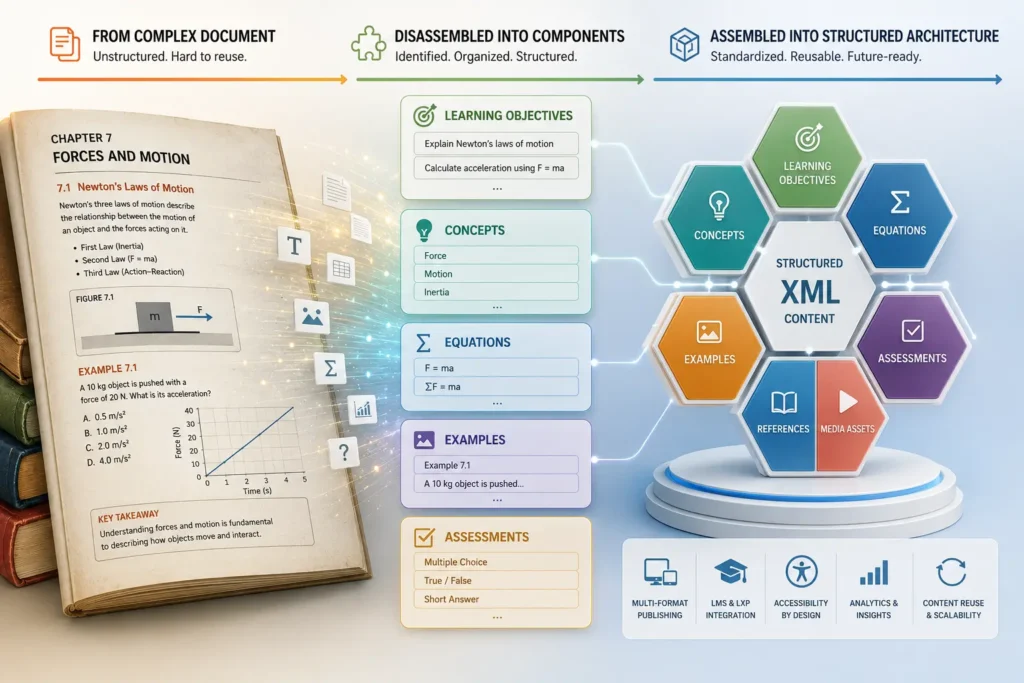
One of the most important steps in modernization is transforming unstructured content into structured content.

Structured workflows organize educational elements such as:

  • Chapter titles
  • Learning objectives
  • Figures
  • Tables
  • Assessment questions
  • References
  • Glossaries

This structure enables publishers to generate multiple outputs from a single content source.

Rather than maintaining separate versions for different platforms, publishers can support a more efficient multi-channel publishing strategy.

Managing Complex Educational Elements

Educational content often contains components that require specialized handling during conversion.

Examples include:

Mathematics And Scientific Content

Equations, formulas, and scientific notation must remain accurate across digital formats.

Special attention is often required to preserve:

  • Mathematical expressions
  • Scientific symbols
  • Chemical formulas
  • Technical diagrams
Tables And Data-Rich Content

Educational resources frequently contain large tables, charts, and data sets that must remain readable on multiple screen sizes.

Assessments And Learning Activities

Questions, answer choices, and scoring structures often require careful tagging to support digital learning systems.

These elements are critical to learning outcomes and require rigorous quality review throughout the conversion process.

Improving Accessibility During Modernization

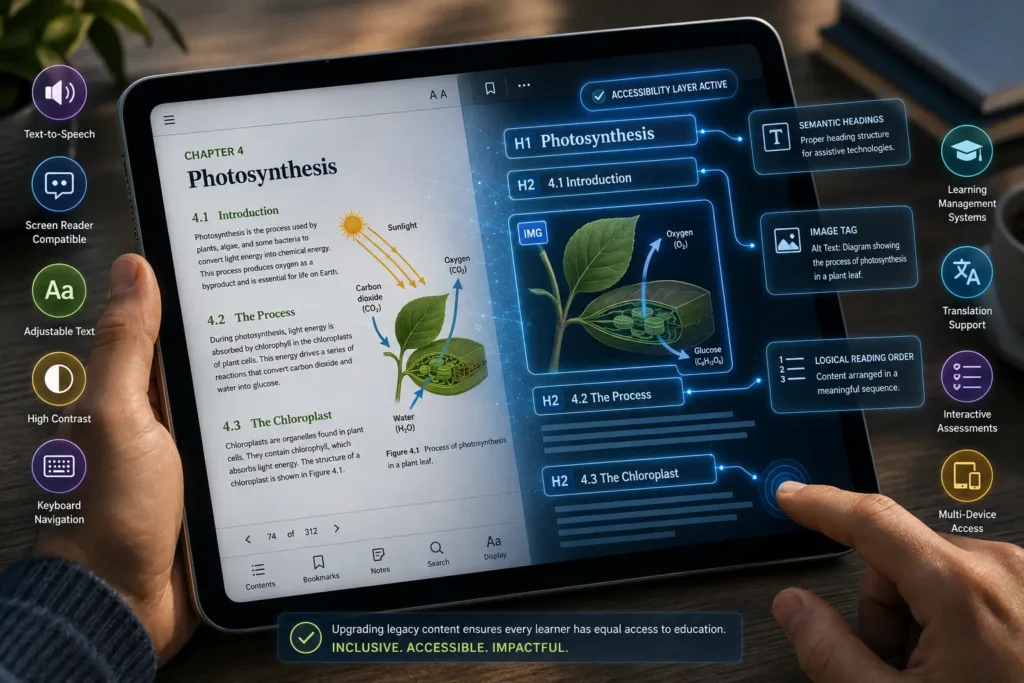
Legacy content often lacks the accessibility features expected in modern educational publishing.

Content conversion provides an opportunity to improve:

  • Heading structures
  • Navigation systems
  • Alternative text for images
  • Table accessibility
  • Semantic tagging
  • Reading order consistency

By incorporating accessibility during conversion, publishers can create resources that support a wider range of learners while meeting institutional expectations.

Supporting Long-Term Content Reuse

Modern educational publishing increasingly relies on content reuse and multi-platform delivery.

A structured conversion strategy helps publishers:

  • Reuse content across product lines
  • Simplify future updates
  • Improve version control
  • Accelerate new product development
  • Reduce duplicate production effort

Traditional Legacy Workflow

Modern Structured Workflow

Format-specific files

Single-source content

Repeated updates

Centralized updates

Limited reuse

Multi-channel reuse

Separate production paths

Unified publishing workflow

Higher maintenance effort

Improved efficiency

This approach helps publishers maximize the long-term value of educational content assets

Practical Publishing Scenario

A publisher has a collection of science textbooks originally produced more than ten years ago. The files exist as print PDFs and older layout files, while educators now request digital learning resources compatible with online platforms.

The publisher begins by extracting content, organizing educational elements into structured formats, improving accessibility, and preparing outputs for EPUB, web-based learning environments, and digital assessment systems. Instead of maintaining separate production workflows, the publisher creates a reusable content foundation that supports future updates and additional product development.

The result is a more sustainable and scalable publishing operation.

Transforming Content Assets For Future Learning Environments

Educational content represents a significant long-term investment for publishers. Converting legacy materials into modern digital formats helps organizations extend content value, support evolving learning technologies, improve accessibility, and create more efficient publishing workflows. Publishers who update their content libraries will be better equipped to satisfy evolving learner and institutional expectations as digital education continues to grow.

FAQ

Legacy educational content refers to older publishing assets such as textbooks, assessments, teacher guides, and learning materials created using outdated production methods or formats.

Conversion helps publishers extend content lifespan, support digital distribution, improve accessibility, and increase content reuse opportunities.

Common formats include EPUB, HTML5, XML, PDF, LMS-compatible packages, and mobile-responsive learning content.

Structured content enables publishers to manage information efficiently and generate multiple outputs from a single source.

Common challenges include handling mathematical content, complex tables, assessments, outdated files, accessibility improvements, and maintaining content accuracy throughout the conversion process.