
How AI Is Transforming Educational Publishing Operations

Educational publishers are managing larger content volumes, shorter production timelines, expanding digital product portfolios, and increasing accessibility requirements. At the same time, institutions expect high-quality educational resources that can be delivered across multiple platforms and updated efficiently when curriculum requirements change.

These pressures are encouraging publishers to explore technologies that improve operational efficiency without compromising editorial quality. Artificial intelligence (AI) is emerging as one of the most significant tools supporting this transformation. While AI is not replacing publishing professionals, it is helping organizations automate repetitive tasks, improve workflows, and make better use of their content assets.

The focus in 2026 is increasingly on how AI supports publishing operations rather than fully automating educational content creation.

Why Publishers Are Adopting AI-Powered Workflows

Educational publishing involves numerous processes that require significant manual effort.

Examples include:

  • Content classification
  • Metadata creation
  • Quality checks
  • Content organization
  • Asset management
  • Workflow tracking
  • Accessibility validation

As content libraries continue to grow, manually managing these activities becomes more difficult.

AI helps publishers handle repetitive, data-intensive tasks more efficiently while allowing editorial teams to focus on higher-value responsibilities.

How AI Is Transforming Educational Publishing Operations

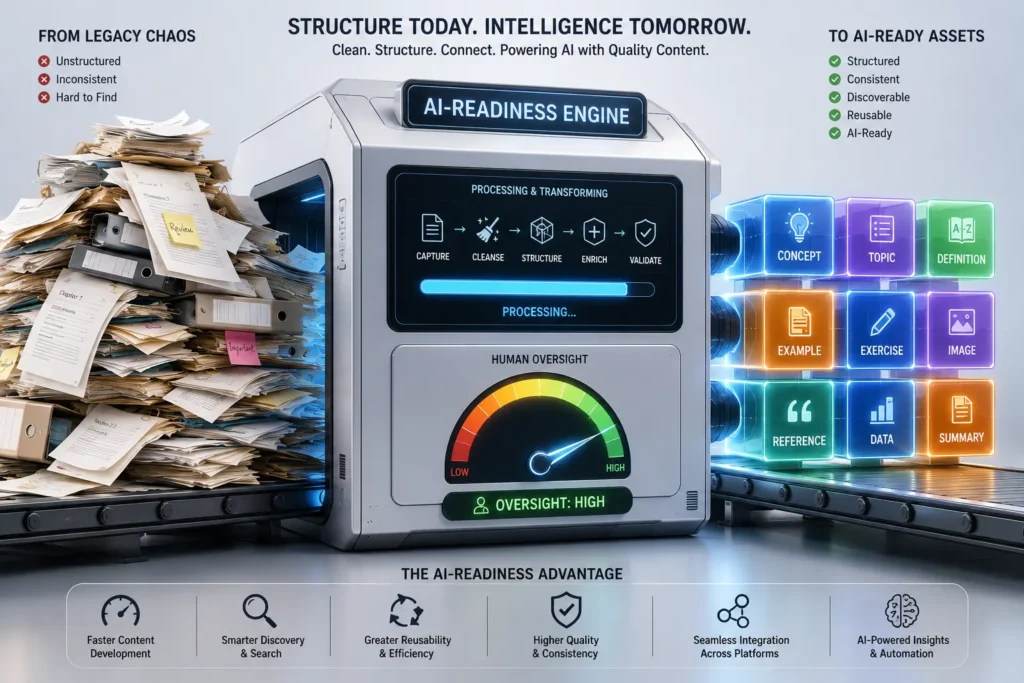
Automating Content Organization And Metadata

One of the most practical applications of AI in publishing operations is content organization.

Educational publishers often manage thousands of content assets across multiple product lines.

AI can assist with:

  • Metadata generation
  • Content tagging
  • Subject categorization
  • Learning-objective mapping
  • Content indexing
  • Asset discovery

Improved content organization makes it easier for teams to locate, reuse, and update educational resources.

This becomes especially valuable within large educational content repositories.

Enhancing Content Discovery And Reuse

Content reuse has become a major priority for publishers seeking greater efficiency.

AI can help identify:

  • Duplicate content
  • Related learning materials
  • Reusable content components
  • Similar assessments
  • Shared curriculum resources

Instead of rebuilding content from scratch, publishers can leverage existing assets more effectively.

This supports:

  • Faster product development
  • Reduced production effort
  • Improved content consistency
  • Better return on content investments

Compare Traditional Publishing Workflows And AI-Supported Operations

AI is changing how many publishing activities are managed.

Traditional Workflow

AI-Supported Workflow

Manual content tagging

Automated metadata generation

Time-consuming asset searches

Intelligent content discovery

Manual quality reviews

Assisted validation processes

Separate content analysis efforts

Automated content insights

Reactive workflow management

Data-driven operational visibility

The goal is not to eliminate human involvement but to improve efficiency and decision-making.

How AI Is Transforming Educational Publishing Operations

Supporting Editorial And Quality Assurance Teams

Editorial accuracy remains critical in educational publishing.

AI can assist quality assurance processes by identifying potential issues before final review.

Examples include:

  • Inconsistent terminology
  • Missing metadata
  • Formatting anomalies
  • Broken references
  • Duplicate content
  • Accessibility concerns

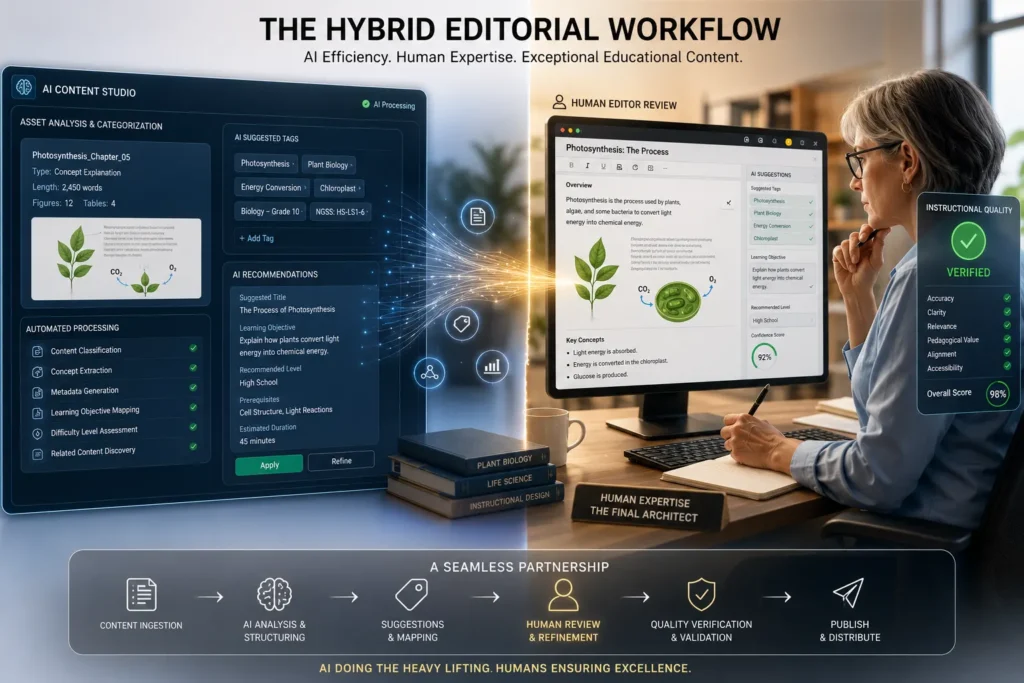
Human editors remain responsible for instructional accuracy, educational value, and final publication decisions.

AI functions as a support tool rather than a replacement for editorial expertise.

Improving Accessibility Workflows

Accessibility continues to be a growing priority across educational publishing.

AI-assisted tools can help identify:

  • Missing alternative text
  • Structural inconsistencies
  • Navigation issues
  • Accessibility compliance concerns
  • Content organization problems

These capabilities help publishers incorporate accessibility checks earlier in production workflows.

Earlier identification of issues often reduces remediation effort later in the publishing process.

Streamlining Multi-Format Publishing Operations

Modern educational resources are frequently distributed across:

  • Print products
  • EPUB formats
  • Learning management systems
  • Mobile applications
  • Digital learning portals

Managing multiple outputs can be complex.

AI can support production teams by helping organize structured content, track relationships between assets, and improve workflow coordination.

Combined with structured publishing strategies, AI contributes to more efficient multi-platform content delivery.

Data-Driven Operational Decision Making

AI is also helping publishers gain greater visibility into operational performance.

Publishers can analyze:

  • Content production trends
  • Workflow bottlenecks
  • Resource utilization
  • Asset usage patterns
  • Product performance indicators

These insights support more informed planning and operational improvements.

Rather than relying solely on historical experience, organizations can incorporate data-driven decision-making into publishing operations.

The Importance Of Human Oversight

Despite growing AI adoption, educational publishing continues to require significant human expertise.

Educational professionals remain responsible for:

  • Curriculum alignment
  • Instructional quality
  • Subject-matter accuracy
  • Editorial review
  • Accessibility governance
  • Ethical publishing standards

The most effective publishing models increasingly combine AI efficiency with human oversight.

This “human-in-the-loop” approach allows organizations to improve productivity while maintaining content quality and accountability.

How AI Is Transforming Educational Publishing Operations

Practical Publishing Scenario

A publisher manages thousands of educational assets across textbooks, digital learning resources, and assessment products. Editorial teams spend considerable time organizing content, generating metadata, and searching for reusable resources.

By implementing AI-assisted content management tools, the publisher automates metadata generation, improves content discovery, and identifies reusable assets more efficiently. Editorial staff continue to oversee educational quality while spending less time on administrative tasks.

The result is improved operational efficiency without sacrificing content integrity.

Building Smarter Publishing Operations

AI is becoming an important operational tool for educational publishers seeking greater efficiency, scalability, and visibility across increasingly complex content ecosystems. While human expertise remains central to educational publishing, AI-assisted workflows are helping organizations streamline content management, improve accessibility processes, enhance content reuse, and support data-driven decision-making. Publishers that successfully combine automation with strong editorial governance are likely to be better positioned for the evolving demands of modern educational publishing.

FAQs

AI is commonly used for metadata generation, content organization, workflow automation, quality assurance support, and content discovery.

No. Human editors remain essential for ensuring educational accuracy, curriculum alignment, instructional quality, and final editorial decisions.

AI reduces manual effort by automating repetitive tasks such as content tagging, metadata creation, asset organization, and workflow analysis.

AI-assisted tools can help identify accessibility issues, structural inconsistencies, and content organization concerns earlier in production.

A human-in-the-loop model combines AI-powered workflow support with human editorial oversight to maintain quality, accuracy, and governance.