
The Role of Structured XML in Future-Ready Educational Publishing

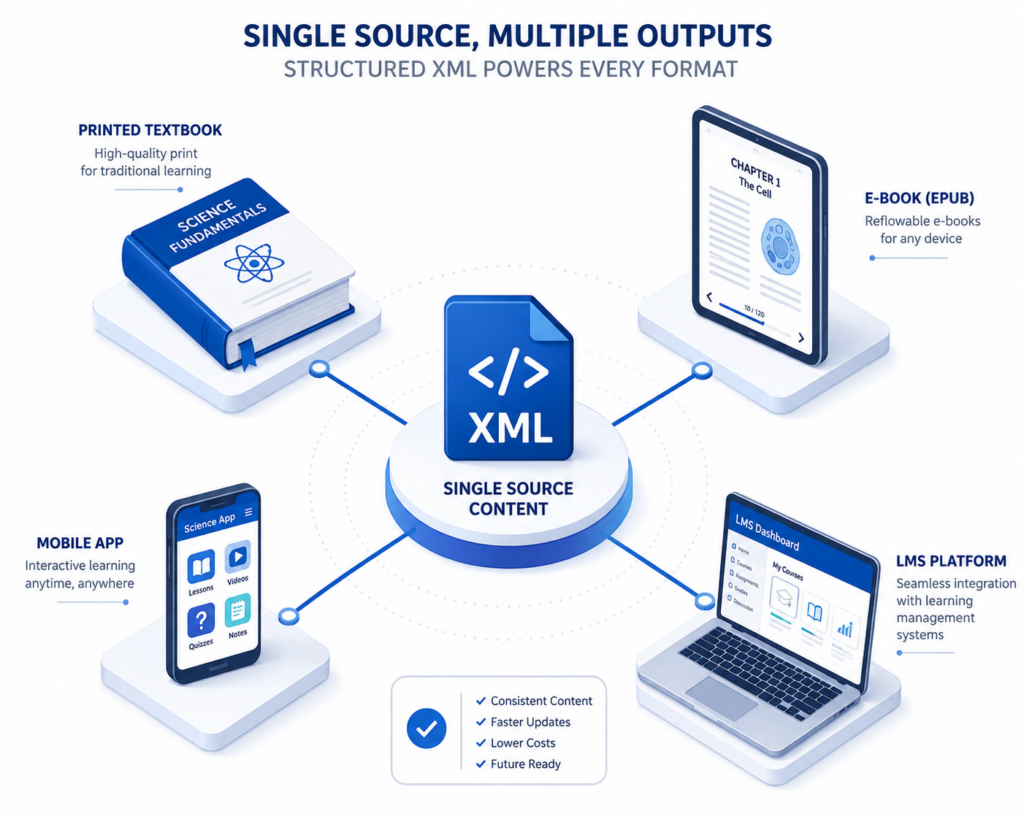
Educational publishers face increasing pressure to deliver the same content across multiple formats, platforms, and devices while maintaining consistency and accuracy. A textbook may need to be published as a print book, EPUB, online learning module, mobile application, accessible digital resource, and learning management system (LMS) content package. Managing these requirements through traditional document-based workflows often leads to duplication of effort, version-control challenges, and higher production costs.

This is why structured XML has become an important foundation for future-ready educational publishing. Rather than treating content as static pages, XML allows publishers to manage content as reusable, structured information that can be transformed into multiple outputs from a single source.

Why Educational Publishers Are Moving Beyond Traditional Workflows

Traditional publishing workflows typically rely on separate files for different formats. When updates are required, production teams often need to modify multiple versions individually.

This approach creates several challenges:

  • Repeated formatting work
  • Increased risk of inconsistencies
  • Longer production cycles
  • Difficult content reuse
  • Higher maintenance costs

As educational content becomes more dynamic and digital-first, publishers need workflows that support flexibility and scalability.

Structured XML addresses these challenges by separating content from presentation.

Understanding Structured XML in Educational Publishing

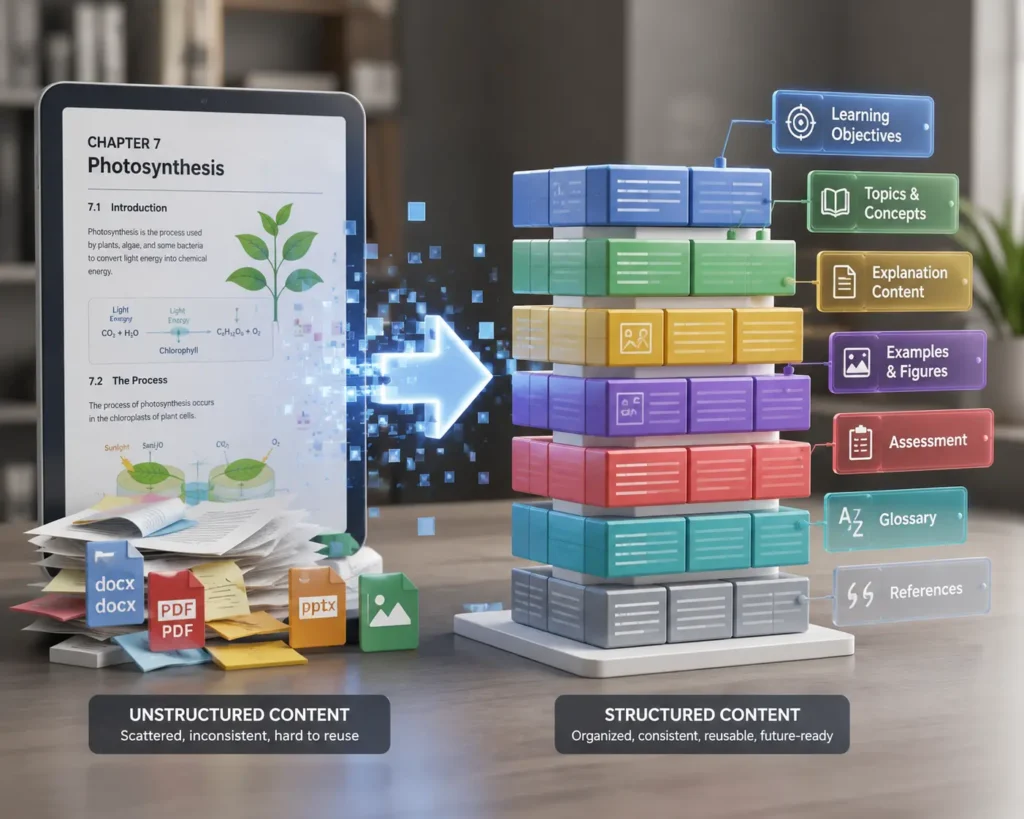
Structured XML (Extensible Markup Language) organizes content using predefined tags that identify the purpose and meaning of information.

For example:

  • Chapter titles
  • Learning objectives
  • Assessment questions
  • Tables
  • Figures
  • References
  • Glossaries

Instead of focusing on how content looks on a page, XML focuses on what the content represents.

This structured approach allows publishing systems to process, reuse, and distribute content efficiently across multiple channels.

How XML Supports Multi-Channel Publishing

Educational publishers increasingly need to distribute content through various platforms.

These may include:

  • Print textbooks
  • eBooks and EPUB files
  • Online learning portals
  • Mobile learning applications
  • LMS platforms
  • Assessment systems
  • Accessibility-compliant digital products

With a structured XML workflow, publishers maintain a single content source while generating multiple outputs automatically.

Traditional Publishing

XML-Based Publishing

Multiple source files

Single source content

Manual format updates

Automated output generation

Duplicate content maintenance

Centralized content management

Higher revision effort

Efficient content reuse

Format-specific workflows

Multi-channel publishing workflow

This approach improves efficiency while reducing production complexity.

Improving Content Reuse Across Educational Products

Educational publishers often develop content collections that share common material across multiple products.

Examples include:

  • Curriculum series
  • Teacher guides
  • Student editions
  • Assessment resources
  • Digital learning modules

Without structured content, teams may repeatedly recreate or copy material between projects.

XML enables publishers to:

  • Reuse learning objectives
  • Share assessment content
  • Repurpose glossary entries
  • Maintain common references
  • Update content centrally

This reduces duplication and helps maintain consistency across product portfolios.

Supporting Accessibility Requirements

Accessibility has become a critical requirement for modern educational publishing.

Publishers must ensure content can be accessed by diverse learners using various assistive technologies.

Structured XML provides a strong foundation for accessibility because content elements are clearly identified and organized.

Benefits include:

  • Improved semantic structure
  • Better navigation support
  • More accurate screen-reader interpretation
  • Easier conversion to accessible EPUB formats
  • Consistent tagging of educational content elements

By building accessibility into the content structure from the beginning, publishers can reduce remediation efforts later in the production process.

Enabling Faster Content Updates And Revisions

Educational content frequently requires updates due to:

  • Curriculum changes
  • Regulatory revisions
  • New academic standards
  • Subject matter updates
  • Assessment modifications

In traditional workflows, updating multiple versions can be time-consuming.

With XML, content changes are made once at the source level and then distributed across all required outputs.

This allows publishers to:

  • Reduce revision cycles
  • Improve content accuracy
  • Accelerate publication schedules
  • Maintain version consistency
  • Respond more quickly to market demands

The result is a more agile publishing operation.

Integrating XML With Modern Publishing Technologies

Structured XML works effectively alongside many technologies used in educational publishing.

These include:

  • Adobe InDesign publishing workflows
  • EPUB production systems
  • Learning management systems
  • Digital asset management platforms
  • Content management systems
  • Accessibility validation tools

Because XML is platform-independent, publishers gain greater flexibility when adopting new technologies or expanding digital offerings.

This helps protect long-term content investments while supporting future growth.

Practical Publishing Scenario

Consider a publisher developing a K–12 science curriculum.

The project includes:

  • Student textbooks
  • Teacher resources
  • Interactive digital lessons
  • Online assessments
  • Accessible EPUB editions

Using a traditional workflow, each format may require separate production efforts.

With a structured XML workflow, content is created once, tagged according to its educational purpose, and automatically transformed into multiple outputs. When a curriculum update occurs, the publisher modifies the source content and regenerates all required formats from the same structured repository.

This significantly reduces production effort while improving consistency across products.

FAQ

Structured XML is a content framework that organizes information using semantic tags, allowing publishers to manage and reuse content efficiently across multiple formats.

XML reduces duplicate work by enabling publishers to create content once and generate multiple outputs from a single source.

XML provides clear content structure that supports accessible digital publishing, screen readers, and standards-compliant EPUB production

Publishers can reuse educational content across textbooks, assessments, digital platforms, and learning resources while maintaining consistency.

Because XML separates content from presentation, publishers can adapt content for emerging technologies, platforms, and delivery channels without recreating materials from scratch.
