
Making Educational Books Accessible for Diverse Learners

Creating Clear Content Structures

A well-organized book is easier for everyone to use.

Accessible educational books typically include:

  • Logical chapter organization
  • Consistent heading structures
  • Clear section divisions
  • Meaningful titles
  • Predictable layouts

Structured content helps readers quickly locate information and supports digital navigation systems.

Why Structure Matters

Strong content structure improves:

  • Readability
  • Navigation
  • Content discovery
  • Digital accessibility
  • Learning efficiency

It also supports future updates and multi-format publishing.

Accessible educational books

Learning Should Not Depend on How Content Is Delivered

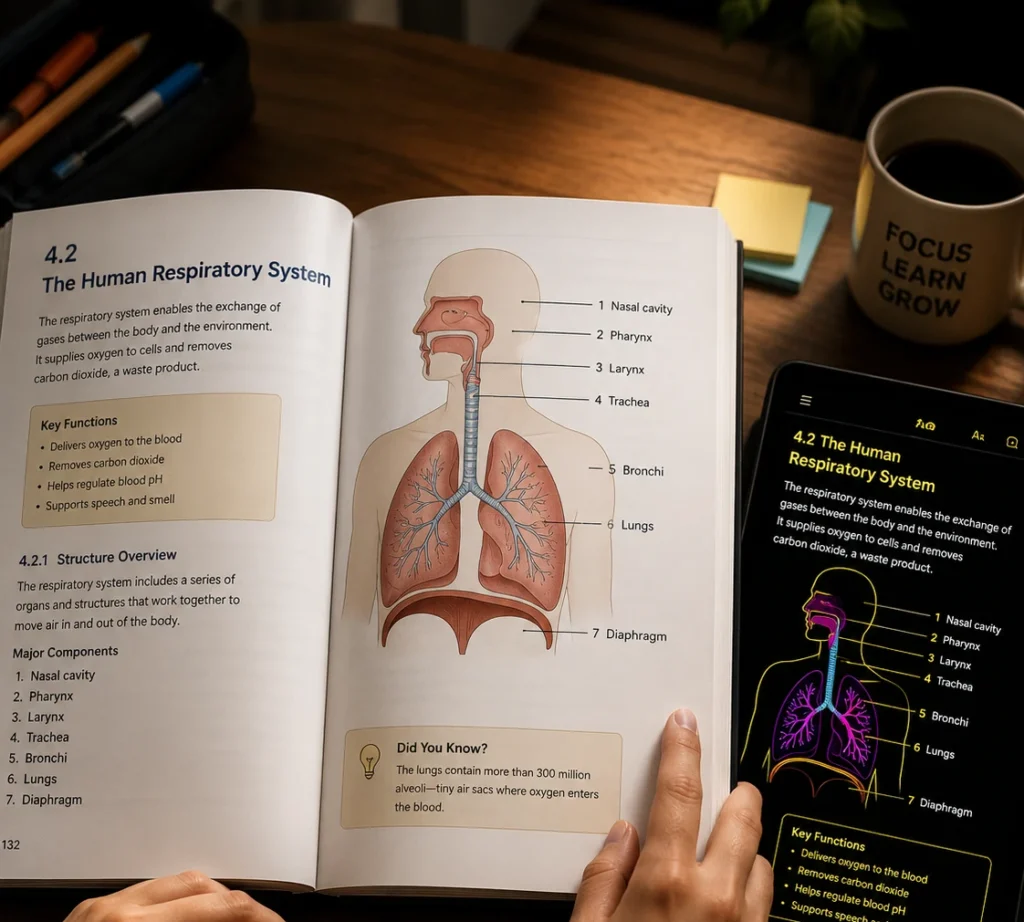
Students engage with educational materials in different ways. Some prefer printed textbooks, while others rely on tablets, laptops, smartphones, or assistive technologies. A learner studying biology may need zoomable diagrams, while another may use a screen reader to navigate the same content. Educational publishers therefore face an important challenge: ensuring that learning materials remain usable and understandable for as many learners as possible.

Accessibility is not simply about compliance requirements. It is about creating educational books that remove barriers to learning and support meaningful engagement with content across different learning environments.

Understanding Diversity in Learning Needs

Educational audiences are more diverse than ever.

Learners may vary in:

  • Reading preferences
  • Device usage
  • Visual capabilities
  • Navigation requirements
  • Learning environments
  • Language proficiency

A single textbook may be accessed by students in classrooms, libraries, remote learning settings, and mobile environments.

Accessible publishing helps ensure that content remains effective regardless of how students interact with it.

Building Accessibility Into Content Development

Accessibility is most effective when considered during content creation rather than after publication.

Key planning areas include:

  • Content structure
  • Visual design
  • Navigation systems
  • Digital compatibility
  • Quality assurance processes

When accessibility is integrated early, publishers can reduce production challenges while improving the overall learning experience.

Accessibility Planning vs Post-Publication Fixes

Accessibility Built Early

Accessibility Added Later

More efficient workflows

Additional remediation effort

Better content consistency

Higher correction costs

Easier multi-format publishing

Increased production complexity

Improved learner experience

Potential usability gaps

Better long-term maintenance

Repeated accessibility reviews

Accessible educational books

Making Visual Content More Accessible

Educational books often contain important visual elements.

Examples include:

  • Scientific diagrams
  • Engineering illustrations
  • Maps
  • Charts
  • Tables
  • Infographics

These visuals often communicate essential learning concepts.

Publishers should ensure that learners can understand the educational purpose of visual content even when they cannot rely solely on visual interpretation.

Accessible Visual Content Practices

  • Clear figure organization
  • Consistent labeling
  • Logical callouts
  • Descriptive figure information
  • Structured visual hierarchy

These practices improve comprehension for a broad range of learners.

Supporting STEM Content Accessibility

STEM publications present unique accessibility requirements.

Common challenges include:

  • Mathematical equations
  • Scientific notation
  • Chemical structures
  • Technical diagrams
  • Large data tables

Publishers must ensure these elements remain understandable and functional across multiple formats.

Key Validation Areas For STEM Content

Validation Area

Accessibility Benefit

Equation display integrity

Accurate mathematical interpretation

Symbol rendering

Consistent notation

Table structure

Improved data navigation

Figure references

Better content relationships

Responsive formatting

Multi-device usability

These checks help maintain educational accuracy while improving accessibility.

Designing For Multiple Devices

Modern educational books are frequently accessed through:

  • Printed textbooks
  • eBooks
  • Tablets
  • Smartphones
  • Learning management systems

A learner may switch between several devices throughout the day.

Publishers therefore need workflows that support:

  • Responsive layouts
  • Scalable content
  • Consistent formatting
  • Reliable navigation

Device flexibility helps extend the reach of educational materials.

Accessible educational books

Improving Navigation And Content Discovery

Accessible learning depends on more than readable content.

Students also need efficient ways to locate information.

Helpful navigation features include:

  • Structured tables of contents
  • Chapter links
  • Internal references
  • Search functionality
  • Consistent navigation controls

Good navigation supports both independent learning and assistive technology usage.

The Role Of Accessibility Quality Assurance

Accessibility should be treated as a core publishing quality measure.

Review teams commonly evaluate:

  • Logical heading order
  • Reading order
  • Contrast ratios
  • Alternative text verification
  • Keyboard navigation
  • Responsive behavior
  • Cross-reference functionality
  • Multi-device compatibility

Systematic validation helps ensure that accessibility goals remain intact throughout the publishing workflow.

A Practical Publishing Scenario

Consider a publisher producing a secondary-school science textbook.

The project includes:

  • Hundreds of illustrations
  • Scientific diagrams
  • Interactive digital resources
  • Print and eBook editions

By incorporating accessibility requirements during content development, the publisher can create a resource that works effectively across different devices and learning environments while reducing the need for extensive post-production revisions.

Expanding Educational Opportunities Through Accessible Publishing

Making educational books accessible for diverse learners is about creating learning experiences that work for a wider audience. Accessible content structures, thoughtful visual design, responsive publishing workflows, and rigorous quality assurance all contribute to stronger educational outcomes.

Publishers that prioritize accessibility can improve usability, strengthen content quality, support inclusive learning, and ensure that educational resources remain valuable for students regardless of how they access or engage with information.

FAQs

Accessibility helps ensure that educational content can be used by a broader range of learners across different devices and learning environments.

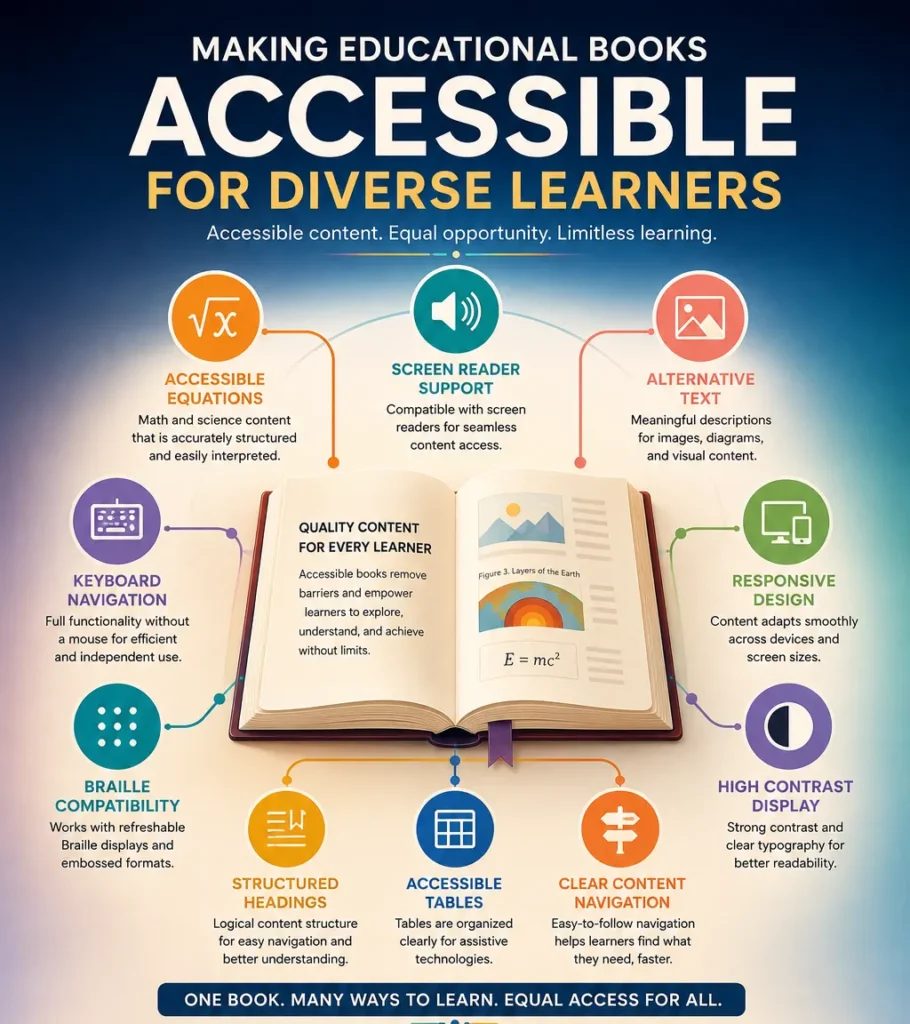
Accessible textbooks typically include structured content, clear navigation, usable visual content, responsive layouts, and compatibility with assistive technologies.

STEM content often includes equations, diagrams, tables, and technical notation that require specialized accessibility planning.

Responsive design allows content to adapt to different screen sizes and devices while maintaining readability and usability.

Publishers use quality assurance processes that review content structure, navigation, visual elements, responsiveness, and compatibility across formats and devices.
