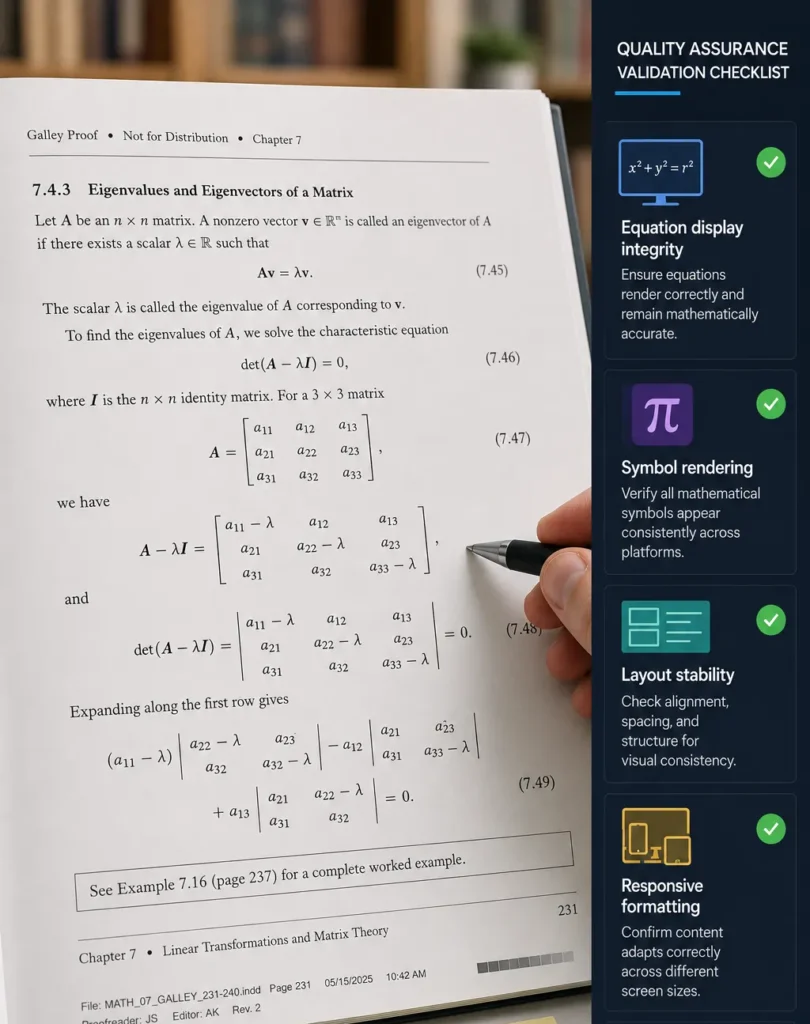


Quality Assurance Methods for Mathematics Typesetting Projects

Why Quality Assurance Is Critical in Mathematics Publishing

Thousands of equations, symbols, matrices, graphs, and cross-references can be found in a mathematics textbook. Unlike general text, mathematical content leaves little room for error. A misplaced superscript, an incorrect symbol, or a broken equation reference can change meaning entirely and create confusion for students, educators, and researchers.

For publishers, educational institutions, and assessment providers, quality assurance is not simply a final review step. It is an essential process that protects accuracy throughout the entire typesetting workflow.

Effective quality assurance methods help ensure that mathematical content remains technically correct, visually consistent, and ready for both print and digital distribution.

Why Mathematics Typesetting Requires Specialized Quality Control

Mathematical content contains elements that are more complex than standard publishing projects.

These often include:

  • Multi-line equations
  • Matrices and vectors
  • Fractions and radicals
  • Greek symbols
  • Subscripts and superscripts
  • Statistical formulas
  • Equation numbering systems
  • Cross-references

A single formatting error can affect multiple sections of a publication, making systematic quality control essential.

Common Typesetting Errors

Mathematics production teams frequently monitor for:

  • Missing symbols
  • Incorrect equation numbering
  • Misaligned expressions
  • Broken references
  • Spacing inconsistencies
  • Font mismatches
  • Incorrect superscripts or subscripts

Identifying these issues early reduces costly revisions later in the production cycle.

Establishing Standardized Typesetting Guidelines

Quality assurance begins before production starts.

Publishers typically create detailed standards covering:

  • Equation formatting
  • Numbering conventions
  • Symbol usage
  • Font specifications
  • Layout requirements
  • Reference structures

These standards provide consistency across chapters, contributors, and editions.

Benefits of Standardized Rules

  • Improved consistency
  • Faster reviews
  • Reduced production errors
  • Easier content maintenance
  • Better multi-format publishing

Standardization creates a foundation for scalable mathematics publishing.

Manual Review vs Structured Validation

Manual Validation

Structured Validation

Higher review effort

Standardized checking procedures

Greater risk of oversight

Consistent verification

Slower revision cycles

Faster review workflows

Variable quality outcomes

Improved accuracy

Difficult scalability

Better project management


Structured validation improves both quality and efficiency.

Ensuring Visual Consistency

Mathematical accuracy alone is not enough.

Readers must also be able to interpret content easily.

Quality assurance teams evaluate:

  • Equation spacing
  • Matrix alignment
  • Operator placement
  • Line breaks
  • Indentation
  • Typography consistency

These visual checks help improve readability while maintaining professional publishing standards.

Multi-Level Review Processes

Mathematics content often undergoes several layers of review.

Editorial Review

Editors verify:

  • Mathematical accuracy
  • Terminology consistency
  • Numbering structure
  • Reference integrity

Typesetting Review

Production specialists check:

  • Equation alignment
  • Symbol placement
  • Layout consistency
  • Page formatting

Final Proof Review

Proofing teams validate:

  • Cross-references
  • Figure citations
  • Table references
  • Page breaks
  • Final rendering quality

Multiple review stages help identify different categories of errors before publication.

Reviewing Multi-Format Outputs

Modern mathematics content is often delivered through:

  • Printed textbooks
  • eBooks
  • Learning platforms
  • Online assessments
  • Mobile applications

Each format may render mathematical content differently.

Quality assurance processes verify:

  • Equation display integrity
  • Symbol rendering
  • Layout stability
  • Responsive formatting
  • Navigation functionality

This guarantees a uniform educational experience on all platforms.

Using Checklists for Quality Control

Many mathematics publishing teams rely on structured review checklists.

Typical verification areas include:

  • Equation numbering
  • Figure references
  • Table consistency
  • Symbol accuracy
  • Layout structure
  • Cross-references
  • Typography standards
  • Mathematical notation

Checklists help maintain consistency across large publishing projects.

Multi-Level Review Processes

Mathematics content often undergoes several layers of review.

Editorial Review

Editors verify:

  • Mathematical accuracy
  • Terminology consistency
  • Numbering structure
  • Reference integrity

Typesetting Review

Production specialists check:

  • Equation alignment
  • Symbol placement
  • Layout consistency
  • Page formatting

Final Proof Review

Proofing teams validate:

  • Cross-references
  • Figure citations
  • Table references
  • Page breaks
  • Final rendering quality

Multiple review stages help identify different categories of errors before publication.

A Practical Publishing Scenario

Consider a higher-education mathematics textbook containing:

  • 2,800 equations
  • 350 figures
  • 120 tables
  • Print and digital editions

During peer review, multiple chapters are revised and several new examples are added.

Equation references, numbering schemes, and page layouts can easily become inconsistent in the absence of a systematic quality assurance procedure.

By implementing standardized review procedures and multiple validation stages, the publisher can maintain accuracy throughout the project while reducing revision-related risks.

Building Confidence Through Mathematical Accuracy

Quality assurance is one of the most important components of mathematics typesetting projects. It ensures that equations, symbols, references, and layouts remain accurate throughout the publishing process.

Organizations that adopt structured quality assurance methods can reduce errors, improve consistency, streamline production workflows, and deliver mathematics content that supports effective teaching and learning across both print and digital environments.

FAQ

Mathematical content is highly sensitive to formatting and notation errors, making systematic quality assurance essential for accuracy.

Common issues include incorrect equation numbering, symbol placement errors, alignment problems, spacing inconsistencies, and broken references.

Publishers use editorial reviews, typesetting reviews, proof checks, and structured validation processes to identify and correct errors.

Precise numbering guarantees that readers can find cited equations and navigate the text logically.

Quality assurance verifies that mathematical content renders correctly across print, eBooks, learning platforms, and other digital delivery formats.
