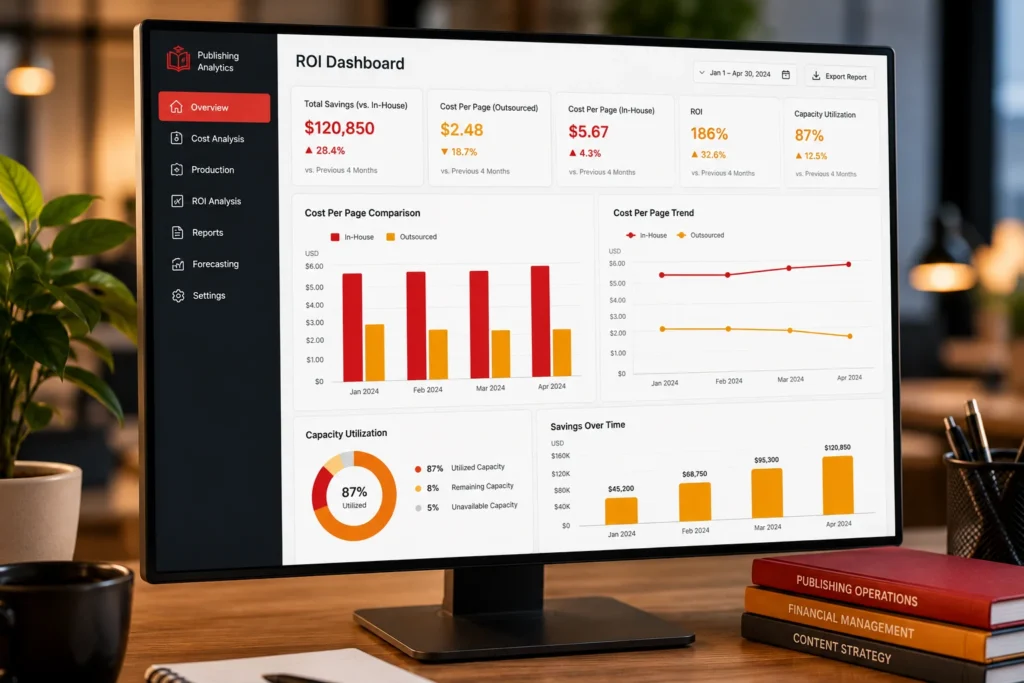


ROI Calculator: In-House vs Outsourced Typesetting

A publishing organization may have experienced editors, designers, and production specialists, yet still struggle to determine whether its typesetting operation is delivering the best return on investment. As content volumes increase and production schedules become tighter, management teams often begin questioning whether maintaining an internal typesetting department remains the most cost-effective approach.

The answer is rarely based on direct salary costs alone. Software licensing, employee training, capacity utilization, quality control, and project management all influence the true cost of content production. Understanding these factors can help publishers make more informed decisions about in-house and outsourced typesetting strategies.

Looking Beyond Direct Production Costs

When calculating typesetting costs, many organisations take project expenses and employee pay into account. However, a number of hidden expenses are frequently overlooked.

Typical In-House Cost Components

  • Employee salaries and benefits
  • Recruitment and onboarding
  • Adobe InDesign licensing
  • Hardware and workstation upgrades
  • Project management oversight
  • Training and skill development
  • Employee leave and turnover coverage
  • Internal quality assurance activities

While these investments can support long-term operations, they can also increase the cost per page when production volumes fluctuate.

Building A Practical ROI Framework

A meaningful ROI assessment should evaluate both financial and operational factors.

Key Measurement Areas

Evaluation Factor

Why It Matters

Cost Per Page

Measures production efficiency

Resource Utilization

Indicates workforce productivity

Turnaround Time

Impacts delivery schedules

Revision Costs

Reflects quality performance

Scalability

Supports growth and peak workloads

Technology Investment

Influences long-term operating costs

Rather than focusing on a single metric, publishers should evaluate the combined impact of these factors.

Comparing In-House And Outsourced Typesetting Models

The following comparison highlights common operational differences.

Cost Factor

In-House Typesetting

Outsourced Typesetting

Staffing Costs

Higher fixed expense

Variable project-based cost

Software Licenses

Managed internally

Often included in service

Training Requirements

Ongoing responsibility

Managed by provider

Capacity Expansion

Requires hiring

Easier to scale

Production Flexibility

Limited by team size

Greater workload adaptability

Infrastructure Costs

Internal investment

Reduced infrastructure burden

The most suitable model depends on production volume, content complexity, and business objectives.

When Internal Typesetting Delivers Strong Value

In-house production can be beneficial under specific circumstances.

Situations Where Internal Teams Often Perform Well

  • Consistent year-round production volume
  • Highly specialized publication formats
  • Strict internal workflow requirements
  • Long-term resource availability
  • Dedicated publishing departments with stable workloads

Organizations producing large volumes of content every month may find it easier to justify ongoing operational investments.

When Outsourcing Can Improve ROI

Outsourcing becomes attractive when flexibility and scalability are priorities.

Common Outsourcing Scenarios

  • Seasonal publishing cycles
  • Large backlist conversion projects
  • Journal and periodical production
  • Educational content updates
  • High-volume textbook production
  • Document conversion and formatting initiatives

Many publishers use outsourcing to supplement internal resources rather than replace them entirely.

Sample ROI Calculation

Consider a hypothetical publisher producing 40,000 pages annually.

Metric

In-House Team

Outsourced Partner

Annual Production Cost

$250,000

$145,000

Annual Output

40,000 Pages

40,000 Pages

Cost Per Page

$6.25

$3.63

Average Turnaround

10 Days

7 Days

Scalability During Peak Demand

Limited

Flexible

In this example, outsourcing reduces operating costs while maintaining the same production volume. Actual results will vary based on project requirements and internal efficiencies.

Factors That Influence Long-Term Value

ROI should not be measured solely through cost reduction.

Publishers should also consider:

  • Production consistency
  • Quality control effectiveness
  • Delivery reliability
  • Operational flexibility
  • Resource availability
  • Risk management

A lower-cost solution that creates delays or quality issues may ultimately reduce overall value.

Questions Publishers Should Ask Before Calculating ROI

Before comparing models, organizations should evaluate their current production environment.

Readiness Checklist

✔ Is content volume predictable throughout the year?

✔ Are production delays becoming more common?

✔ Is recruiting experienced typesetting professionals becoming difficult?

✔ Are software and infrastructure costs increasing?

✔ Is the team operating at full capacity?

✔ Do peak workloads create scheduling challenges?

✔ Are revision costs affecting profitability?

The responses frequently show whether current workflows are successfully assisting business objectives.

Making Smarter Production Investment Decisions

In the end, choosing between in-house and outsourced typesetting is more of a financial decision than a completely production-focused one. By evaluating direct expenses, operational efficiency, scalability, and long-term resource requirements, publishers can gain a clearer understanding of which model delivers the strongest return on investment. A structured ROI analysis provides the visibility needed to align production strategies with organizational goals while supporting sustainable publishing operations.

Frequently Asked Questions

Organizations should include salaries, software licenses, hardware, training, quality assurance, project management, and operational overhead expenses.

ROI is typically measured using cost savings, production efficiency improvements, faster turnaround times, and scalability benefits.

Not necessarily. The outcome depends on production volume, content complexity, internal resources, and workflow efficiency.

Higher and more consistent production volumes can improve internal resource utilization and reduce cost per page.

The break-even point varies by organization and depends on staffing costs, technology investments, production volume, and outsourcing rates.
