
Assessment & Test Preparation Content Development

Developing High-Quality Assessment and Test Preparation Resources
Strategies for Effective Learner Evaluation and Exam Readiness

Educational content is only effective when learners can demonstrate understanding and apply what they have learned. This is why assessment and test preparation materials remain a critical part of every educational program. Whether supporting school curricula, professional certification courses, higher education programs, or corporate training initiatives, assessments help measure progress and identify learning gaps.

As learning environments become increasingly digital and multiformat, publishers and content developers must create assessment resources that are accurate, engaging, accessible, and aligned with learning objectives. Effective assessment and test preparation content supports both learner success and instructional quality.

Why Assessment Content Matters

Learning materials teach concepts, but assessments validate whether those concepts have been understood.

Well-designed assessment content helps organizations:

  • Measure learning outcomes
  • Evaluate learner performance
  • Identify knowledge gaps
  • Improve instructional effectiveness
  • Support certification and compliance requirements
  • Prepare learners for formal examinations

Without structured assessments, it becomes difficult to determine whether educational objectives have been achieved.

Aligning Assessments With Learning Objectives

Every assessment should directly support a specific learning objective.

When assessments are poorly aligned, they may evaluate information that learners were not expected to master.

A structured approach helps ensure consistency.

Learning Objective

Assessment Method

Recall facts and terminology

Multiple-choice questions

Explain concepts

Short-answer questions

Apply knowledge

Scenario-based activities

Analyze information

Case-study questions

Evaluate outcomes

Critical-thinking exercises

Alignment helps create fair and meaningful assessments.

Challenges In Assessment Content Development

Developing high-quality assessment materials involves more than writing questions.

Publishers often encounter several challenges.

Maintaining Content Accuracy

Assessment questions must reflect current curriculum requirements and subject matter standards.

Even minor inaccuracies can affect learner performance and credibility.

Ensuring Appropriate Difficulty Levels

Questions should neither be too simple nor unnecessarily complex.

A balanced assessment often includes:

  • Foundational questions
  • Intermediate questions
  • Advanced application questions

This approach provides a more complete evaluation of learner understanding.

Preventing Content Repetition

Repeated question patterns may reduce assessment effectiveness.

Content developers must create sufficient variety while maintaining consistency with learning objectives.

Supporting Multiple Delivery Formats

Modern assessments may appear in:

  • Printed workbooks
  • LMS platforms
  • Digital assessments
  • Mobile learning applications
  • Accessible learning resources

Each format requires careful review and adaptation.

Best Practices For Assessment Content Development

Educational publishers can improve assessment quality by following structured development practices.

Recommended approaches include:

Start With Learning Outcomes

Assessment planning should begin with clearly defined educational objectives.

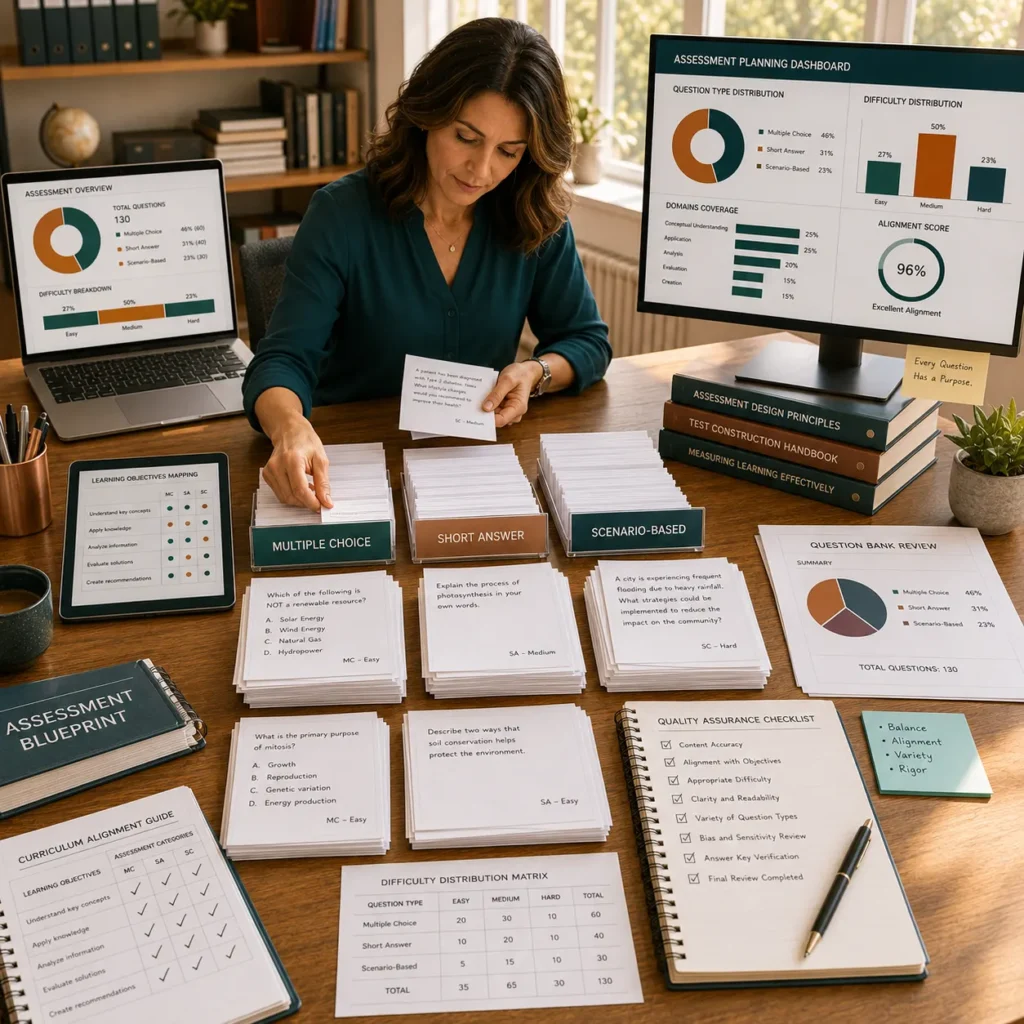
Create Assessment Blueprints

Blueprints help maintain balance across:

  • Topics
  • Difficulty levels
  • Question types
  • Learning outcomes
Conduct Independent Reviews

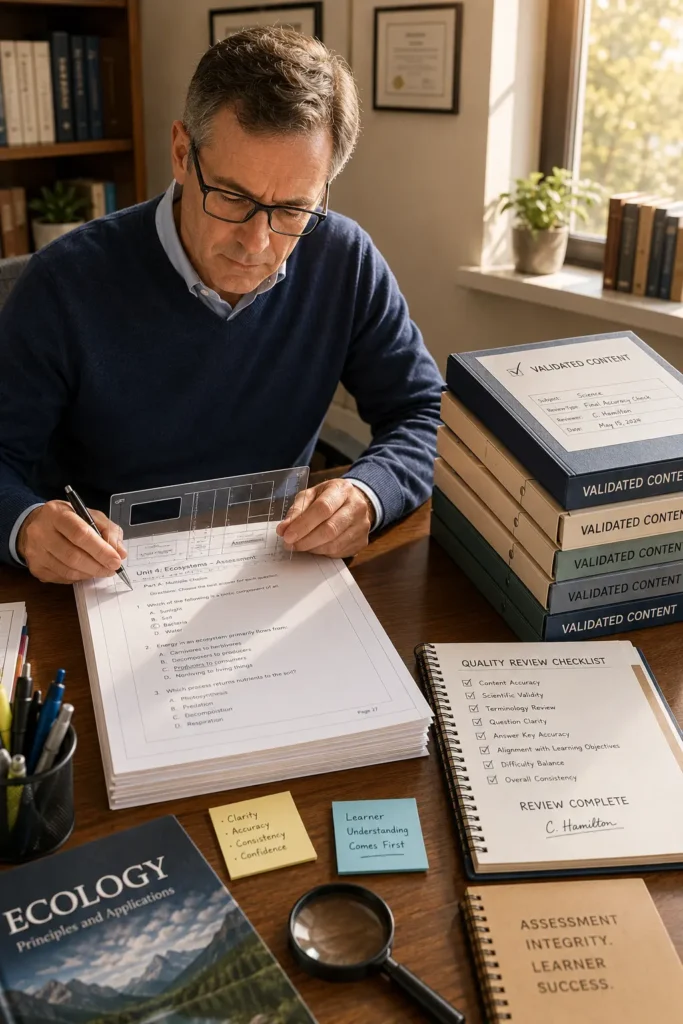
Subject matter experts should validate:

  • Accuracy
  • Clarity
  • Alignment
  • Consistency

Independent review reduces errors before publication.

Plan For Accessibility

Assessment materials should support a broad range of learners through:

  • Clear instructions
  • Consistent navigation
  • Readable formatting
  • Accessible content structures

Accessibility planning should occur early in development.

A Practical Development Scenario

A publisher is creating assessment materials for a secondary-school science program.

The project includes chapter quizzes, end-of-unit tests, practice exams, and digital LMS assessments. The content team develops an assessment blueprint that maps every question to specific learning objectives.

Subject matter experts review scientific accuracy, instructional designers verify alignment with curriculum standards, and quality assurance teams check consistency across print and digital formats.

This structured process helps ensure that every assessment accurately measures learner understanding while maintaining consistency across delivery channels.

Building Confidence Through Effective Assessment Design

Assessment and test preparation materials are essential components of successful learning programs. When developed with clear objectives, strong quality controls, and learner-focused design principles, assessments provide valuable insights into progress while helping learners build confidence and improve performance. Educational organizations that invest in structured assessment development processes can create more reliable, consistent, and effective learning experiences across every delivery format.

FAQ

Assessment content development involves creating quizzes, tests, exams, and evaluation materials that measure learner understanding and performance.

Alignment ensures that assessment questions accurately evaluate the skills and knowledge learners are expected to acquire.

Common assessment formats include multiple-choice questions, short-answer questions, knowledge checks, practice tests, and scenario-based activities.

Publishers can improve quality through structured planning, expert review, assessment blueprints, and comprehensive quality assurance processes.

Learners increasingly access assessments through print materials, LMS platforms, mobile devices, and digital learning environments, requiring content that performs consistently across formats.
