

The Growing Demand For Multiformat Educational Content Production

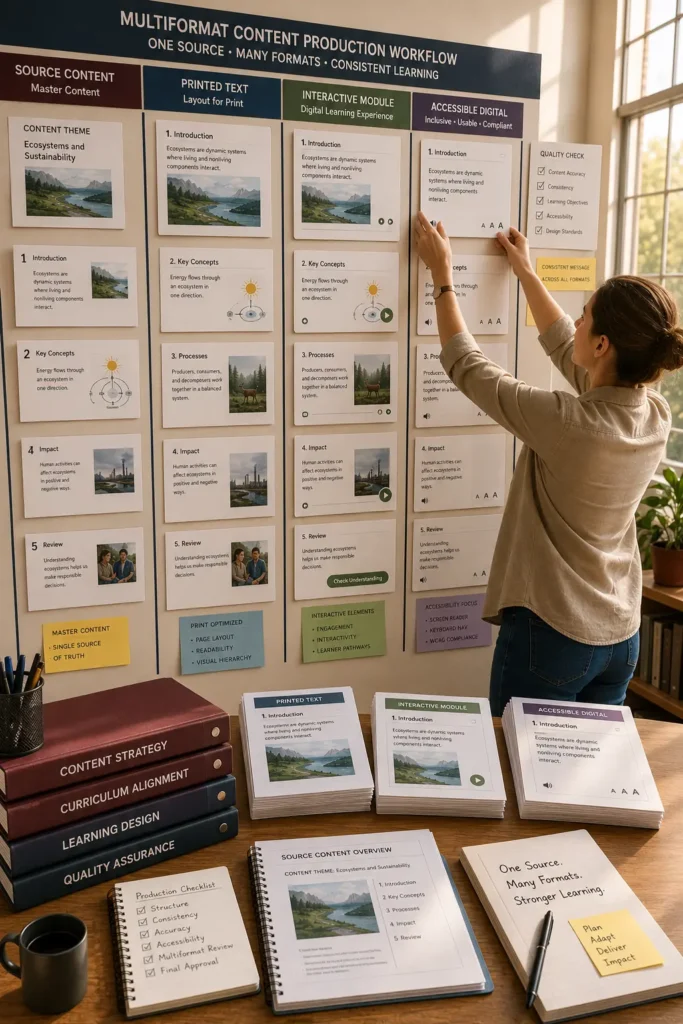
Educational publishers face a significant challenge today: the same learning content often needs to be delivered across multiple platforms, devices, and learning environments. A curriculum developed for a printed textbook may also need to appear as an EPUB3 publication, an LMS course, a mobile learning module, an accessible digital resource, and a downloadable PDF.

Creating separate versions for every format is costly, time-consuming, and difficult to maintain. As educational institutions continue to expand digital learning initiatives, publishers are increasingly adopting multiformat content production strategies that allow a single content source to support multiple outputs efficiently.

The requirement for flexibility, consistency, and scalability in contemporary publishing workflows is reflected in the rising need for multiformat educational content development.

Why Educational Publishing Is Becoming Multiformat

Learners access educational content in many different ways.

Some learners prefer:

  • Printed textbooks
  • Tablets and eReaders
  • Learning management systems
  • Mobile learning applications
  • Online training portals

Educational institutions also operate across diverse learning environments, including classroom-based instruction, remote learning, blended learning, and corporate training programs.

As a result, publishers must create content that performs consistently regardless of how it is delivered.

The Shift From Single-Format To Multi-Channel Learning

Traditional publishing workflows were often designed around a single final output, usually print.

Today’s learning ecosystem requires educational content to support multiple channels simultaneously.

Examples include:

  • Student textbooks
  • Teacher guides
  • Interactive digital lessons
  • Mobile learning resources
  • Accessible learning materials
  • Assessment platforms

The significance of structured content creation and reusable publishing assets has grown as a result of this change.

Common Formats Used In Educational Publishing

Different formats serve different educational needs.

Print Publications

Print remains important for:

  • Classroom learning
  • Workbooks
  • Reference materials
  • Examination preparation

Many institutions continue to rely on printed educational resources.

Digital Publishing Formats

Digital delivery supports broader accessibility and learner flexibility.

Common digital formats include:

  • EPUB3 publications
  • Interactive eBooks
  • PDF resources
  • Online course modules
  • Digital study guides

Each format has unique design and usability requirements.

LMS And eLearning Content

Learning management systems require content that supports:

  • Structured navigation
  • Assessments
  • Learning pathways
  • Progress tracking

Content developed for LMS environments often requires additional formatting and instructional design considerations.

Comparing Traditional And Multiformat Content Production

Traditional Publishing

Multiformat Content Production

Single output format

Multiple delivery formats

Separate content versions

Centralized content source

Manual duplication

Content reuse

Limited scalability

Scalable production workflows

Independent updates

Coordinated content management

Multiformat production helps publishers manage growing content demands more effectively.

Benefits Of A Multiformat Publishing Strategy

Organizations that invest in multiformat workflows often experience several operational advantages.

Improved Content Reusability

A structured source file can support multiple outputs without recreating content for each format.

Faster Updates

Content revisions can be applied more efficiently when publishers maintain a centralized content source.

Greater Audience Reach

Educational materials become available across a wider range of learning environments and devices.

Better Consistency

Learning objectives, assessments, and instructional content are consistent across all forms.

These benefits help publishers maintain quality while improving production efficiency.

Challenges Publishers Must Address

Despite the advantages, multiformat production introduces several challenges.

Version Control

Managing updates across numerous formats can become complex without structured workflows.

Design Adaptation

Content created for print does not always translate directly to digital environments.

Responsive layouts, navigation systems, and accessibility requirements often require additional planning.

Quality Assurance

Every format must be reviewed independently to ensure:

  • Accurate display
  • Functional navigation
  • Accessibility compliance
  • Consistent learner experience

Quality assurance becomes a critical component of successful multiformat publishing.

Best Practices For Educational Content Production

Publishers can improve multiformat project success by following structured development practices.

Recommended approaches include:

  • Creating well-structured source content
  • Using consistent heading hierarchies
  • Developing reusable content components
  • Planning accessibility from the beginning
  • Establishing version control procedures
  • Conducting format-specific testing

These practices reduce production complexity and improve long-term content maintenance

A Practical Publishing Scenario

A publisher develops a secondary-school science program that must support classroom instruction, online learning, and mobile access.

Instead of creating separate content for each delivery channel, the team develops a structured master source. The same content is then adapted into a printed textbook, an EPUB3 publication, LMS modules, and accessible digital learning materials.

By using a coordinated multiformat workflow, the publisher improves consistency, reduces duplication, and simplifies future updates.

FAQ

It is the process of producing instructional materials from a single structured source that can be distributed in a variety of formats.

It helps publishers support diverse learning platforms, devices, and educational delivery methods more efficiently.

Common formats include print, PDF, EPUB3, LMS content, mobile learning resources, and accessible digital materials.

Version control, content consistency, design adaptation, and quality assurance are among the most common challenges.

Structured content development, reusable content models, and standardized production processes can improve efficiency significantly.
