
Educational Publishing & Typesetting Services India

Meeting The Demand For High-Quality Educational Content

Educational publishers today face growing pressure to produce textbooks, workbooks, assessment materials, teacher guides, and digital learning resources quickly while maintaining accuracy and consistency. Tight publishing schedules, multiple curriculum updates, complex page layouts, and large volumes of content often create challenges for in-house teams.

A manuscript may contain tables, diagrams, mathematical equations, illustrations, references, and multilingual content that require careful formatting before publication. Even a well-written manuscript can lose its effectiveness if the final layout is poorly structured or difficult to navigate.

This is where professional educational publishing and typesetting services play an important role. By combining publishing expertise, technology, and quality-control processes, organizations can transform raw content into professionally designed learning materials ready for print and digital distribution.

Why Educational Publishers Require Professional Typesetting

Educational content is significantly more complex than standard business documents. Learning materials must be visually organized to support comprehension and engagement.

Professional typesetting helps ensure:

  • Consistent page layouts
  • Accurate formatting of tables and figures
  • Proper hierarchy of headings and subheadings
  • Clear presentation of learning objectives
  • Readable typography
  • Improved learner experience
  • Compliance with publishing standards

Well-structured educational materials can improve readability while helping publishers maintain consistency across multiple titles and grade levels.

Core Educational Publishing Services

Educational publishing projects often require a combination of services rather than simple page formatting.

Content Layout And Page Composition

Professional page composition involves arranging content into visually balanced layouts while maintaining curriculum requirements and publishing specifications.

This may include:

  • Textbook layout design
  • Workbook formatting
  • Teacher guide production
  • Assessment and examination materials
  • Interactive PDF preparation
  • Digital learning content formatting
Illustration And Figure Placement

Educational materials frequently contain:

  • Scientific diagrams
  • Maps
  • Charts
  • Infographics
  • Technical illustrations

Proper placement and alignment help learners understand concepts more effectively.

Table And Equation Formatting

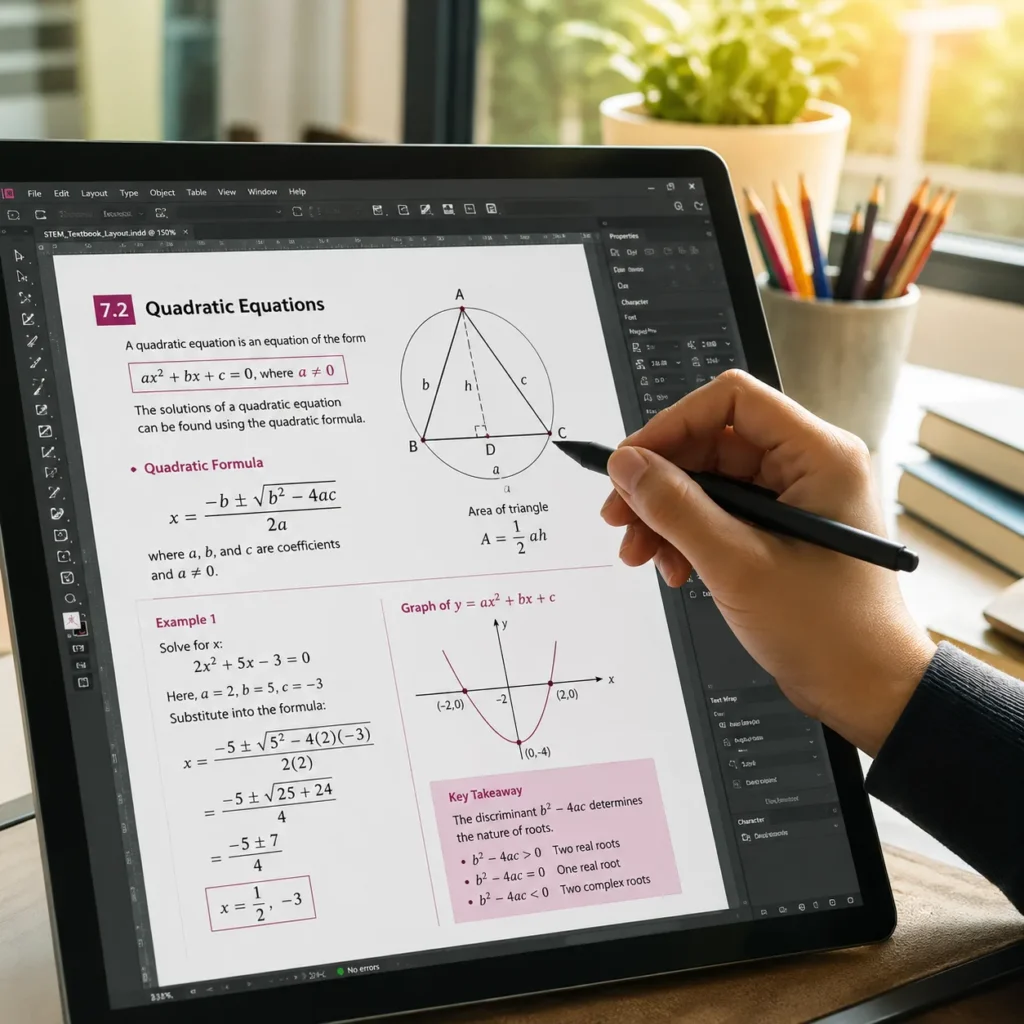
Subjects such as mathematics, engineering, economics, and science often require complex equations and structured tables.

Professional typesetting teams ensure:

  • Consistent equation formatting
  • Accurate table alignment
  • Improved readability
  • Standardized presentation
Benefits Of Outsourcing Educational Publishing Services To India

Many global publishers choose India for educational publishing support due to the combination of skilled publishing professionals, scalable production capacity, and established quality-control processes.

Key advantages include:


Publishing Challenge

Benefit Of Professional Support

Large content volumes

Faster production scalability

Multiple book titles

Standardized formatting

Tight deadlines

Efficient project management

Complex layouts

Specialized publishing expertise

Frequent revisions

Streamlined update workflows

Quality requirements

Structured review processes

Organizations can manage peak workloads without significantly expanding internal production teams.

Technology Used In Modern Educational Publishing

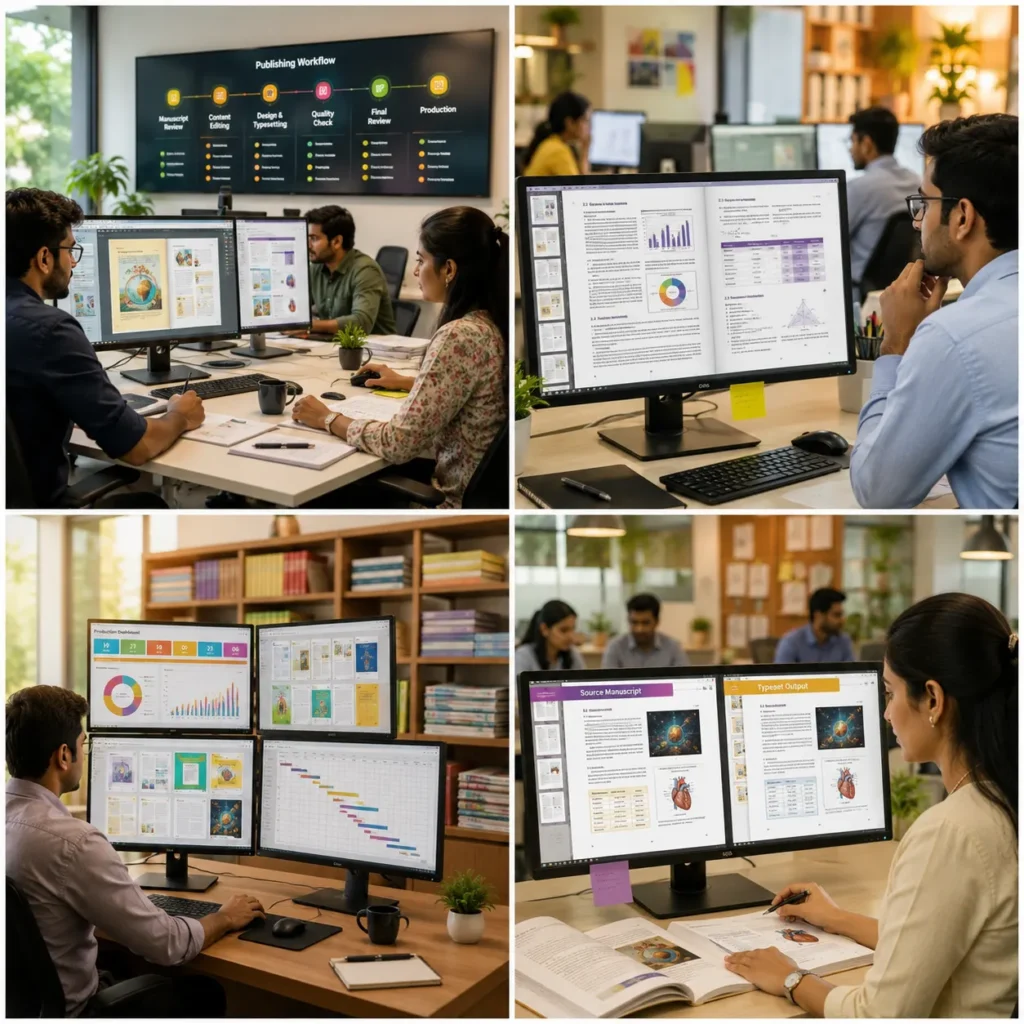
Modern educational publishing relies on specialized tools and workflows to improve efficiency and maintain consistency.

Common technologies include:

  • Adobe InDesign for page composition
  • XML-based publishing workflows
  • OCR-supported document conversion
  • PDF remediation and formatting
  • Digital publishing workflows
  • Translation-ready file preparation
  • Trados-compatible publishing workflows
  • MemoQ-compatible file preparation

These technologies help publishers manage large-scale projects while reducing manual formatting effort.

Quality Assurance In Educational Typesetting

Quality assurance is a critical component of educational publishing.

Even small formatting issues can affect learner experience and increase revision cycles.

A structured quality-review process typically includes:

  • Layout verification
  • Style consistency checks
  • Figure and table validation
  • Pagination review
  • Cross-reference verification
  • Content completeness checks
  • Final pre-production review

This process helps publishers reduce production errors and maintain publication quality.

Supporting Print And Digital Learning Resources

Educational publishing is no longer limited to printed textbooks.

Publishers increasingly produce:

  • eBooks
  • Digital course materials
  • Interactive learning resources
  • Online assessments
  • Hybrid learning content

Professional publishing workflows support both print and digital formats while maintaining consistency across multiple delivery channels.

Traditional Production Vs Modern Educational Publishing Workflows

Traditional Workflow

Modern Publishing Workflow

Manual formatting

Automated layout workflows

Multiple file versions

Centralized project management

Time-consuming revisions

Efficient update cycles

Separate print and digital processes

Integrated publishing workflows

Limited scalability

High-volume production capability

Reactive quality checks

Structured quality-control processes

Modern workflows help publishers improve productivity while maintaining content quality.

Strengthening Educational Content Delivery

As educational content continues to evolve across print and digital platforms, the importance of structured publishing workflows becomes increasingly clear. Professional educational publishing and typesetting services help organizations maintain consistency, improve production efficiency, support curriculum updates, and deliver high-quality learning resources that meet the expectations of educators, institutions, and learners alike.

FAQ

Educational publishing services include content preparation, typesetting, page composition, formatting, quality assurance, and production support for learning materials.

Typesetting improves readability, visual organization, consistency, and overall learner experience

Outsourcing helps manage large workloads, accelerate production schedules, and access specialized publishing expertise.

Adobe InDesign, XML publishing systems, OCR tools, PDF workflows, and translation-compatible publishing platforms are widely used.

Publishers should evaluate production capacity, quality-control processes, educational publishing experience, technology expertise, scalability, and ability to support both print and digital content.
