

The Role of XML-First Publishing in Modern Educational Content Production

Managing Educational Content Across Multiple Formats Is Becoming More Complex

Educational publishers today rarely produce content for a single output format. A textbook may need to appear as a printed book, eBook, online learning module, assessment platform resource, instructor guide, and accessible digital publication.

Maintaining separate versions for each format creates significant challenges. Content updates become difficult to manage, production costs increase, and consistency can suffer across learning resources.

To address these challenges, many educational publishers are adopting XML-first publishing workflows. Rather than designing content separately for each format, XML-first publishing creates a structured content foundation that can support multiple outputs from a single source.

What Is XML-First Publishing?

XML (Extensible Markup Language) is a structured format used to organize content according to meaning rather than visual appearance.

Instead of defining how content looks, XML identifies what the content represents.

For example:

  • Chapter title
  • Learning objective
  • Assessment question
  • Figure caption
  • Table
  • Reference
  • Glossary term

This structured approach allows publishers to separate content creation from final presentation.

As a result, the same content can be published across multiple formats without recreating layouts from scratch.

Why Traditional Publishing Workflows Create Challenges

Many legacy publishing workflows rely on format-specific production.

This often means:

  • Separate files for print and digital products
  • Repeated formatting efforts
  • Manual content updates
  • Version-control difficulties
  • Increased production costs

When curriculum updates occur, publishers may need to modify multiple files individually.


Traditional Vs XML-First Publishing

Traditional Workflow

XML-First Workflow

Format-specific production

Single-source content management

Multiple content versions

Centralized content repository

Manual updates

Structured content reuse

Higher maintenance effort

Easier content updates

Increased production complexity

Streamlined workflows

Greater risk of inconsistencies

Improved content consistency

For publishers managing large educational content libraries, these differences can significantly affect efficiency.

Supporting Multi-Channel Educational Publishing

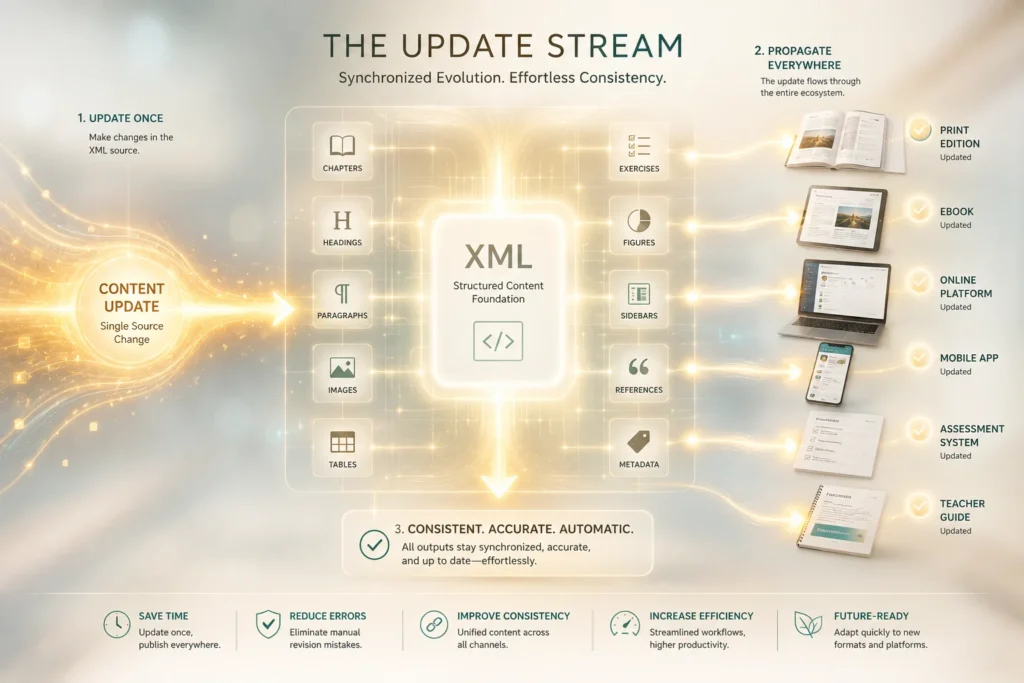
One of the biggest advantages of XML-first publishing is content reuse.

A single XML source can support:

  • Printed textbooks
  • eBooks
  • Learning platforms
  • Assessment systems
  • Mobile learning applications
  • Accessible educational resources

Instead of rebuilding content for each platform, publishers can generate multiple outputs from the same structured source.

This reduces duplication while improving consistency.

Improving Content Maintenance And Updates

Educational content frequently changes.

Publishers often update:

  • Curriculum requirements
  • Learning objectives
  • Assessment questions
  • Statistical data
  • Scientific information
  • Regulatory references

Without structured workflows, maintaining these updates across multiple products can be time-consuming.

Benefits Of XML-Based Updates

XML-first workflows allow publishers to:

  • Update content once
  • Republish multiple outputs
  • Reduce manual intervention
  • Maintain version consistency
  • Improve update speed

This becomes particularly valuable for publishers managing large educational portfolios.

Enhancing Collaboration Across Publishing Teams

Educational content production typically involves multiple stakeholders.

These may include:

  • Authors
  • Editors
  • Instructional designers
  • Typesetters
  • Production teams
  • Digital publishing specialists

XML-first workflows create a shared content structure that helps teams work more efficiently.

Instead of exchanging multiple file versions, contributors can work within a centralized content framework.

This improves collaboration and reduces workflow bottlenecks.

Supporting Accessibility And Future Publishing Requirements

Modern educational publishing increasingly emphasizes accessibility.

Educational content may require:

  • Screen-reader compatibility
  • Accessible navigation structures
  • Alternative text support
  • Device-independent presentation

XML naturally supports structured content organization, making accessibility initiatives easier to implement.

Publishers also benefit from greater flexibility as new technologies and delivery platforms emerge.

Because content is stored independently from presentation formats, future adaptations become more manageable.

XML And Educational Content Reuse

Many educational publishers create related content across multiple products.

Examples include:

  • Student textbooks
  • Teacher editions
  • Assessment materials
  • Study guides
  • Digital learning modules

XML-first publishing enables content reuse across these resources without repeatedly recreating the same material.

This can improve:

  • Production efficiency
  • Content consistency
  • Resource utilization
  • Publishing scalability

For large educational programs, content reuse can become a major operational advantage.

Integrating XML With Modern Production Workflows

XML-first publishing often works alongside established educational production tools and workflows.

Common integrations may include:

  • Adobe InDesign publishing workflows
  • Digital learning platforms
  • Content management systems
  • Assessment publishing systems
  • Print production environments

Rather than replacing existing publishing processes, XML often serves as the structured content foundation that connects them.

This helps organizations create more flexible and scalable production ecosystems.

Building A More Scalable Educational Publishing Future

As educational publishing continues to expand across print, digital, and interactive learning environments, managing content efficiently becomes increasingly important. XML-first publishing provides a structured foundation that supports content reuse, simplifies updates, improves consistency, and enables multi-channel distribution. For educational publishers seeking greater scalability and long-term efficiency, XML-first workflows are becoming an increasingly valuable part of modern content production strategies.

Frequently Asked Questions

XML-first publishing is a content-production approach that structures information independently from its final presentation format.

XML helps publishers manage content efficiently, support multiple output formats, and simplify content updates.

XML enables content reuse, centralized updates, improved consistency, and streamlined multi-channel publishing.

Yes. XML can serve as a single content source for print publications, eBooks, learning platforms, and other digital outputs.

Yes. Publishers managing extensive content collections often benefit significantly from XML’s structured content management capabilities.
