Why Educational Content Formatting Matters in Student Learning Experiences

A student may spend hours studying a chapter yet still miss important concepts hidden within dense paragraphs, poorly organized activities, or inconsistent page layouts. In many educational settings, learning challenges are not caused solely by the complexity of the subject matter. They are often influenced by how information is presented.

Educational publishers, curriculum developers, and instructional designers invest significant effort in creating accurate content. However, if that content is difficult to navigate, learners may struggle to engage with it effectively. This is why educational content formatting plays a critical role in shaping student learning experiences.

When Information Becomes Difficult to Navigate

Modern learning materials contain much more than text.

A typical educational resource may include:

  • Learning objectives
  • Explanations
  • Examples
  • Diagrams
  • Activities
  • Assessments
  • Review sections

When these elements are not clearly organized, students often spend unnecessary time figuring out where information begins and ends.

Common formatting problems include:

  • Long text-heavy pages
  • Inconsistent heading structures
  • Poor spacing between topics
  • Confusing activity placement
  • Unclear assessment sections

These issues create friction that can distract learners from the actual educational content.

Why Structure Matters for Learning

When knowledge is presented logically, students learn it more efficiently.

A well-formatted page helps learners understand:

  • What they are about to learn
  • Which concepts are most important
  • Where examples are located
  • When activities should be completed
  • How sections relate to one another

Without this structure, educational materials can feel overwhelming, particularly for younger learners and students encountering new subjects.

Formatting acts as a visual roadmap that guides students through the learning process.

The Hidden Impact of Visual Overload

Educational publishers often face pressure to fit more content into fewer pages. While this may reduce page counts, it can create another problem: visual overload.

Pages crowded with information may cause learners to:

  • Lose focus more quickly
  • Miss important instructions
  • Skip key learning points
  • Feel overwhelmed by the volume of content

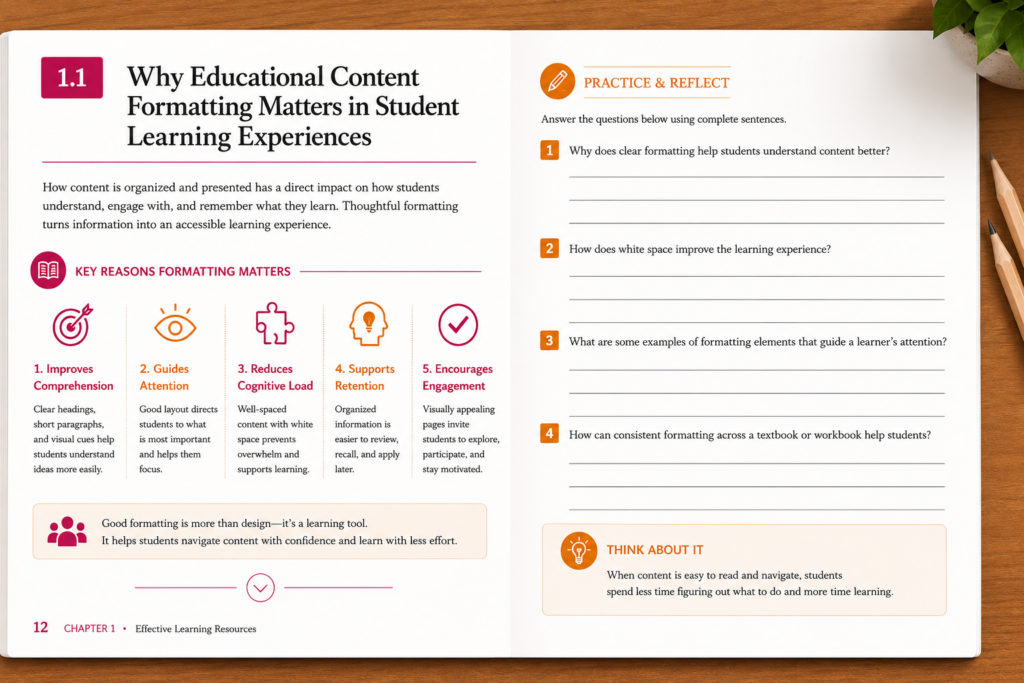
White space is often overlooked, yet it serves an important educational purpose. Strategic spacing helps separate ideas, improve readability, and make content feel more approachable.

The goal is not simply to fit information onto a page but to make that information easier to absorb.

Consistency Builds Learner Confidence

Students develop familiarity with educational resources over time.

When every chapter follows a different layout style, learners must continually adjust to new page structures.

Consistent formatting provides:

  • Predictable navigation
  • Familiar activity placement
  • Standardized assessment sections
  • Uniform visual cues
  • Easier content discovery

This consistency reduces cognitive effort and allows students to focus more attention on learning.

Inconsistent Formatting
Consistent Formatting

Different layouts per chapter

Predictable page structure

Changing activity formats

Standardized activities

Unclear navigation

Easy content flow

Higher learner confusion

Improved usability

Increased adjustment time

Faster learner engagement

Supporting Different Learning Components

Educational resources typically contain multiple content types that serve different purposes.

For example:

  • Learning objectives establish expectations.
  • Explanations introduce concepts.
  • Examples demonstrate application.
  • Activities encourage practice.
  • Assessments measure understanding.

Effective formatting helps students immediately recognize the purpose of each section.

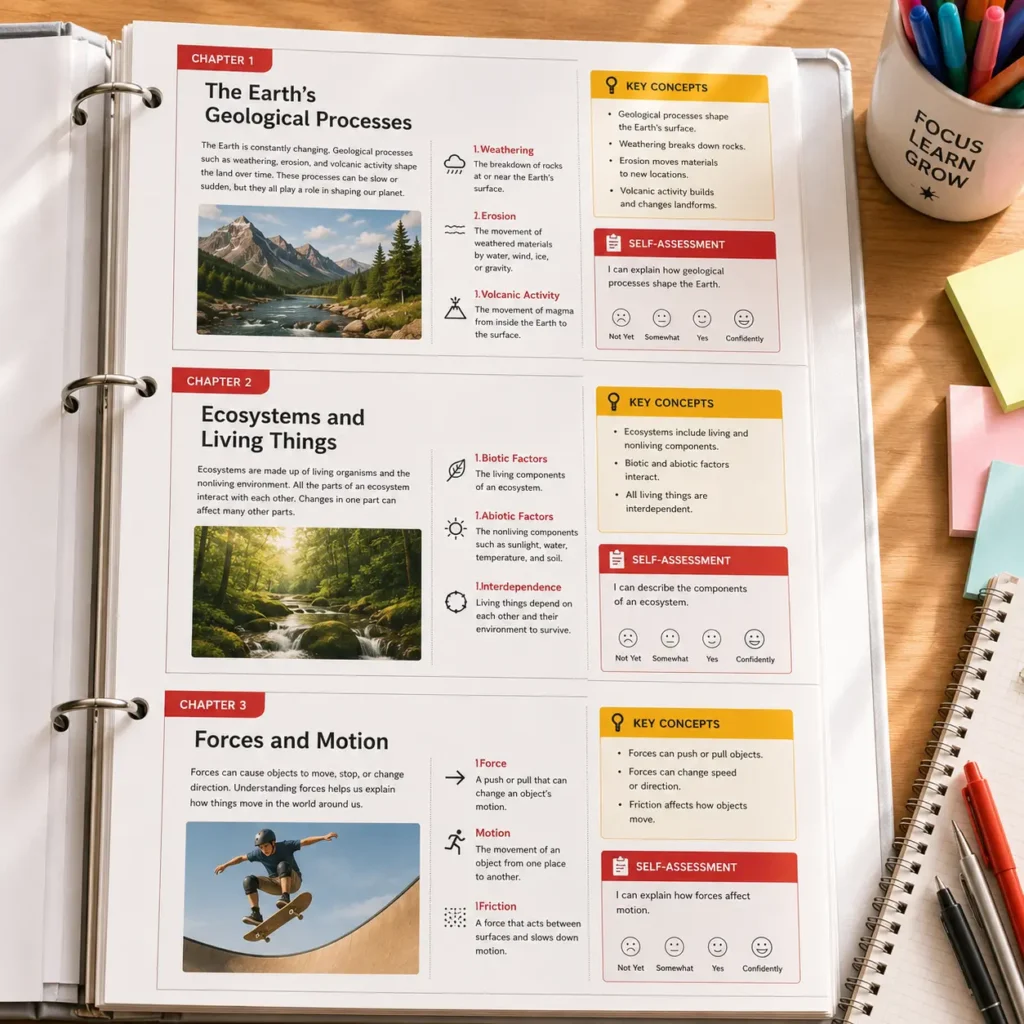
Visual differentiation through typography, spacing, borders, and layout structures makes educational content easier to interpret and use.

Improving Accessibility and Inclusivity

Educational materials must support learners with different reading abilities, learning preferences, and educational backgrounds.

Thoughtful formatting can improve accessibility by providing:

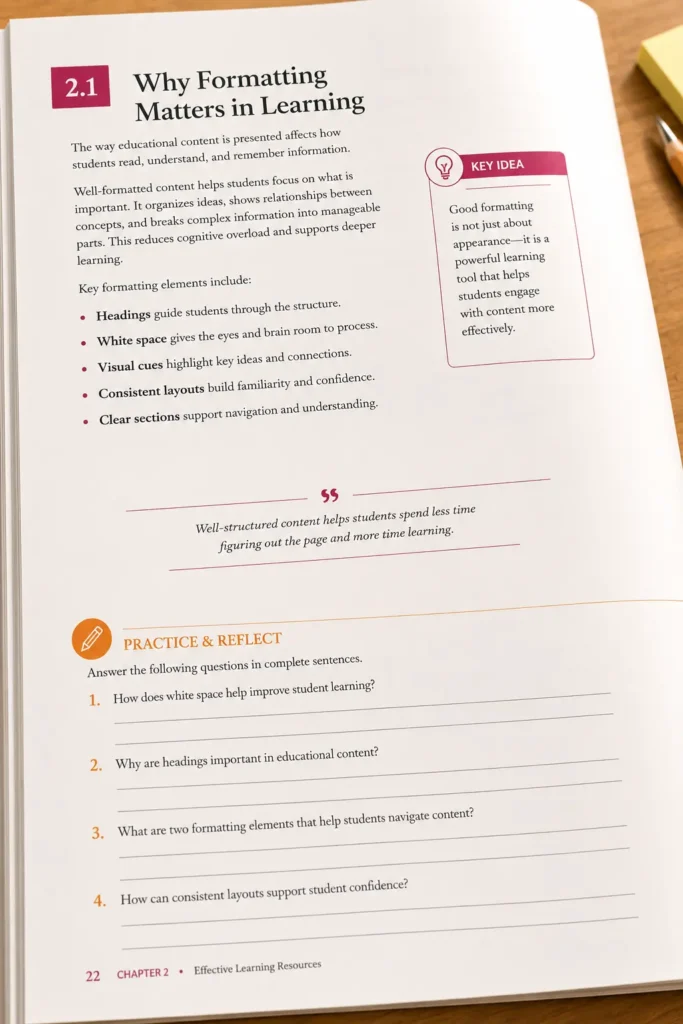
  • Clear heading hierarchies
  • Logical reading sequences
  • Readable text structures
  • Consistent navigation patterns
  • Well-organized visual elements

When educational resources are easier to navigate, more students can engage with content independently and confidently.

A Practical Publishing Scenario

Consider a publisher developing a middle-school geography workbook.

The first version contains accurate content but uses lengthy paragraphs, inconsistent activity placement, and minimal visual separation between sections. During classroom evaluations, teachers observe that students frequently miss instructions and struggle to locate important information.

The workbook is redesigned using structured headings, dedicated activity blocks, improved spacing, highlighted learning objectives, and consistent page layouts. Although the educational content remains largely unchanged, the resource becomes easier to navigate and more engaging for students.

This demonstrates how formatting can significantly influence the learner experience without altering the curriculum itself.

Turning Educational Content Into Effective Learning Experiences

Strong educational content alone is not enough to create meaningful learning experiences. Students also need resources that are easy to navigate, visually organized, and structured in ways that support comprehension. Thoughtful formatting helps bridge the gap between information and understanding, enabling learners to engage with content more confidently. As educational publishing continues to evolve, effective formatting will remain a fundamental part of successful learning resource development.

FAQ

Educational content formatting refers to the organization and presentation of learning materials, including text, activities, visuals, assessments, and navigation elements.

Formatting helps students locate information, follow learning sequences, and understand content more efficiently

White space reduces visual clutter, improves readability, and helps separate concepts into manageable sections

Common issues include overcrowded pages, inconsistent headings, poor activity organization, and unclear visual hierarchies.
