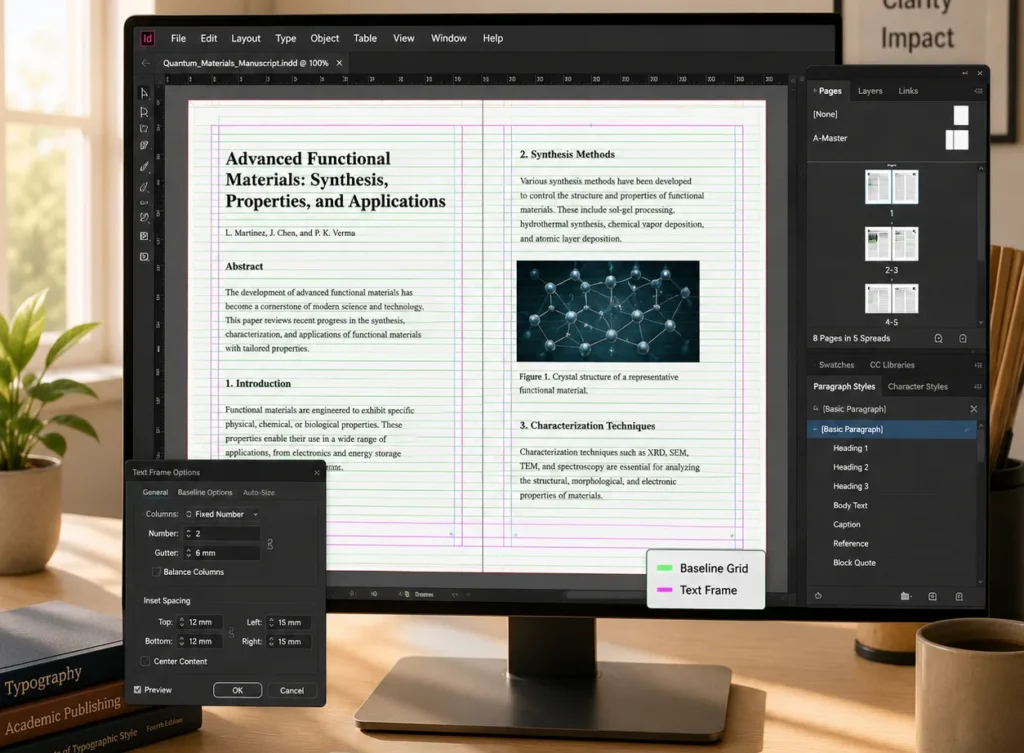


Why InDesign Is Critical for High-Volume Academic Typesetting Projects

A university publisher preparing hundreds of research journals for publication faces a challenge that goes far beyond formatting text. Every manuscript may arrive in a different structure, contain complex tables, mathematical equations, citations, figures, footnotes, and varying author preferences. Maintaining quality and uniformity becomes a major production challenge when processing dozens or even hundreds of academic publications within tight publishing constraints.

This is where Adobe InDesign plays a critical role. For organizations handling high-volume academic publishing, it provides a structured environment that helps production teams manage large quantities of scholarly content while maintaining editorial and design standards.

Why Academic Typesetting Becomes More Complex at Scale

A single academic paper may appear straightforward. However, large publishing programs often involve:

  • Research journals
  • Conference proceedings
  • Technical papers
  • Medical publications
  • Engineering reports
  • Academic textbooks
  • Thesis and dissertation projects

Each publication contains unique content elements that require precise formatting.

Production teams must strike a balance between accuracy, consistency, and turnaround times without sacrificing publishing quality as project volume rises.

The Challenge of Managing Multiple Manuscript Sources

Academic publishers rarely receive manuscripts in a standardized format.

Authors may submit files created in:

  • Microsoft Word
  • LaTeX exports
  • PDF documents
  • Scanned files
  • Legacy publishing formats

Each source introduces formatting variations that can complicate production workflows.

Without a structured typesetting system, teams often spend significant time correcting inconsistencies before actual page composition begins.

This challenge becomes even more pronounced when managing hundreds of manuscripts simultaneously.

Why Manual Formatting Creates Production Bottlenecks

Many organizations initially attempt to manage academic layouts through document-level formatting and manual adjustments.

While this may work for small projects, it becomes increasingly difficult as publication volume grows.

Common issues include:

  • Inconsistent heading structures
  • Citation formatting differences
  • Table alignment problems
  • Figure placement errors
  • Page numbering conflicts
  • Style variations between publications

When these issues occur across hundreds of files, production timelines can quickly expand.

How InDesign Supports Large-Scale Academic Production

Rather than treating each publication as an independent project, InDesign allows publishers to establish standardized production frameworks.

These frameworks can define:

  • Journal layouts
  • Article structures
  • Typography standards
  • Citation presentation
  • Table formatting rules
  • Figure placement guidelines

Once standards are established, production teams can apply them consistently across large publishing programs.

As a result, the academic production pipeline becomes more regulated.

Managing Complex Academic Content More Efficiently

Academic publications frequently contain elements that require precise handling.

Examples include:

  • Multi-level headings
  • Footnotes and endnotes
  • Mathematical equations
  • Scientific illustrations
  • Research tables
  • Cross-references
  • Bibliographies

InDesign provides the layout control necessary to accommodate these components while preserving readability and publication standards.

Traditional Formatting Approach

Structured InDesign Workflow

Individual document formatting

Standardized publication templates

Manual layout adjustments

Controlled style systems

Repeated formatting corrections

Centralized document standards

Higher risk of inconsistency

Improved publication governance

Difficult large-scale management

Streamlined academic production

Supporting Journal and Book Series Consistency

Numerous scholarly publishers oversee continuing textbook series or journal editions.

A common challenge is ensuring that each new publication maintains alignment with previous editions.

InDesign helps publishers establish reusable design systems that can be applied across:

  • Journal volumes
  • Annual publications
  • Research collections
  • Textbook editions
  • Academic book series

This supports long-term learning resource and publication standardization.

Integrating Editorial and Production Workflows

High-volume academic publishing often involves multiple departments working together.

These may include:

  • Authors
  • Peer reviewers
  • Editors
  • Proofreaders
  • Typesetters
  • Production managers

A structured InDesign workflow helps create a shared framework that improves coordination between editorial review and final page composition.

This reduces rework and improves publishing predictability.

A Practical Academic Publishing Scenario

Consider a scholarly publisher responsible for producing 300 engineering journal articles each quarter.

Each article contains technical diagrams, equations, references, and author-specific formatting.

Without standardized templates, the production team would spend substantial time correcting inconsistencies across manuscripts.

By implementing structured InDesign templates and predefined typesetting standards, the publisher can process submissions more efficiently while maintaining consistency across every journal issue.

Creating Reliable Academic Publishing Operations

As academic publishing programs expand, maintaining consistency across large volumes of scholarly content becomes increasingly challenging. Structured typesetting workflows help publishers manage complexity while preserving editorial quality and publication standards. By providing a scalable framework for page composition and document management, InDesign remains an important tool for organizations responsible for producing high-volume academic content.

Frequently Asked Questions

Large publishing programs involve significant content variation, making standardization essential for maintaining quality and production efficiency.

Yes. It is widely used for publications that contain research tables, citations, figures, equations, and other technical content elements.

I am item content. Click edit button to change this text. Lorem ipsum dolor sit amet, consectetur adipiscing elit. Ut elit tellus, luctus ullamcorper mattis, pulvinar dapibus leo.

Consistent formatting improves readability, strengthens publication credibility, and supports a professional reader experience.

Many organizations establish standardized design frameworks and reusable templates that minimize repetitive formatting work.