Why Structured InDesign Templates Are Important in Educational Publishing
Consistency Is a Bigger Challenge Than Content Creation
Educational publishers often invest significant effort in developing curriculum, reviewing academic content, and ensuring learning outcomes are met. However, once content moves into production, a different challenge emerges: maintaining consistency across hundreds or even thousands of pages.
A modern educational publishing project rarely consists of a single book. Publishers often oversee whole content ecosystems that comprise digital learning resources, instructor aids, workbooks, student textbooks, and assessment tools. Ensuring that all these resources follow the same design standards can be difficult without a structured production approach.
This is why structured InDesign templates play an important role in educational publishing workflows.
The Problem With Designing Every Page Independently
Consider a publisher creating a comprehensive science curriculum for grades K–12.
The project may contain:
- Student textbooks
- Activity books
- Teacher editions
- Assessment materials
- Laboratory guides
- Digital companion resources
If every publication is designed independently, small differences can quickly appear. Chapter titles may be formatted differently, learning objectives may move to different locations, and assessment sections may lose visual consistency.
Over time, these inconsistencies can affect both production efficiency and the learner experience.
What Makes a Structured Template Different?
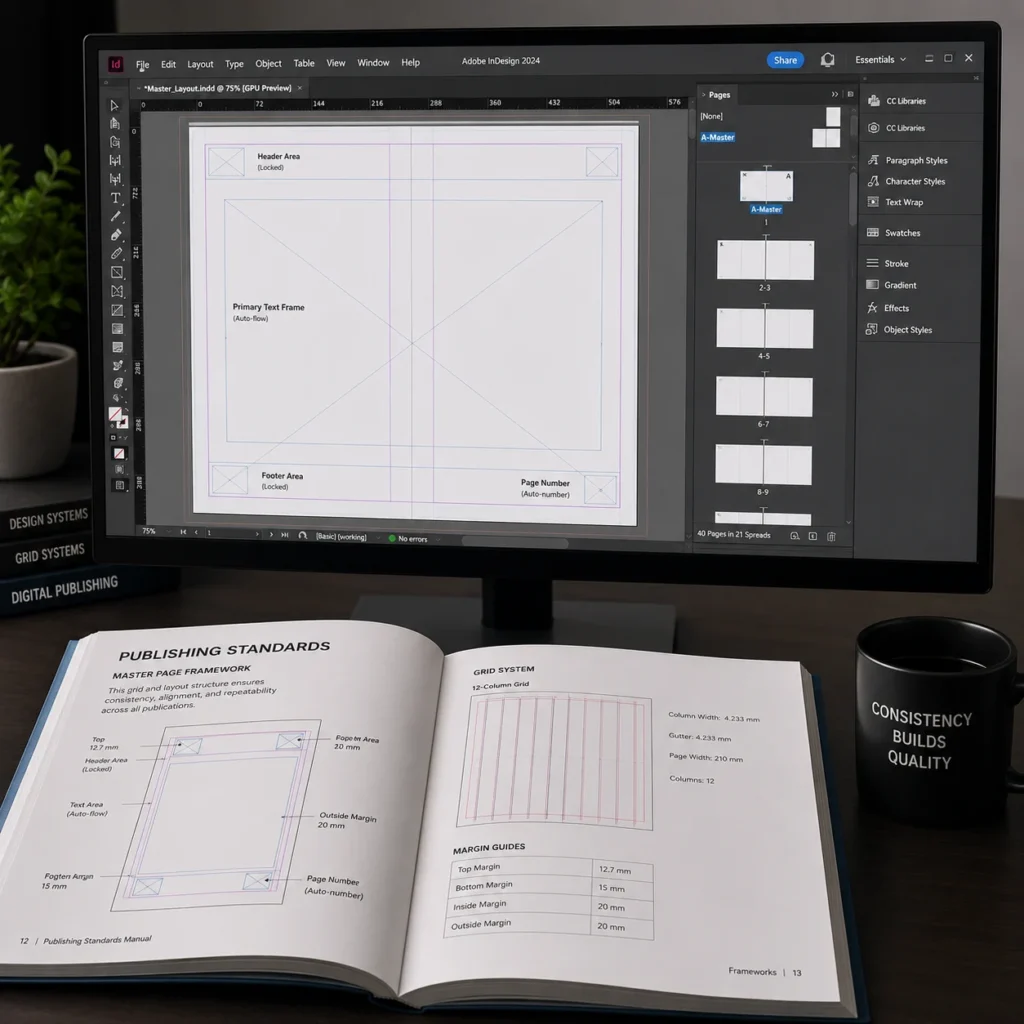
A structured template acts as a publishing framework that defines how content should appear throughout a project.
Instead of starting every chapter or publication from scratch, teams work from a predefined structure that establishes:
- Page layouts
- Typography standards
- Heading hierarchies
- Learning objective sections
- Activity formats
- Assessment layouts
- Figure and table placement rules
This creates a repeatable system that helps maintain consistency across all educational materials.

Supporting Large Publishing Teams
Educational publishing projects often involve multiple contributors working simultaneously.
A typical project may include:
- Authors
- Subject matter experts
- Editors
- Designers
- Production specialists
- Quality reviewers
Without standardized templates, each contributor may interpret formatting requirements differently.
Structured templates provide a shared framework that helps every team member work within the same publishing standards, reducing confusion and minimizing production errors
Faster Production and Easier Updates
One of the biggest advantages of structured templates is efficiency.
When design standards are already built into the template, production teams can focus on content rather than repeatedly formatting pages.
This becomes especially valuable when revisions are required.
For example, if a publisher decides to update chapter-opening pages across an entire textbook series, standardized templates make it easier to apply changes consistently rather than manually updating every chapter

Maintaining a Consistent Learner Experience
Students benefit from familiarity.
When educational materials follow a consistent structure, learners can focus on understanding the content rather than navigating different layouts.
Consistent placement of elements such as:
- Learning objectives
- Key concepts
- Activities
- Assessments
- Review sections
helps create a predictable and intuitive learning experience across multiple books and grade levels.
A Real-World Publishing Example
Consider a higher education publisher producing a series of engineering textbooks.
Although each book covers a different subject, the publisher wants students to experience the same visual structure throughout the series. Chapter introductions, case studies, diagrams, and review questions should appear in familiar locations.
By using structured templates, production teams can maintain a unified visual identity across the entire collection while allowing each title to contain unique academic content
Supporting Long-Term Publishing Programs
Educational content is rarely published once and forgotten.
Publishers often release:
- New editions
- Curriculum updates
- Revised assessments
- Expanded learning resources
Structured templates make these long-term maintenance activities more manageable by providing a stable production foundation that can be reused across future projects.
Creating Scalable Educational Publishing Workflows
As educational publishers manage larger content portfolios and more frequent updates, consistency becomes a critical production requirement. Structured InDesign templates provide a reliable framework for organizing content, maintaining visual standards, and improving workflow efficiency. By reducing repetitive design tasks and supporting standardized publishing practices, templates help educational organizations produce high-quality learning materials at scale while delivering a consistent experience for both students and educators.
FAQ
A structured InDesign template is a predefined publishing framework that includes standardized layouts, styles, and content structures used across educational publications.
Templates help maintain consistency, improve production efficiency, reduce formatting errors, and support large-scale content development.
They eliminate repetitive design work and allow teams to focus on content development and quality review rather than page formatting.
Yes. Publishers often use templates across textbooks, workbooks, teacher guides, assessment materials, and digital learning resources.
Students can more easily navigate resources in a familiar learning environment created by consistent layouts and content formats

ValueDocs India offer the most competent multilingual typesetting services that are best in the industry. Typesetting services includes all aspects of designing a book.