When Formatting Accuracy Becomes a Publishing Requirement
In peer-reviewed engineering journals, formatting is more than visual presentation it is a critical part of publication integrity. A technically strong manuscript can still face delays, repeated revisions, or rejection if formatting guidelines are not followed precisely.
Engineering publishers and editorial teams must manage highly structured content that includes equations, references, CAD illustrations, graphs, tables, and journal-specific layouts. Maintaining consistency across these elements is essential for readability, reviewer confidence, indexing compatibility, and publication quality.
As submission volumes continue to grow globally, professional formatting compliance solutions are becoming an essential component of modern engineering publishing workflows.
Why Engineering Journals Demand Higher Formatting Precision
Unlike general academic publications, engineering journals contain dense technical information that must remain accurate across both print and digital platforms.
Formatting compliance typically involves:
- Multi-level equation structuring
- Technical figure positioning
- Reference and citation accuracy
- Journal template adherence
- Scientific table formatting
- XML compatibility
- Cross-linking and indexing consistency
- Multi-column layout management
Even small inconsistencies in symbols, spacing, or references can create major production complications during peer review and final publication.
The Real Impact of Non-Compliance
Formatting errors do more than affect appearance. They can directly slow publishing workflows and increase editorial workload.
Delayed Peer Review Cycles
Reviewers often request resubmissions when equations, references, or figure placements fail to meet journal standards.
Increased Production Corrections
Manual corrections across large technical manuscripts consume valuable editorial time and increase operational costs.
Digital Publishing Issues
Improperly structured files can create compatibility problems for XML conversion, indexing databases, and online journal platforms.
Reduced Reader Experience
Poorly formatted equations, crowded layouts, and inconsistent figures reduce readability and weaken publication credibility.
Inside a Modern Engineering Formatting Workflow
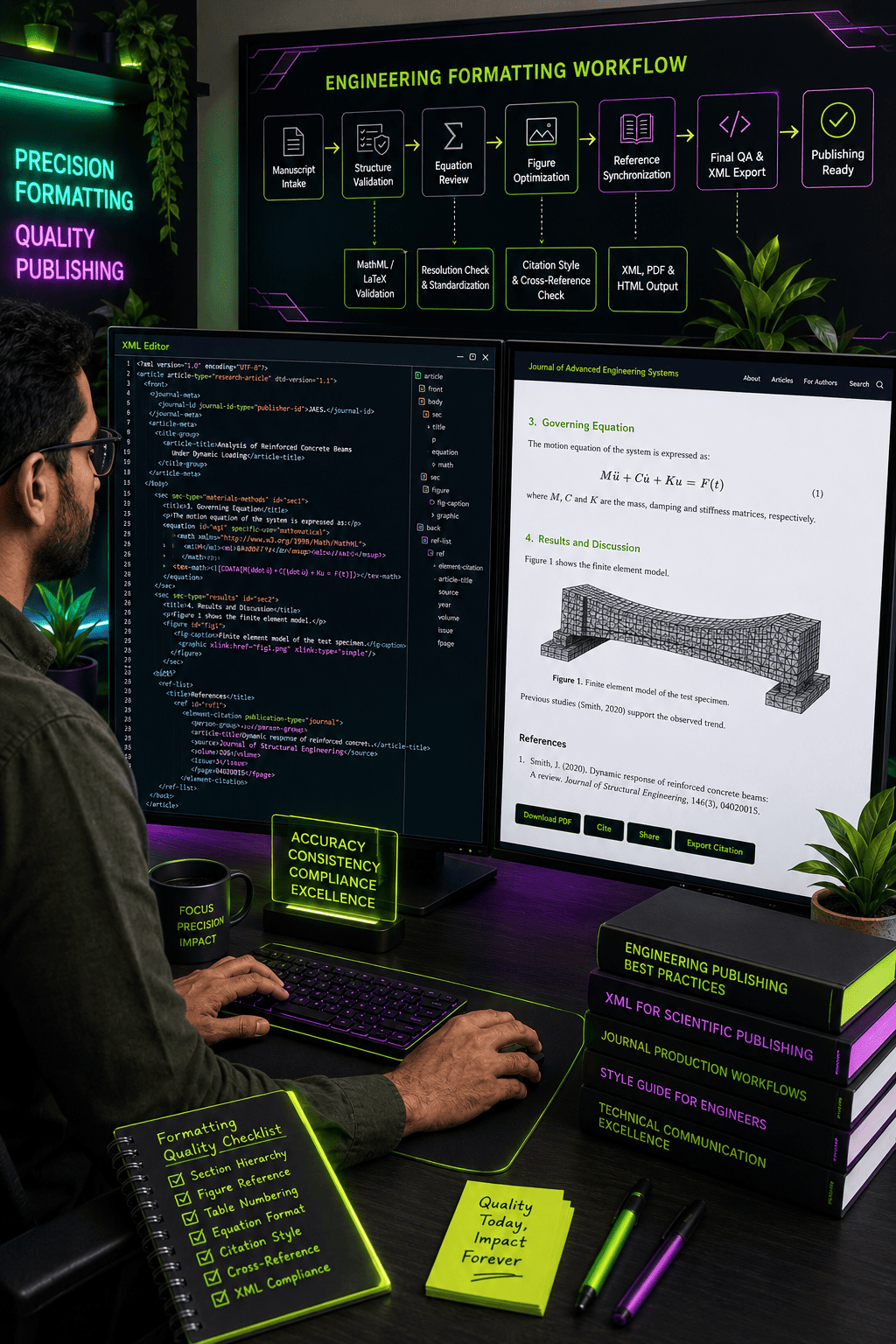
Professional formatting compliance follows a highly structured production approach designed for technical publishing accuracy.
Manuscript Structure Validation
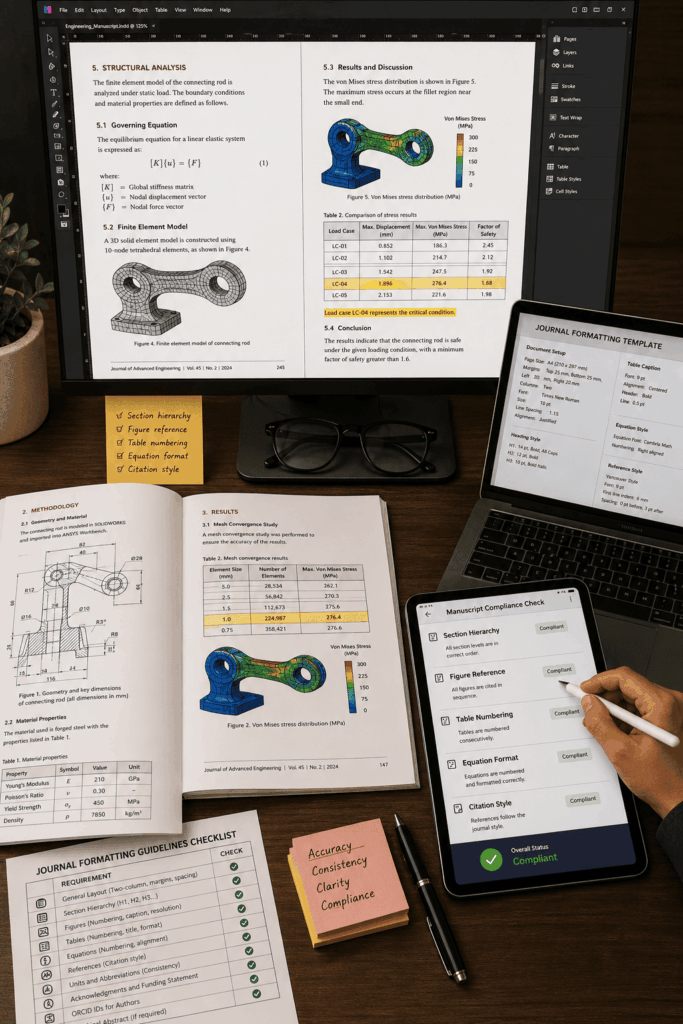
Every submission is reviewed for journal-specific layout compliance, section hierarchy, figure references, and formatting consistency.
Equation and Technical Content Review
Mathematical equations, scientific symbols, and engineering notations are carefully standardized using advanced formatting tools.
Figure and CAD Optimization
Engineering diagrams and technical illustrations are optimized for clarity, resolution, and publication compatibility.
Reference Synchronization
Cross-references, citations, bibliographies, and indexing elements are verified to ensure consistency across the manuscript.
Final Pre-Publication Checks
Before publication, the entire document undergoes quality assurance for layout precision, XML readiness, and digital publishing compliance.
Precision Tools Behind Engineering Journal Formatting
Modern engineering publishers rely on advanced publishing technologies to maintain strict compliance standards efficiently.
Commonly used platforms include:
- LaTeX
- Adobe InDesign
- MathType
- XML publishing systems
- AutoCAD-compatible workflows
- OCR correction software
- Automated proofing tools
These technologies help production teams reduce formatting inconsistencies while accelerating publication timelines.
Building Confidence for Editors, Reviewers, and Authors
For Editors
Consistent formatting reduces manual corrections and improves production efficiency.
For Reviewers
Clear presentation improves readability and allows reviewers to focus on technical quality rather than formatting issues.
For Authors
Publication-ready formatting minimizes revision cycles and improves submission confidence.
For Publishers
Accurate formatting strengthens journal reputation and supports professional publishing standards globally.
Why Specialized Engineering Formatting Expertise Matters
Engineering content requires subject-specific understanding that general formatting teams often lack. Technical publications contain unique combinations of formulas, engineering symbols, CAD drawings, performance graphs, and structured datasets.
Experienced engineering formatting specialists understand how these elements interact within peer-reviewed publishing systems. This expertise ensures every manuscript aligns with journal guidelines while preserving technical accuracy.
For publishers handling high-volume engineering submissions, specialized formatting support becomes essential for maintaining both speed and quality.
Precision Publishing Starts with Compliance
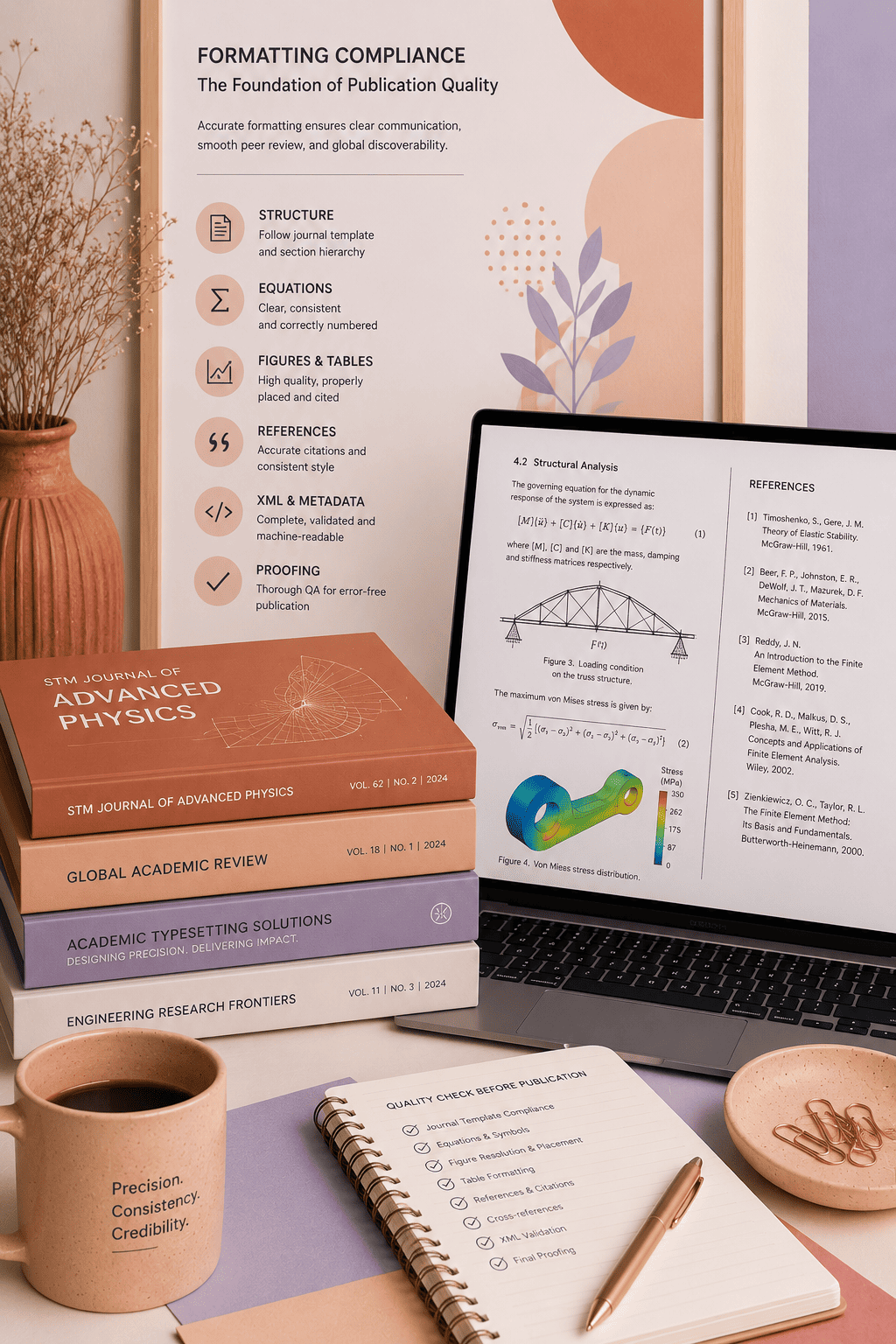
In today’s competitive academic publishing environment, formatting compliance is no longer a secondary production task. It directly influences editorial efficiency, peer-review timelines, digital publishing compatibility, and overall publication quality.
Professional engineering journal formatting solutions help publishers maintain consistency, reduce production delays, and deliver technically accurate publications ready for global academic distribution.
As engineering research becomes increasingly advanced and data-intensive, strict formatting compliance remains one of the most important foundations of credible scholarly publishing.
FAQ
Most frequent questions and answers
Formatting compliance refers to aligning manuscripts with strict journal guidelines for equations, references, figures, layouts, citations, and technical content presentation.
Accurate formatting improves readability, reduces revision cycles, supports XML indexing, and helps manuscripts move smoothly through peer review and production workflows.
Equations, CAD drawings, graphs, scientific tables, references, symbols, multi-column layouts, and XML structures require detailed formatting precision.
Popular tools include LaTeX, Adobe InDesign, MathType, XML publishing systems, and AutoCAD-compatible formatting workflows.
They reduce manual corrections, standardize layouts, optimize technical visuals, accelerate production timelines, and ensure journal-ready consistency.
Yes. Professional formatting services prepare engineering manuscripts for print journals, online publishing platforms, XML repositories, and mobile-compatible digital formats.

ValueDocs India offer the most competent multilingual typesetting services that are best in the industry. Typesetting services includes all aspects of designing a book.