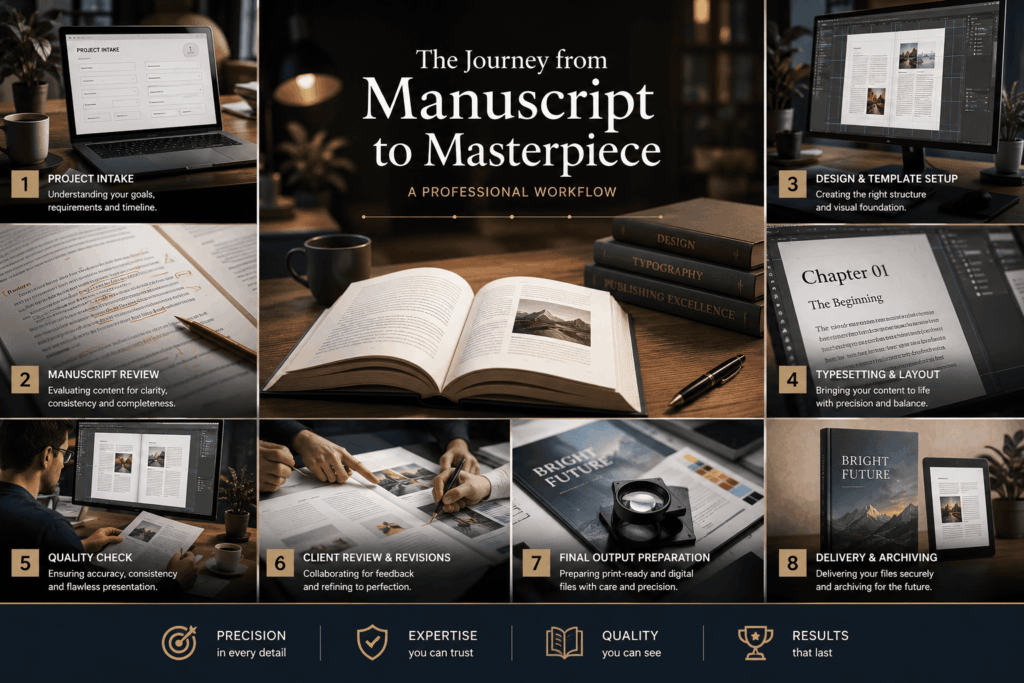
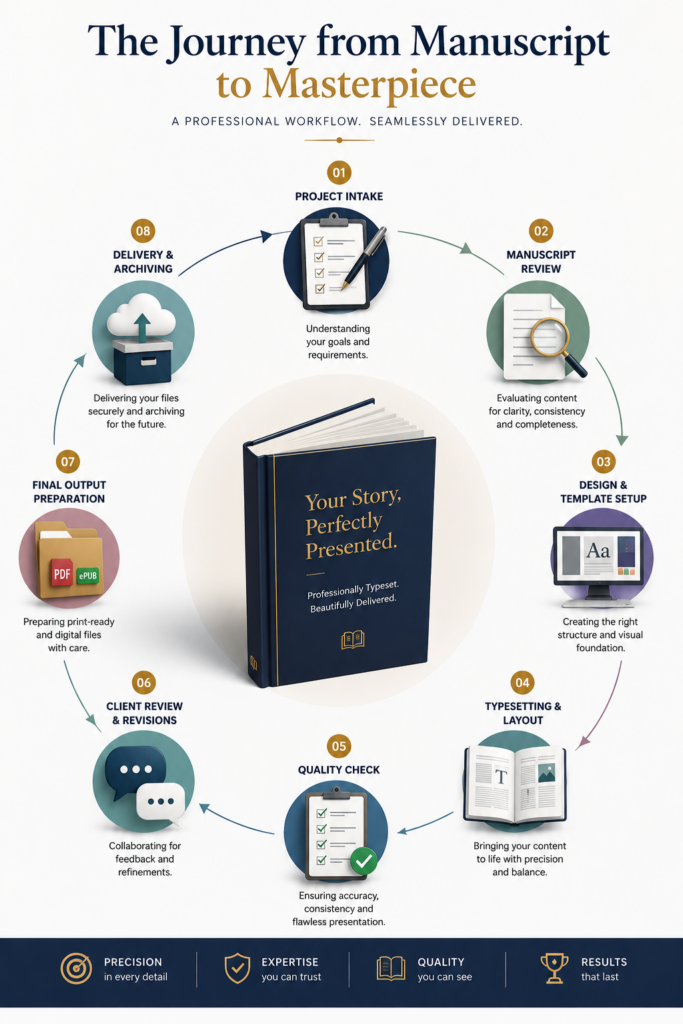
In today’s competitive publishing landscape, delivering content that is visually polished, structurally consistent, and print-ready demands far more than just good writing. It requires a disciplined, multi-stage production process handled by seasoned professionals. At our typesetting and publishing company, every project moves through a carefully orchestrated workflow from raw manuscript to flawless final output.
Here is an inside look at how we transform your content into publication-worthy material.
Stage 1: Project Intake and Requirement Analysis
Every successful publication begins with clarity. When a new project arrives, our team conducts a thorough intake session to understand the scope, format specifications, target audience, and delivery timeline. We review all client-supplied assets manuscripts, images, brand guidelines, and style sheets and document every requirement before a single page is touched.
This stage ensures zero misalignment between client expectations and our deliverables, saving both time and revision cycles.
Stage 2: Manuscript Evaluation and Copyediting Support
Before layout begins, the manuscript undergoes a structured content review. While we are a typesetting company and not a full-service editorial house, we flag obvious inconsistencies, missing elements, or formatting anomalies that could affect the final layout. If copyediting is part of the service agreement, our editorial partners review the text for grammatical accuracy, tonal consistency, and style-guide compliance.A clean, well-structured manuscript translates directly into a smoother typesetting process and fewer post-layout revisions.
Stage 3: Template Creation and Design Setup
Using industry-leading tools such as Adobe InDesign, QuarkXPress, or LaTeX (for academic and technical publications), our designers build or adapt a master template tailored to your project. This includes:
- Page grid, margins, and column structures
- Typography hierarchy (fonts, sizes, leading, kerning)
- Heading and body text styles
- Running headers, footers, and page numbering
- Color profiles and image placeholder zones
Consistency at this stage ensures every chapter, section, and page feels cohesive from start to finish.
Stage 4: Typesetting and Layout Composition
This is the essence of our work. Our typesetters precisely apply all specified styles while flowing the manuscript material into the authorized template. Widows, orphans, and awkward line breaks are avoided by balancing the text throughout columns and pages. Figures, tables, charts, and images are arranged in accordance with visual hierarchy and editorial aim.
For complex publications technical manuals, journals, educational textbooks, or multi-volume series we apply conditional formatting, cross-reference linking, and structured tagging that supports both print and digital output.
Stage 5: Proofreading and Internal Quality Review
Once the initial layout is complete, every page passes through a rigorous internal quality check. Our proofreading team reviews the typeset document against the original manuscript to catch:
- Text omissions or transpositions
- Style inconsistencies across chapters
- Image resolution and placement accuracy
- Hyphenation and justification errors
- Pagination and cross-reference accuracy
Nothing leaves our studio without passing this layer of scrutiny.
Stage 6: Client Review and Revisions
A proof copy digital PDF or physical galley is shared with the client for review. We provide annotated files that make it easy for clients to leave comments and markup directly. Based on client feedback, our team implements revisions promptly. We typically allow up to two structured revision rounds within the project scope, with clear documentation of all changes made.
Stage 7: Prepress and Final Output Preparation
Once the client signs off on the layout, our prepress team prepares the files for printing or digital distribution. This includes:
- Color separation and ICC profile embedding
- Bleed, crop marks, and trim line setup
- Font embedding and image linking verification
- PDF/X export for print-ready files
- ePub or accessible PDF generation for digital editions
Every output file is verified against the printer’s or platform’s technical specifications before handoff.
Stage 8: Delivery and Archiving
Final files are delivered through secure file-transfer channels in the agreed format print-ready PDFs, editable InDesign packages, ePub files, or all of the above. We also archive a complete project package (source files, fonts, images, and output versions) for future reprints, revised editions, or format conversions.Our clients benefit from knowing their publication assets are safely stored and retrievable whenever needed.