Challenges in OCR-Based Document Conversion and How Experts Solve Them

In today’s digital-first business landscape, data is your most valuable asset. But if that data is trapped inside scanned PDFs, legacy paper invoices, or handwritten forms, it is essentially useless.

Many businesses turn to Optical Character Recognition (OCR) software expecting a quick, flawless transition from paper to searchable digital text. However, the reality of DIY OCR often involves garbled text, misplaced columns, and massive data gaps.

If your organization is having trouble turning chaotic scans into useful insights, you are not alone. Here’s a look into why basic OCR fails, how industry specialists overcome these problems, and how your company may gain from doing it appropriately.
OCR-Based Document Conversion

Why Standard OCR Fails: The Core Challenges

While OCR technology has come a long way, standard out-of-the-box software still stumbles over real-world document complexities.

Poor Source Quality and Smudges

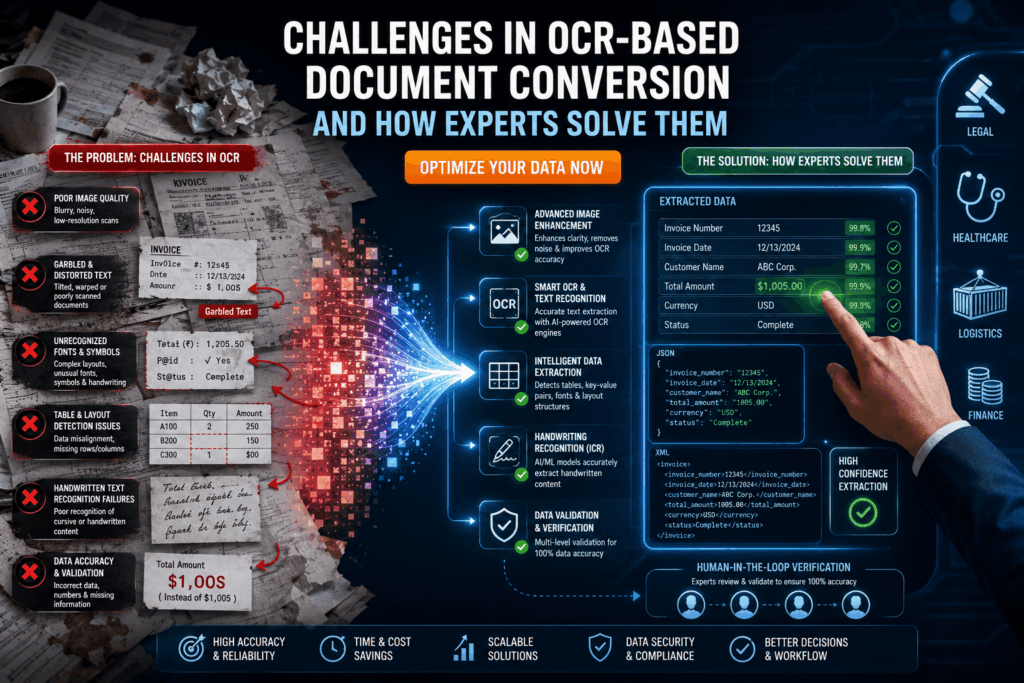
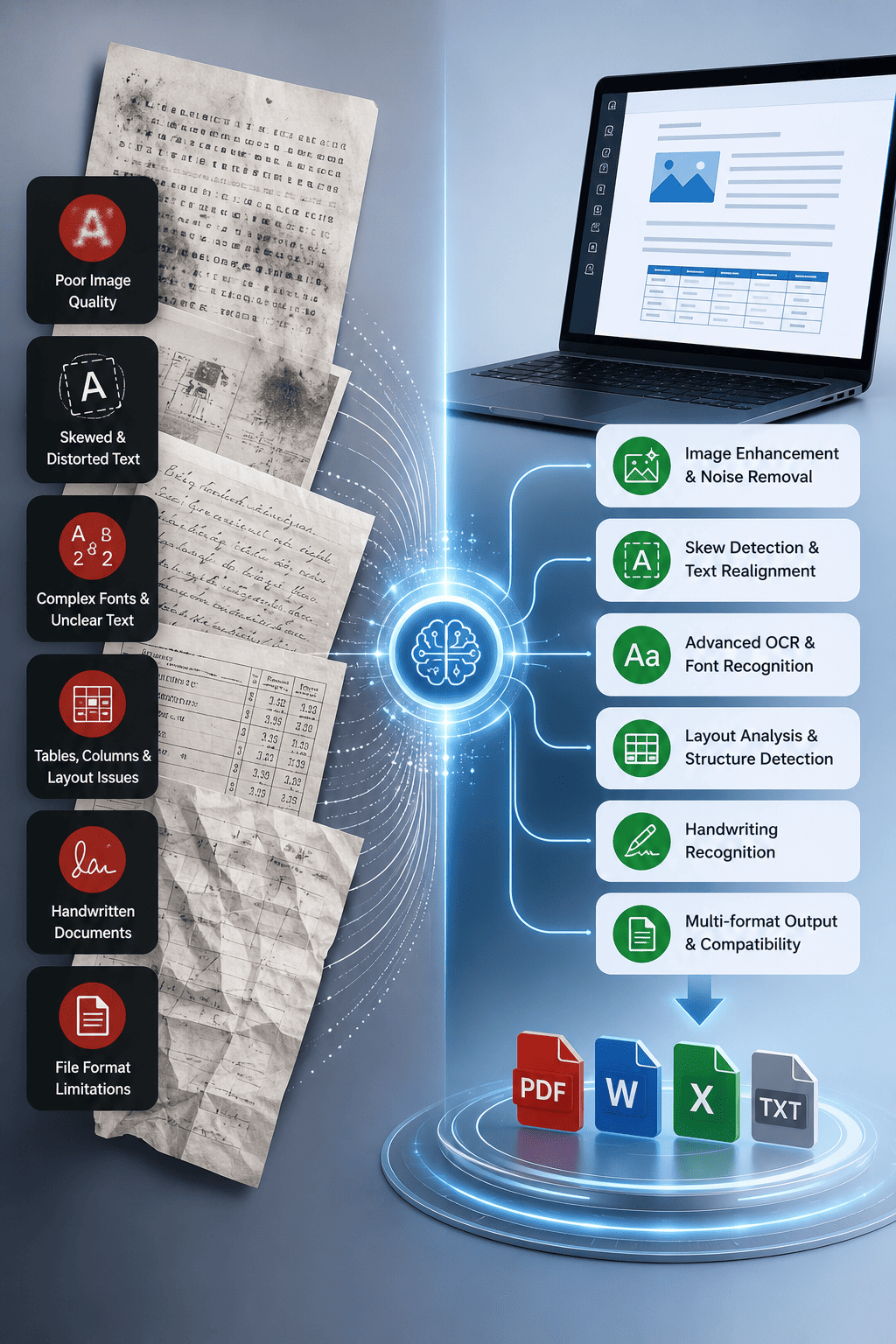
OCR engines rely on contrast to recognize text. Low-resolution scans, crumpled paper, faded ink, or coffee stains can confuse the software, leading to frequent typos or completely skipped lines.

Complex Layouts and Multi-Column Tables

Standard OCR reads from left to right, top to bottom. When faced with financial statements, multi-column newsletters, or side-by-side tables, basic software often blends separate text blocks together, destroying the logical flow of the data.

The Nightmare of Handwritten Data

Human handwriting is unpredictable. Variations in cursive, slant, and spacing make it incredibly difficult for standard OCR to achieve acceptable accuracy rates on medical intake forms, insurance claims, or legacy archives.

Lack of Contextual Awareness

An OCR engine recognizes shapes, not meaning. It easily confuses the letter "O" with the number "0", or "I" with "1". Without contextual understanding, a critical invoice amount like $1,005 can easily be misread as $1,OOS.

How the Experts Solve It: The Strategic Approach

It is a long established fact that a reader will be distracted by the readable content of a page when looking at its layout. The point of using Lorem Ipsum is that it has a more-or-less normal distribution of letters, as opposed to using ‘Content here, content here’, making it look

Document conversion experts don’t just run a file through software and hope for the best. They deploy a sophisticated, multi-layered workflow to guarantee near-100% accuracy.

  • Advanced Image Pre-Processing: Before text extraction begins, professionals employ AI-powered technologies to de-skew tilted pages, eradicate background noise (such as stains), binarize the image (to enhance contrast), and sharpen text edges.
  • Zonal OCR and Intelligent Document Processing (IDP): Instead of scanning a whole page blindly, experts program the system to look at specific “zones.” By combining OCR with Machine Learning, the system understands what it is reading—identifying an invoice number versus a line-item total based on its location and context.
  • Human-in-the-Loop (HITL) Verification: No automated system is perfect. Industry experts utilize a validation layer where human data specialists review low-confidence scores and anomalies flagged by the AI, ensuring flawless quality control.

like readable English. Many desktop publishing packages and web page editors.

It is a long established fact that a reader will be distracted by the readable content of a page when looking at its layout. 

OCR-Based Document Conversion

Strategic Value: What Your Business Gains

Investing in professional-grade document conversion delivers significant operational dividends.

Business Impact

What It Means for You

Instant Searchability

Turn days of manual file-hunting into a two-second keyword search.

Flawless Data Integrity

Eradicate manual data entry errors that derail financial and legal compliance.

Drastic Cost Reductions

Free up your staff from tedious typing, shifting labor hours to revenue-generating tasks.

Seamless System Integration

Convert static text into clean JSON, XML, or CSV formats that plug directly into your ERP or CRM.

OCR-Based Document Conversion

Who Reaps the Rewards From Professional Conversion?

If your organization handles high-volume documentation, professional OCR conversion is a necessity, not a luxury.

  • Legal and compliance firms: It may search through large volumes of documents, including discovery, case files, and historical contracts
  • Healthcare Providers: For converting handwritten patient intake forms and historical charts into secure, searchable Electronic Health Records (EHR).
  • Logistics & Supply Chain: For automating the extraction of data from bills of lading, customs paperwork, and shipping invoices.
  • Finance and Banking: Instantly digitize financial proofs to speed up loan processing, mortgage applications, and audit trails

FAQ

Most frequent questions and answers

Free online tools lack data security protocols, leaving your sensitive business information vulnerable to leaks. Furthermore, they cannot handle complex layouts, handwriting, or high-volume processing, resulting in high error rates that your team will have to spend hours fixing manually.

Standard OCR simply converts an image of text into machine-readable characters. IDP goes a step further by using Artificial Intelligence and Natural Language Processing (NLP) to understand, classify, and extract meaning from the data, even if the document layout varies.

Reputable document conversion partners adhere to strict security frameworks, including SOC 2 Type II compliance, HIPAA alignment, and advanced data encryption both at rest and in transit, ensuring your proprietary data remains entirely confidential.

Yes. Unlike basic tools that can only process one pre-selected dictionary at a time, expert-level setups utilize multi-lingual neural networks. These models automatically detect code-switching and extract mixed-script text (such as English and Spanish, or English and Mandarin) on the exact same page without losing context or accuracy

While standard manual data entry averages around a 4% error rate, expert-managed AI workflows consistently achieve 98% to 99.9% accuracy for printed text. To guarantee this level of precision, any ambiguous character or low-confidence data field is automatically routed to a human validator for manual review before final integration into your system.